
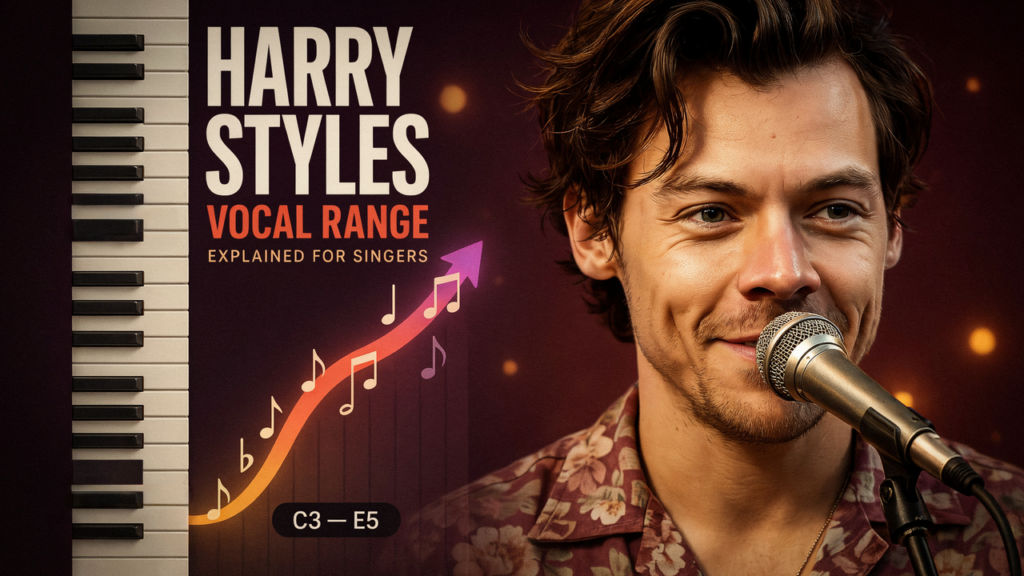
Harry Styles’ vocal range is best described as a baritone-leaning pop range with a flexible upper extension. His commonly reported range varies by source, but a practical estimate places his lead vocal work around A2 or B2 up to the C5–E5 area, with some higher falsetto or harmony notes reported above that.
The important point is that Harry Styles’ voice type should not be decided by one extreme note. His lower-middle tone, warm vocal color, and comfortable pop-rock tessitura often point toward baritone, while his lighter upper notes and falsetto give him enough height for tenor-friendly songs.
Harry Styles’ Vocal Range at a Glance
Harry Styles is often called a lyric baritone or baritone-leaning pop singer. That does not mean he cannot sing high. It means his voice tends to feel most grounded in the lower-middle and middle male register rather than living naturally in a bright classical tenor zone.
| Category | Best Description |
|---|---|
| Common voice type | Baritone-leaning pop voice |
| Practical lead range | Often around A2/B2 to C5/E5, depending on song and source |
| Falsetto/high extension | Some databases report notes above E5 |
| Signature tone | Warm, slightly raspy, relaxed, pop-rock color |
| Strongest area | Mid-range phrasing, emotional lift, and textured upper notes |
| Best-known vocal styles | Pop, soft rock, glam-rock-influenced ballads, folk-pop |
Some vocal-range databases list Harry Styles as high as D6 when falsetto, layered studio vocals, or upper harmony notes are included. Singing Carrots, for example, lists an artist range of A2–D6 and identifies “Sunflower, Vol. 6” as a low-range example and “Matilda” as a high-range example. That is useful as a database signal, but it should not be treated the same as a sustained, full-voice lead vocal range.
For a broader comparison, the male vocal ranges guide helps show why baritone and tenor ranges can overlap in pop singing.
Evidence for His Lowest and Highest Notes
Harry Styles’ range is difficult to summarize with one number because different sources count different things. Some count only the main melody. Others include falsetto, background vocals, studio layering, or brief pitch peaks. A clean analysis needs to separate those layers.
| Note or Range | Song or Context | Vocal Use | Evidence Status |
|---|---|---|---|
| A2/B2 area | “Sunflower, Vol. 6” and lower live/studio phrases | Low modal voice | Commonly reported in databases |
| A3–C5 | “Sign of the Times” | Main melody range | Song database example |
| C5–E5 area | Solo-era climaxes and pop-rock belts | Mix/heady belt depending on phrase | Strongly plausible but song-dependent |
| Above E5 | “Matilda”/high harmony or falsetto-style reports | Falsetto or light upper extension | Source-dependent, should be qualified |
“Sign of the Times” is a useful practical example because Singing Carrots lists the song’s range as A3–C5. That fits what many singers feel when covering it: the song is not low, but its main difficulty is the sustained emotional build and upper pop-rock placement rather than constant extreme range.
Very high claims, such as D6, need more caution. A D6 in falsetto or layered harmony is not the same thing as belting D6 in a lead vocal. For Harry Styles, the most useful range discussion is not “how high did a pitch tracker detect once?” but “which notes can he use musically, repeatedly, and recognizably?”
Is Harry Styles a Baritone or Tenor?
Harry Styles is best described as a baritone-leaning pop singer with a tenor-friendly top. His tone has more warmth and lower-middle weight than many bright tenors, but he can still sing in areas that overlap with tenor repertoire.
This is why online debates about his voice type often become messy. In pop music, singers are amplified, songs are transposed, and falsetto is part of the style. A singer can have a baritone-like tone and still sing C5 or higher in the right coordination.
If you compare what is a baritone with what is a tenor, Harry’s voice sits between the two in a modern pop way. His center of gravity feels baritone-leaning, but his upper range is light and flexible enough to carry high pop choruses.
A strict classical label is less useful here than a practical one: Harry Styles has a warm male pop voice that often sits low-to-mid, then opens into lighter upper notes for emotional effect.
Modal Voice vs Falsetto in Harry Styles’ Range
The biggest mistake in Harry Styles vocal range discussions is mixing modal voice and falsetto without saying so. Modal voice is the fuller chest/mix coordination used for most lead singing. Falsetto is a lighter upper-register sound often used for color, softness, or high background textures.
Harry uses both. In songs like “Sign of the Times,” his upper lines often feel like a mix of pop-rock intensity and headier placement. In softer songs, his light upper register can sound intimate rather than forceful. In harmony-heavy arrangements, high notes may be part of the texture rather than the main lead line.
That distinction matters for singers trying to cover him. If a song has a high falsetto note, you do not need to force it in chest voice. If a chorus sits around B4 or C5, you need clean breath management and vowel shape, not just more volume. Harry’s style often rewards restraint as much as power.
Songs That Show Harry Styles’ Range
“Sign of the Times” is one of the best songs for hearing Harry Styles’ dramatic upper pop range. The verses sit more controlled, while the chorus lifts into a higher, more open sound. It shows why his range feels bigger in performance than it may look on paper.
“Golden” shows a brighter, rhythmic side of his voice. The lead melody does not rely on huge belting, but it asks for agility, energy, and repeated upper-middle phrases. That makes it a good example of his tenor-friendly pop writing.
“Matilda” shows the softer side of his high register. Reported high notes in this song are often discussed as falsetto or light upper extension rather than heavy belting. That makes it important evidence for color, but not necessarily for full-voice power.
“Sunflower, Vol. 6” is useful for low-range discussion because databases often identify it as one of his lower-pitched songs. Still, the low notes should be understood as part of his studio and stylistic range, not proof that his whole voice functions like a deep bass or dramatic baritone.
How Harry Styles Compares With Similar Pop Singers
Compared with Shawn Mendes’ vocal range, Harry Styles often sounds warmer and more baritone-leaning. Mendes typically gives a brighter, cleaner pop-tenor impression, while Harry leans more into texture, rasp, and retro rock phrasing.
Compared with Justin Timberlake’s vocal range, Harry uses falsetto less as a slick R&B signature and more as a color inside pop-rock or folk-pop arrangements. Timberlake’s upper voice is often sharper and more dance-pop/R&B-focused; Harry’s tends to feel earthier and more relaxed.
A comparison with Paul McCartney’s vocal range is also useful because Harry’s solo work often draws from older pop-rock traditions. The similarity is not that their voices are identical, but that both singers use character, melodic writing, and tonal contrast as much as technical flash.
If you want to compare your own voice with Harry’s songs, start by measuring your comfortable low and high notes with a vocal range calculator. Then check whether the song’s main melody sits comfortably for you, because one high falsetto note is less important than the range you must sing again and again.
Frequently Asked Questions
What is Harry Styles’ vocal range?
Harry Styles’ vocal range is commonly reported from around A2 or B2 up to the C5–E5 area in practical lead singing, with some higher falsetto or harmony notes reported by databases.
Is Harry Styles a baritone or tenor?
Harry Styles is best described as a baritone-leaning pop singer with a tenor-friendly upper range. His tone and tessitura often feel baritone-like, but his lighter high notes overlap with tenor territory.
What is Harry Styles’ highest note?
Some databases report Harry Styles reaching very high notes, including D6-type falsetto or harmony notes. For practical lead vocals, his important high-note area is usually closer to the C5–E5 range, depending on the song.
Does Harry Styles use falsetto?
Yes. Harry Styles uses falsetto and lighter upper-register sounds for color, intimacy, and high vocal textures. These notes should be separated from fuller chest or mixed-voice singing.
Is Harry Styles hard to sing?
Harry Styles can be hard to sing because his songs require tone control, breath support, phrasing, and smooth movement between registers. The challenge is not only hitting the highest note.

Harlow is a vocal analysis and singing tools writer at Voice Range Test. She focuses on vocal range testing, voice type analysis, pitch recognition, and singing education tools for singers, musicians, choir performers, and beginners.