
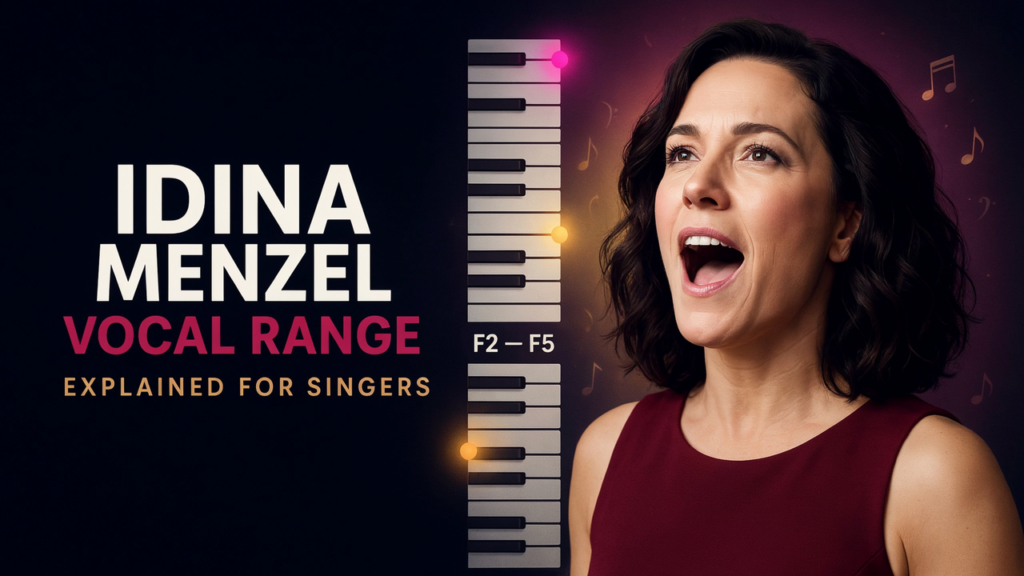
Idina Menzel’s complete career vocal range is not established by the sources checked for this article. One specific, documented reference is F3–E♭5 in the published “Let It Go (Movie Version)” arrangement discussed below. That is the range of an arrangement, not her lowest and highest possible notes.
Her vocal-range discussion is most useful when it separates written song demands, individual performances, and broad descriptions such as “mezzo-soprano” or “belter.” A high note in one song cannot settle all three questions.
Idina Menzel’s Vocal Range: What Is Verified?
| Question | Responsible answer |
|---|---|
| Complete career range | Not verified here from a documented collection of endpoint performances. |
| “Let It Go” arrangement | F3–E♭5 in Musicnotes product MN0127731, original published key. |
| Span of that arrangement | 22 semitones: one octave plus a minor seventh. |
| Lowest or highest career note | Neither endpoint of one score proves an absolute limit. |
| Voice type | A formal classical classification is not established by the score. |
| Practical cover decision | Assess the particular arrangement, repeated high phrases, and your own comfortable key. |
The “Let It Go” Range—and the E♭5 Correction
Musicnotes’ Piano/Vocal/Chords, Singer Pro arrangement lists the voice part as F3–E♭5 and the original published key as F minor. Its product number is MN0127731. This identifies the version being discussed rather than assuming all arrangements share the same limits.
E♭5 is one semitone below E5. F3 to F4 is 12 semitones; F4 to E♭5 adds another 10. The complete written span is therefore 22 semitones, just short of two octaves. It should not be reported as three octaves.
A transposed copy changes both endpoints. Lowering this arrangement by two semitones produces E♭3–D♭5 while preserving the 22-semitone width. That may ease the top but make the bottom less accessible. Check both ends before deciding a lower key is better.
The arrangement is a useful reference for someone choosing music. It is not an acoustic analysis of every note Menzel has sung, and it cannot verify a career maximum. Live versions, optional embellishments, and alternate arrangements need their own evidence.
Is Idina Menzel a Mezzo-Soprano or a Soprano?
Mezzo-soprano is a label readers may encounter in discussions of Menzel, but this article does not treat it as a verified classical classification. Musical-theatre casting, pop descriptions, and operatic voice categories do not use exactly the same criteria. A strong upper note does not automatically establish soprano status.
Traditional female voice categories involve more than endpoints. The mezzo-soprano category concerns the way a voice functions across repertoire, while a soprano classification cannot be confirmed merely by reaching a pitch printed on a chart.
Tessitura, vocal weight, transitions, and endurance would all matter in a fuller assessment. Hearing brightness or intensity in a recording does not provide direct measurements of vocal-fold behavior.
Why a Broadway High Note Can Be Demanding
The difficulty of a song is not fully captured by its highest note. A brief upper pitch approached gently is a different task from repeated high phrases with clear lyrics and a strong dramatic delivery. Breath locations, vowels, tempo, and the preceding phrase can make the same written note feel different.
“Belt” describes a recognizable musical sound and approach; it should not be read as an instruction to shout or keep an unchanged heavy sound as pitch rises. Terms such as chest voice, head voice, and mix also vary between teachers. A recording alone does not justify assigning an exact register mechanism to every note.
When working toward a demanding phrase, use the guide to singing higher to explore a comfortable approach. The goal is a phrase you can repeat with control, rather than a single imitation of a famous climax.
How to Choose a Key for an Idina Menzel Song
Start with the version you actually intend to perform. A karaoke track, audition cut, simplified score, and original recording may not match. Write down the key and the vocal melody’s endpoints; do not accidentally include notes from the piano accompaniment.
| Check | What to try |
|---|---|
| Low passages | Sing them with the actual lyrics; check that they remain clear without pressing downward. |
| Repeated upper phrases | Test a short section at a manageable volume, with quiet pauses between attempts. |
| Transitions | Include the notes before and after the high point, not only the peak. |
| Tempo and words | Restore these gradually after the phrase works on an easy vowel. |
| Complete performance | Check whether earlier material leaves enough ease for the final section. |
Use your measured vocal range as a starting reference, then test the song itself. Being able to produce both endpoints is necessary for that version but does not guarantee the entire song fits your comfortable working range.
If lowering the key solves the top but loses the verse, consider another arrangement, a shorter cut, or a different song. For an audition, follow the stated key and cut requirements and coordinate changes with the accompanist. There is no need to force your voice to match another singer’s tone.
How to Evaluate Other Range Claims
An exact claim should identify the song, release or performance date, timestamp, pitch, and whether the sound is sustained singing or a brief effect. A compilation can point you toward a performance, but its title alone does not verify the note.
Keep score-based evidence separate from recording-based evidence. Also distinguish a studio production from a repeatable live capability. Neither a successful extreme note nor a missed note on one occasion defines an artist’s full ability.
Comparisons with Cynthia Erivo’s vocal range are more meaningful when the same version, key, and evidence criteria are used. Comparing unrelated totals can conceal differences in what was counted.
Frequently Asked Questions
How many octaves can Idina Menzel sing?
This article does not assign a verified career octave total. The documented “Let It Go” arrangement spans 22 semitones, but a single song is not a measurement of the singer’s complete range.
Is the high note in this “Let It Go” arrangement E5?
The cited arrangement lists E♭5, not E5. Check the exact edition and transposition before applying that figure to a different version.
Does singing this song mean I have the same voice type?
No. Different voice types may cover the same notes. Comfort, tone, repeated phrase demands, and the chosen key all affect how a song fits.
Should I copy Menzel’s volume to reach the notes?
No. Establish the phrase at a comfortable intensity first. Stop if it causes pain, hoarseness, or increasing effort, and seek qualified help when difficulties persist.

Harlow is a vocal analysis and singing tools writer at Voice Range Test. She focuses on vocal range testing, voice type analysis, pitch recognition, and singing education tools for singers, musicians, choir performers, and beginners.