
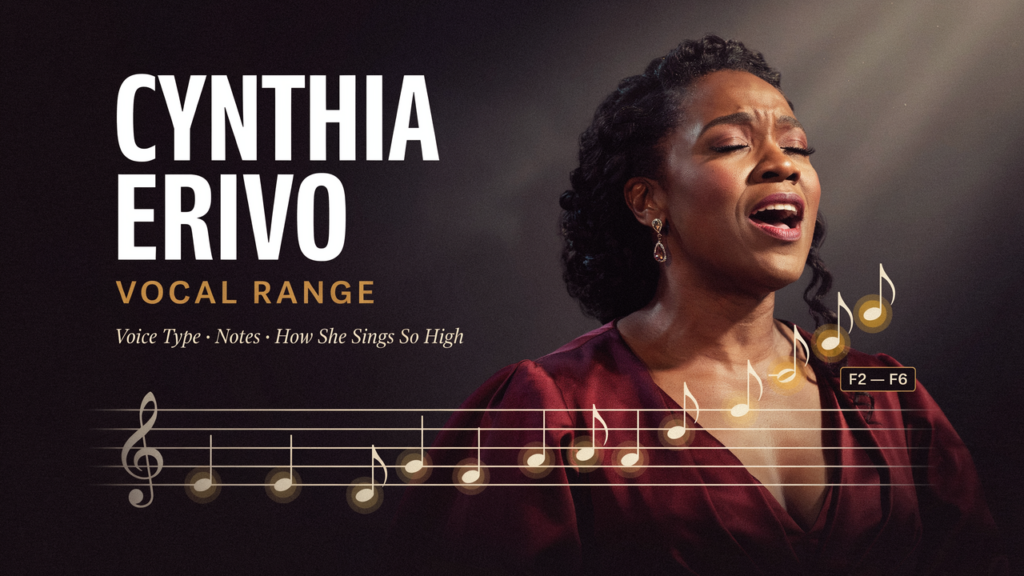
Cynthia Erivo’s commonly reported vocal range is approximately C♯3 to D6, spanning three octaves and one semitone. This estimate reflects pitches collected from performances across musical theatre, film, concerts, and studio recordings, but it is not an officially certified range.
Her lowest and highest notes provide only part of the picture. Erivo’s defining strengths are her powerful upper-middle register, controlled belt, clear head voice, dynamic range, and ability to shape demanding notes around a character’s emotions. Performances such as “I’m Here,” “Stand Up,” and “Defying Gravity” reveal more about her voice than the two endpoints alone.
What Is Cynthia Erivo’s Vocal Range?
The most frequently documented estimate for Cynthia Erivo is C♯3–D6. The interval between those notes is 37 semitones, equal to three octaves and one semitone.
This should be described as an observed total range rather than her comfortable singing range. Compilations may combine notes recorded years apart under very different conditions, including:
- Studio vocals and live performances
- Full-bodied belts and lighter head voice
- Sustained pitches and brief ornamental notes
- Written melody and optional improvisation
- Character-driven vocal effects
Erivo does not sing every song across that complete span. Most of her material occupies a smaller area where she can sustain phrases, communicate lyrics, and maintain tonal consistency.
| Vocal area | Typical use in Erivo’s performances | Evidence interpretation |
|---|---|---|
| Around C♯3 | Low phrases and grounded dramatic delivery | Commonly reported lower boundary |
| Middle register | Speech-connected storytelling and warm sustained singing | Strongly demonstrated |
| Upper-middle register | Powerful musical-theatre and gospel-influenced belts | Central to her singing style |
| Fifth-octave highs | Belts, mixed coordination, riffs, and head voice | Frequently demonstrated |
| Up to D6 | Light upper-register extension | Reported high boundary; performance context matters |
The D6 should not automatically be described as a belt. A singer may reach the same pitch through head voice, a light register, or a brief ornament, each producing a different sound and requiring a different coordination.
What Is Cynthia Erivo’s Lowest Note?
C♯3 is commonly identified as Cynthia Erivo’s lowest recorded note. It sits below middle C and reveals the darker edge of a voice more often celebrated for its upper-register power.
Her lower range is most effective when used for dramatic contrast. Erivo can begin a phrase with a quiet, grounded quality and allow the sound to expand as the emotional intensity rises. This creates a larger perceived journey than starting every passage at full volume.
Low notes also need context. A single audible C♯3 does not establish where Erivo feels most comfortable throughout an entire role. It may be an accessible lower extension rather than the center of her tessitura.
This distinction is apparent when comparing her with Jennifer Hudson’s powerful vocal range. Both singers draw from gospel and contemporary musical-theatre traditions, but their tonal weight, phrasing choices, and placement through the lower-middle register remain individual.
What Is Cynthia Erivo’s Highest Note?
D6 is the highest note most often included in public Cynthia Erivo range compilations. It is better treated as a reported upper extension than as her defining high belt.
Erivo regularly demonstrates strong fifth-octave singing, but not every high pitch uses the same register. Her upper range may include:
- Chest-dominant belting
- Balanced mixed coordination
- Head voice
- Light riffs and ornamental notes
- Character-based cries or vocal releases
A high belt is created differently from a head-voice D6. Calling both sounds “full chest voice” would obscure the coordination that allows Erivo to move through her upper range with flexibility.
Her performance as Elphaba naturally invites comparison with Idina Menzel’s vocal range. Both singers deliver the role’s climactic material with intensity, but they use different tonal colors, phrasing, vibrato, and battle-cry choices. The comparison is more useful when it focuses on interpretation rather than asking which singer reaches the higher isolated pitch.
How Many Octaves Can Cynthia Erivo Sing?
Cynthia Erivo’s reported C♯3–D6 range covers three octaves and one semitone.
The calculation works as follows:
- C♯3 to C♯4 is one octave.
- C♯4 to C♯5 is a second octave.
- C♯5 to C♯6 is a third octave.
- C♯6 to D6 adds one semitone.
That produces 37 semitones in total. Describing the range as “more than three octaves” is accurate, while rounding it up to four octaves would not be.
This measurement represents the distance between the reported endpoints. It does not mean that every note across those three octaves is equally strong, repeatable, or appropriate for every song.
Is Cynthia Erivo a Soprano or Mezzo-Soprano?
Cynthia Erivo is frequently described as a soprano, although her rich lower-middle register and substantial vocal weight sometimes lead listeners to describe her as a mezzo-soprano. A careful contemporary description is a soprano-oriented musical-theatre vocalist with a strong, weighty belt and an extended lower register.
Neither C♯3 nor D6 settles the classification. Voice type depends on where the voice functions most naturally, including:
- Comfortable tessitura
- Vocal weight
- Timbre
- Register transitions
- Sustainable repertoire
- The relationship between belt, mix, and head voice
Musical-theatre performers also adjust their voices according to the character, microphone, arrangement, and production style. Classical labels therefore cannot always describe their work perfectly.
Erivo’s dramatic weight differs noticeably from the lighter, brighter sound associated with Kristin Chenoweth’s vocal range. Both can sing high musical-theatre material, yet range overlap does not make their voices identical.
Cynthia Erivo’s Belt, Mix and Head Voice
Erivo’s belt is powerful because it remains connected to language and dramatic intention. She does not simply increase volume at the climax. She alters vowel shape, resonance, intensity, and phrasing so that the high note feels like the result of the story.
Her upper-middle register often combines chest-like strength with a more efficient mixed coordination. This helps her carry intensity upward without making every pitch sound equally heavy. When the arrangement requires softness or greater height, she can move toward a lighter head-dominant sound.
Her vibrato is another expressive tool. Erivo may begin a note with a straighter tone, allow vibrato to emerge later, or vary its width according to the emotional context. That degree of control is especially valuable in musical theatre, where the lyric must remain intelligible.
The versatility can also be compared with Laura Osnes’s musical-theatre range, though Osnes generally represents a lighter stylistic center. Similar notes can sound very different when vocal weight and dramatic purpose change.
Performances That Best Demonstrate Her Range
Several performances show distinct parts of Cynthia Erivo’s voice.
“I’m Here” from The Color Purple demonstrates her ability to build a song from vulnerable storytelling into a forceful emotional release. The climax depends on sustained phrasing and tonal commitment, not merely high notes.
“Stand Up” combines lower, intimate phrases with a gradually expanding upper register. Its long lines highlight breath pacing, dynamic control, and the gospel influence in her phrasing.
“Nothing Compares 2 U” displays restraint and tonal clarity. It is useful evidence that Erivo’s singing does not depend entirely on large belts.
“The Wizard and I” requires optimism, forward momentum, and an increasingly expansive sound. It shows how she organizes several vocal levels across a long dramatic arc.
“Defying Gravity” brings together speech-like storytelling, sustained upper-middle singing, climactic belts, and an individual battle cry. The performance is particularly notable because Erivo sang on set while completing physically demanding movement and harness work.
Her screen-musical technique can be compared with Rachel Zegler’s vocal range, especially in the way both performers balance vocal polish with character and camera-level intimacy.
What “Defying Gravity” Reveals About Her Voice
“Defying Gravity” does not simply test whether a singer can hit the final notes. It requires stamina, narrative pacing, clear diction, register balance, and enough restraint to leave room for the ending.
Erivo approaches the song as a gradual transformation. Earlier phrases retain conversational detail, while later sections introduce greater resonance and weight. Her climactic singing feels larger because she has not used maximum intensity from the beginning.
The celebrated battle cry should not be treated as a single universal note. Elphaba performers often personalize its pitch sequence, rhythm, and vowel. It functions as an expressive release rather than a standardized test of who has the widest range.
Listeners who want to examine an individual pitch can use the site’s pitch detector, although background music, harmonies, vibrato, and recording effects can make automatic analysis less reliable.
Why Her Usable Range Matters More Than D6
Cynthia Erivo’s D6 is impressive, but her usable range is what supports a complete performance. She can move between quiet storytelling, resonant low phrases, speech-connected middle notes, powerful belts, lighter upper-register singing, and detailed riffs.
That coordination allows her to communicate character without making technique the obvious subject of every song. It also explains why copying one climactic note cannot reproduce her sound.
A singer evaluating Erivo’s work should listen for repeatability, tonal intention, vowel clarity, dynamic control, and how each register serves the lyric. Those qualities reveal far more than a range number by itself.
Frequently Asked Questions
What is Cynthia Erivo’s vocal range?
Cynthia Erivo’s commonly reported range is approximately C♯3–D6, covering three octaves and one semitone. The endpoints come from performance analysis rather than an official standardized assessment.
What is Cynthia Erivo’s highest note?
D6 is frequently cited as her highest recorded note. It should be described as an upper-register extension, not automatically as a full-power belt.
What is Cynthia Erivo’s lowest note?
C♯3 is commonly reported as her lowest recorded pitch. Her most characteristic singing generally sits higher than this isolated lower boundary.
Is Cynthia Erivo a soprano?
She is commonly described as a soprano, particularly in musical-theatre contexts. Her strong lower extension and substantial belt can create mezzo-like color, but range endpoints alone cannot determine a precise classical voice type.
Did Cynthia Erivo sing live in Wicked?
Yes. Erivo performed live vocals during filming, including demanding sequences involving harnesses and physical movement. The finished soundtrack and film still involve professional production, but live singing formed an important part of her performance.
Does Cynthia Erivo belt a D6?
A D6 appears in reported range analyses, but it should not be labeled a belt without verifying the exact performance and vocal production. Her best-known sustained belts generally sit below that extreme.

Harlow is a vocal analysis and singing tools writer at Voice Range Test. She focuses on vocal range testing, voice type analysis, pitch recognition, and singing education tools for singers, musicians, choir performers, and beginners.