
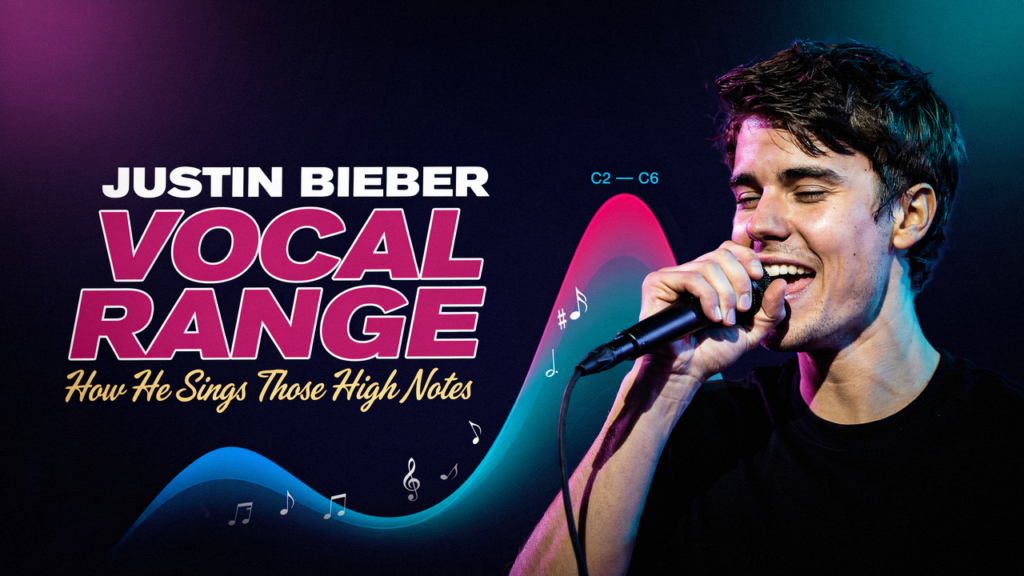
Justin Bieber’s adult vocal range is approximately A2 to F5, spanning about two octaves and a minor sixth. His connected chest and mixed voice appears to extend to roughly C♯5, while the highest notes around E5–F5 are generally produced with falsetto or a lighter head-dominant coordination.
Bieber is best described as a light pop tenor, although some analysts hear light-baritone qualities in his mature lower register. His musical identity depends less on extreme notes than on smooth register changes, flexible falsetto, R&B-influenced runs, breathy phrasing, and a youthful tonal quality.
| Vocal characteristic | Approximate assessment |
|---|---|
| Adult overall range | A2–F5 |
| Connected chest/mix range | A2–C♯5 |
| Falsetto extension | E5–F5 |
| Probable voice type | Light tenor |
| Strongest area | C3–B4 |
| Known for | Falsetto, vocal runs and smooth pop phrasing |
What Is Justin Bieber’s Adult Vocal Range?
Bieber’s adult range is most realistically placed around A2–F5. Some profiles begin his range at B♭2 or C3, while others identify occasional lower sounds near F♯2. The upper estimate also changes depending on whether falsetto, harmonies, and background vocals are included.
A useful way to interpret his range is by register:
- A2–E4: lower and middle modal voice
- F4–C♯5: upper mix or light connected singing
- E5–F5: falsetto extension
These zones overlap because vocal registers are not separate switches with identical boundaries in every song. Bieber frequently transitions gradually between a light chest voice, mix, and falsetto.
His comfortable tessitura is narrower than his total range. Most adult material sits between the third octave and the upper fourth, allowing him to use a relaxed contemporary pop tone without relying on extreme pitches.
Why Do Some Sources Report C6 or D6?
Some song databases credit Bieber with notes as high as C6 or D6. These figures may come from sheet-music arrangements rather than isolated analysis of his lead vocal.
Published scores can include background harmonies, doubled melodies, octave displacement, or notation designed for a particular instrument or voice arrangement. A high note listed for the complete song is not necessarily sung by Bieber as a solo lead pitch.
The same issue appears at the bottom of his range. A database may assign him an F2 because of a low harmony, processed vocal, or transcription choice. That does not automatically make F2 part of his repeatable adult singing range.
For these reasons, A2–F5 is a more cautious estimate than the nearly four-octave F2–D6 figures found online.
Justin Bieber’s Lowest Notes
Bieber uses his lower register sparingly. Songs such as “Love Yourself” reveal a comparatively low, conversational side of his adult voice, with a published song range around B2–B3.
“Mistletoe” also descends to approximately B2, while some recordings contain less clearly established sounds around A2. His low notes are generally light and intimate rather than large or chest-heavy.
This lower register became more noticeable as his voice matured. It shares some of the smoky, understated quality heard in Shawn Mendes’s vocal range, although Mendes often uses more weight in his midrange and rock-influenced belts.
Bieber’s low notes help create contrast, but they are not the main evidence for his voice type. His tessitura and upper-register flexibility remain more characteristic.
Justin Bieber’s Highest Notes
Bieber’s most defensible connected high notes extend to approximately C♯5. Above that area, he usually reduces vocal weight and moves toward falsetto.
“I’ll Show You” covers approximately E4–E5, showcasing an upper-centered melody and light vocal production. “What Do You Mean?” uses quick transitions near the passaggio, with falsetto ad-libs extending above the primary melody.
“Holy” has been transcribed with a range reaching into the fifth octave. However, its highest score-based pitches should be interpreted carefully because harmonies and light upper-register parts can be counted differently.
Bieber’s falsetto is stylistically important. It gives him access to high notes without forcing a heavy chest-dominant sound. This approach can be compared with The Weeknd’s vocal range, though The Weeknd typically uses an even more head-led upper placement and a brighter high tessitura.
Is Justin Bieber a Tenor or Baritone?
Justin Bieber is most usefully classified as a light tenor in contemporary pop. His comfortable upper-middle register, bright tonal center, and frequent falsetto transitions support that description.
Some vocal profiles label him a light lyric baritone because his adult voice gained warmth and depth after puberty. That classification is understandable, but his songs frequently sit in tenor-friendly territory, and his lower register lacks the sustained weight usually associated with a clear baritone.
Pop classifications are less strict than operatic voice types. Bieber does not sing classical repertoire requiring formal Fach placement, so “light tenor” should be treated as a practical description rather than a clinical diagnosis.
A comparison with Harry Styles’s vocal range illustrates the tonal difference. Styles generally carries more weight and grit through his middle register, while Bieber favors a lighter, smoother R&B coordination.
How Puberty Changed Justin Bieber’s Voice
Bieber began his career before his adult voice had fully developed. Early recordings therefore reflect a smaller and lighter vocal instrument.
“Baby” spans approximately G3–C5. Its high chorus suited his youthful voice, which could access the upper fourth octave with less adult vocal weight. “Pray” covers roughly F3–B4 and represents another example of his early high-centered singing.
As puberty progressed, his vocal folds lengthened and thickened, lowering his speaking and singing pitch. His tone became warmer, his lower register expanded, and some early songs required new live arrangements.
His adult voice did not simply replace the high range with a low one. He developed falsetto and mixed coordination to preserve upper flexibility. This evolution should be considered whenever his childhood and adult recordings are combined in one range estimate.
Chest Voice, Mixed Voice and Falsetto
Bieber’s chest voice is most evident in his lower and middle passages. It usually remains light, speech-like, and slightly breathy rather than heavily projected.
Mixed voice allows him to move above the middle register while retaining more connection than pure falsetto. “As Long as You Love Me” and “Love Yourself” demonstrate how he can lighten the sound as it rises without producing an obvious register break.
Falsetto is one of his most recognizable tools. He uses it for emotional contrast, ad-libs, and high melodic hooks. The tone may be airy, but breathiness alone does not define falsetto; the underlying vocal-fold coordination also changes.
Justin Timberlake’s vocal range provides a useful comparison because both singers combine pop and R&B phrasing with frequent falsetto. Timberlake often uses sharper rhythmic articulation, while Bieber’s delivery tends to sound softer and more conversational.
Songs That Showcase Justin Bieber’s Range
“Love Yourself” highlights his lower adult register and restrained phrasing. Its narrow melody places greater attention on timing, diction, and tonal control.
“Sorry” demonstrates rhythmic precision, register changes, and the light vocal quality associated with the Purpose era. “What Do You Mean?” uses breathy delivery and quick falsetto transitions.
“I’ll Show You” showcases his upper register, while “Ghost” demonstrates a stronger modern pop mix and sustained emotional build. “Peaches” emphasizes relaxed R&B phrasing, vocal runs, and groove rather than extreme high notes.
Bieber’s melismatic style reflects the influence of contemporary R&B singers such as Usher. His runs are usually short and integrated into the phrase rather than designed as separate vocal showcases.
Studio Range Versus Live Singing
Studio recordings allow vocal doubling, comping, pitch correction, harmonies, and multiple attempts. These processes can improve consistency and density, but they do not automatically create the fundamental notes of the lead performance.
Live singing adds movement, fatigue, monitor balance, and the need to perform several songs consecutively. Bieber may simplify a run, lower a key, or substitute falsetto for a heavier note during a concert. These are normal performance decisions and should not be treated as proof that the original range is false.
When analyzing an unusual pitch, a note identifier can help estimate its frequency, but the vocal part must first be isolated from harmonies and instruments.
Frequently Asked Questions
How many octaves can Justin Bieber sing?
His cautious adult range of A2–F5 covers approximately two octaves and a minor sixth. Broader figures may include uncertain harmonies or transcription errors.
What is Justin Bieber’s highest note?
C♯5 is a commonly cited connected high note. His falsetto extends higher, reaching approximately E5–F5.
What is Justin Bieber’s lowest note?
A2 is a reasonable lower estimate, although clearly identifiable melodic lows often begin around B♭2 or B2.
Is Justin Bieber a tenor?
Yes. Light tenor is the most practical classification for his adult voice, though some analysts hear light-baritone qualities in his lower register.
Does Justin Bieber use falsetto?
Yes. Falsetto is central to his style and appears in many adult recordings, including upper ad-libs and emotional hooks.
Was Justin Bieber a soprano as a child?
His childhood voice was naturally higher, but applying a permanent adult classification to pre-puberty recordings is misleading. His mature voice developed into a light male tenor.
Justin Bieber’s adult vocal range is impressive for its flexibility rather than its size alone. His ability to move smoothly from a conversational lower register into mix and falsetto gives his voice the fluid quality heard throughout his modern pop and R&B catalog.

Harlow is a vocal analysis and singing tools writer at Voice Range Test. She focuses on vocal range testing, voice type analysis, pitch recognition, and singing education tools for singers, musicians, choir performers, and beginners.