
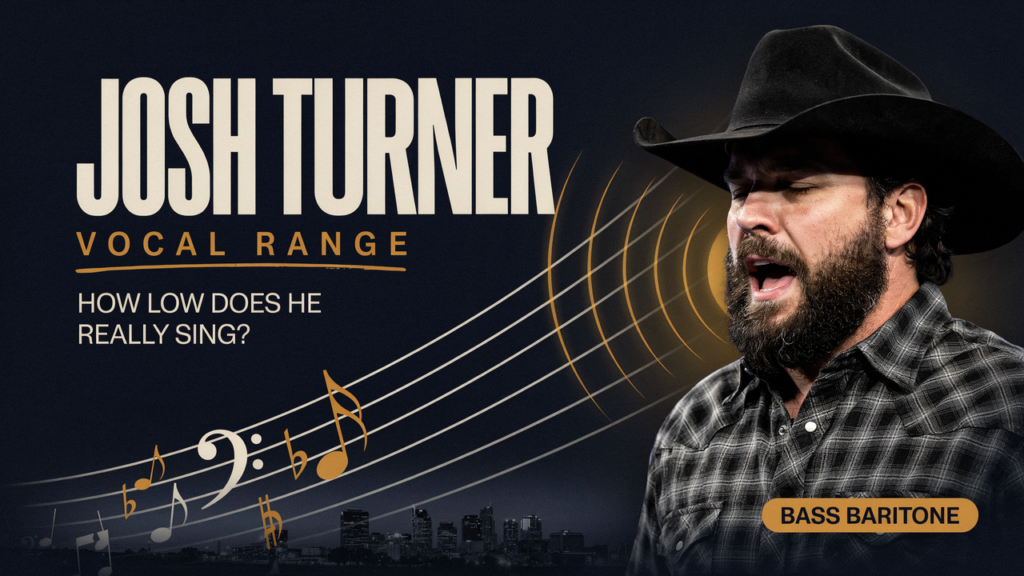
Josh Turner’s practical, well-documented vocal range is approximately F2 to E4, covering almost two octaves. Broader range compilations credit him with rare career extremes from A1 to C♯5, but those endpoints include isolated live lows and lighter upper-register notes rather than the range used consistently throughout his songs.
Turner is best described as a bass-baritone or exceptionally low baritone. His voice combines bass-like depth with enough upper flexibility to deliver melodic country choruses. His real distinction is not one extreme A1; it is the clarity, resonance, and consistency he maintains through a low tessitura.
Josh Turner’s vocal range F2–E4
87.3–330 Hz · 1 octave and 11 semitones · Bass-baritone or low baritone
Documented range Wider reported range (A1–C♯5) You
Don’t know your range? Take the voice range test.
| Vocal characteristic | Approximate assessment |
|---|---|
| Practical song range | F2–E4 |
| Broad reported range | A1–C♯5 |
| Most-used area | G2–D4 |
| Probable voice type | Bass-baritone or low baritone |
| Strongest register | Low and middle chest voice |
| Known for | Deep resonance, clear lows and country phrasing |
What Is Josh Turner’s Documented Vocal Range?
Turner’s familiar catalog provides strong evidence for a working range around F2–E4.
“Long Black Train” spans approximately F2–D4, while “Your Man” covers roughly G2–E4. “Why Don’t We Just Dance” also reaches around F2–D4. These songs show that Turner can remain musical and intelligible in an area where many male singers begin to lose tonal strength.
The broader A1–C♯5 estimate comes from vocal compilations that include rare performances across his career. An A1 has been attributed to live material such as “Firecracker” or “Hillbilly Squeegee,” while C♯5 has been associated with “Haywire.”
Those extremes are relevant, but they should not be treated as equally repeatable parts of his voice. The supported F2–E4 span better represents the range listeners hear consistently.
Josh Turner’s Lowest Notes
Turner is capable of entering the first octave, an unusual ability for a mainstream country singer. A1 is the most commonly reported low extreme, although the precise performance and production conditions must be considered.
A first-octave sound may be produced as a connected chest note, vocal fry, or a subharmonic-like effect. These coordinations do not carry the same vocal weight or reliability. A clear A1 in a live moment is impressive, but it does not mean Turner spends entire songs singing that low.
His more dependable low register begins around F2 or G2. These notes retain pitch definition, volume, and lyrical clarity. That consistency is what separates a usable bass-baritone low register from an isolated growl.
For comparison, Tim Foust’s vocal range includes similarly notable low extensions, though Foust’s a cappella work often places more deliberate focus on bass effects and extreme register displays.
How Low Does Josh Turner Sing in “Your Man”?
“Your Man” has a published vocal range of approximately G2–E4 in its original key of G major.
The famous opening phrase begins in Turner’s resonant lower register, but it does not require an A1 or another exceptional first-octave note. Its difficulty comes from maintaining a full, relaxed G2 while preserving rhythm, diction, and a conversational tone.
Many singers imitate the song by pressing the larynx downward or adding exaggerated vocal fry. That usually creates a swallowed sound and unstable pitch. Turner’s performance sounds deep because the note is connected and resonant, not because he forces it downward.
If G2 disappears or becomes breathy, raising the key is more effective than manufacturing a false bass tone. Singers can also use a deep voice test to identify which low notes remain clear and stable in their natural range.
Josh Turner’s Highest Notes
Turner can sing higher than his best-known songs suggest. Range compilations attribute a connected G4 to “So Not My Baby” and a C♯5 to “Haywire.”
The C♯5 should be classified cautiously. It may use falsetto, a head-dominant coordination, or another light upper-register production rather than the chest-heavy tone associated with his lower range.
His practical upper limit in most commercial material is closer to D4 or E4. This creates enough contrast for a chorus to rise without moving far from the low-centered character of his voice.
The range of Peter Steele provides an interesting rock comparison. Both singers are recognized for dark lows, but Steele often used gothic theatricality and register extremes, while Turner maintains a cleaner, speech-like country tone.
Is Josh Turner a Bass or Baritone?
Josh Turner sits near the boundary between bass and baritone. In popular music, bass-baritone is the most useful description.
His bass qualities include:
- A naturally low tessitura
- Strong second-octave notes
- Dark vocal color
- Substantial chest resonance
- A low speaking voice
His baritone qualities include melodic flexibility and enough upper extension to sing choruses approaching E4 or higher without abandoning his core tone.
Classical voice type requires evaluation of tessitura, passaggio, projection, and repertoire—not range endpoints alone. Turner is not being assessed for an operatic bass role, so bass-baritone should be understood as a practical description of how his country voice functions.
The guide to what a bass voice is explains why a single low note cannot establish classification. The voice must remain strong and comfortable throughout a consistently low musical area.
Why Does Josh Turner’s Voice Sound So Deep?
Turner’s depth begins with his natural instrument, but several musical factors reinforce it.
His songs are written in keys that keep much of the melody within his lower tessitura. He uses stable chest coordination, rounded vowels, and controlled airflow, allowing low notes to remain clear instead of airy.
His resonance also contains strong low-frequency overtones. These harmonics make even a G2 or C3 sound deeper than the same pitch sung with a brighter vocal color.
Close microphone placement preserves subtle low-frequency detail. The arrangement often leaves space around his vocal line, preventing guitars and backing vocals from masking the fundamental pitch. Production enhances the presentation, but it does not create the natural depth of his voice.
Tim Storms’s vocal range demonstrates the difference between extreme physiological range and ordinary musical tessitura. Turner does not need record-setting frequencies to sound convincingly deep in country music.
Supported Chest Notes Versus Vocal Fry
A supported low chest note has a stable pitch, connected tone, and enough resonance to carry a lyric. Vocal fry sounds looser, slower, and more crackling.
Turner may use fry as a stylistic color, but his characteristic lows are not built entirely from it. Notes in “Long Black Train” and “Why Don’t We Just Dance” remain musically centered and understandable.
Subharmonics are different again. This coordination can produce a pitch below the fundamental note being sung, but it is not part of most singers’ everyday chest range.
When evaluating a lowest-note claim, ask whether the pitch is sustained, identifiable, and used melodically. That evidence matters more than how impressive the octave number looks.
Songs That Showcase Josh Turner’s Range
“Long Black Train” is one of the strongest demonstrations of Turner’s low tessitura. Its F2–D4 span combines depth with narrative phrasing and sustained chest resonance.
“Your Man” showcases his famous low tone within a wider G2–E4 melody. The chorus confirms that he can rise without losing the dark character of his voice.
“Why Don’t We Just Dance” covers approximately F2–D4 and adds rhythmic challenges. “Would You Go with Me” demonstrates smoother legato phrasing and a more flowing melody.
“Firecracker” is relevant to discussions of his rare low extremes, while “Haywire” is associated with his less-familiar upper extension. Together, these performances show that his instrument is broader than the “Your Man” opening alone suggests.
How to Approach His Songs Without Forcing
A singer cannot reproduce Turner’s anatomy through technique. Training can improve low-note clarity, but it cannot guarantee an A1 or create a natural bass-baritone voice.
The safest approach is to begin in a comfortable middle register and descend gradually. Keep the jaw and tongue relaxed, use moderate volume, and avoid pushing the chin toward the chest.
The goal is a stable pitch, not the lowest possible noise. The guide on how to sing lower provides a gradual approach for developing usable low notes without forcing.
Stop if low-range practice causes pain, burning, or lingering hoarseness. Raising the song’s key is always preferable to pressing the voice below its natural limit.
Frequently Asked Questions
How many octaves can Josh Turner sing?
His broad reported A1–C♯5 range covers more than three octaves. His regularly documented song range of F2–E4 is just under two octaves.
What is Josh Turner’s lowest note?
A1 is commonly reported as his lowest career extreme. His more consistently supported melodic lows sit around F2–G2.
What is his highest note?
C♯5 has been attributed to “Haywire,” likely using a lighter upper-register coordination. His regular country repertoire usually remains below that note.
Is Josh Turner a bass?
Bass-baritone or very low baritone is the most practical classification. He possesses bass-like lows with more baritone-style melodic flexibility.
Can a baritone sing “Your Man”?
Many baritones can sing it, but G2 must remain stable and resonant. If it becomes breathy or forced, the song should be transposed upward.
Does Josh Turner use vocal fry?
He may use fry as a texture, but his signature second-octave notes are generally clearer and more connected than ordinary vocal fry.
Josh Turner’s reported A1–C♯5 span is impressive, but his artistry is best represented by the supported F2–E4 range heard throughout his catalog. His natural depth, stable resonance, and relaxed country phrasing make low notes sound musical rather than merely extreme.

Harlow is a vocal analysis and singing tools writer at Voice Range Test. She focuses on vocal range testing, voice type analysis, pitch recognition, and singing education tools for singers, musicians, choir performers, and beginners.