
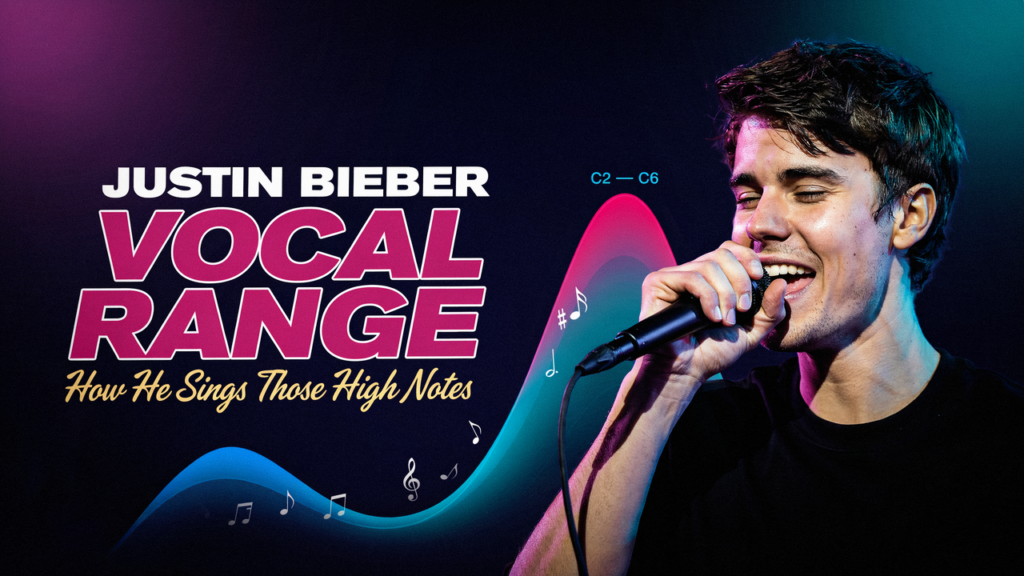
Justin Bieber’s complete adult vocal range is not established by the sources reviewed here. The A2–F5 estimate should be treated as a claim, not a verified measurement. A more concrete reference is a published “Love Yourself” arrangement that lists B3–B4 for the voice part.
That one-octave score range is not Bieber’s total range, and its octave placement should not automatically be treated as the sounding range of a recording. Written notation, arrangement choices, and an artist’s actual performance must be distinguished.
A Verifiable “Love Yourself” Reference
The Musicnotes “Love Yourself” piano/vocal/guitar edition, product MN0159585, lists B3–B4 in its original published key of E major. Those endpoints span 12 semitones.
This is evidence for the publisher’s listed arrangement. It does not establish Bieber’s lowest note, highest note, or complete adult tessitura. The vocal staff and performance convention must be checked before converting written pitches into claims about what sounds in the recording.
For example, shifting the listed melody down two semitones gives A3–A4. Singing a melody an octave lower is a different change: it preserves pitch classes but moves the entire vocal line by 12 semitones. Do not silently apply one adjustment while reporting the other.
Why Online Estimates Disagree
Some profiles count lead singing only; others include falsetto, backing parts, collaborations, or early recordings. Combining these without explanation can create a range no single performance demonstrates.
The estimate A2–F5 spans 32 semitones, or two octaves plus a minor sixth. That calculation says nothing about whether A2 and F5 are correctly attributed, repeatable, or comfortable.
A narrower claim is not automatically more accurate. Both narrow and wide estimates need evidence. Replacing an uncertain high endpoint with a lower guessed one does not create a verified range.
Adult Recordings and Early Recordings
When comparing performances from different periods, keep the recording dates separate. A developing voice and an adult voice should not be combined into a single supposedly current measurement without explanation.
Differences between recordings can also reflect the song, key, microphone, arrangement, and artistic choices. A lower-sounding performance does not by itself show a permanent change in voice type.
For a fair comparison with Shawn Mendes, use comparable material and evidence standards. Avoid treating a description such as youthful, dark, or breathy as a measured physiological fact.
Is Justin Bieber a Tenor or Baritone?
“Light pop tenor” is an informal description readers may encounter. It is not a formal classical assessment, and this article does not certify a Fach classification.
A singer can use a warm low sound and still perform higher repertoire. Equally, producing a high falsetto note does not establish tenor status. Comfortable tessitura, sustained phrases, transitions, and tonal weight all matter.
The same care is useful when reading about Harry Styles’s vocal range. Shared endpoints do not mean two singers have interchangeable voices.
Falsetto, Runs, and Register Labels
Soft high singing may sound light or airy, but a recording alone cannot establish exact vocal-fold behavior at each note. Avoid treating C-sharp5 or any other pitch as a universal switch between “mix” and “falsetto.”
When learning an upper phrase, keep the musical goal specific: clear pitch, recognizable vowels, and a repeatable transition. Do not try to preserve a heavier sound simply because the original vocal seems strong.
Comparisons with The Weeknd can help frame questions about upper-register sound, but they do not prove identical coordination. Likewise, Justin Timberlake’s range should be assessed from his own evidence.
How to Practice a Bieber Song
Choose the exact arrangement and confirm its key. Learn a short melody without ornaments first. Speak the lyrics in rhythm, sing the notes on an easy vowel, then restore the words.
For a run, identify the starting and ending notes and the pitches between them. Slow the passage while preserving pitch, and restore speed only when the sequence stays clear. A quick slide is not necessarily the same as accurately singing each note.
Use the note identifier with your voice alone. If the backing track is loud, the tool may identify the accompaniment or original vocal instead. Confirm surprising results with a reference note and another attempt.
Record the complete phrase, including what comes before and after the difficult section. If it works only after several forceful attempts, choose a more comfortable key or a simpler passage. Pain and new hoarseness are reasons to stop.
Frequently Asked Questions
How many octaves can Justin Bieber sing?
A verified adult career total is not established here. The frequently used A2–F5 estimate has a 32-semitone span, but its endpoints need direct documentation.
Does “Love Yourself” prove he has only one octave?
No. One arrangement’s melody is a small sample of repertoire, not the singer’s complete capability.
Is B2–B3 the published range?
The cited edition lists B3–B4. A different sounding octave must be established from the score convention or recording rather than assumed.
Do I need to copy his tone?
No. Prioritize the melody, rhythm, and clear words in a key that suits your voice. Tone imitation is not a reliable range test.

Harlow is a vocal analysis and singing tools writer at Voice Range Test. She focuses on vocal range testing, voice type analysis, pitch recognition, and singing education tools for singers, musicians, choir performers, and beginners.