
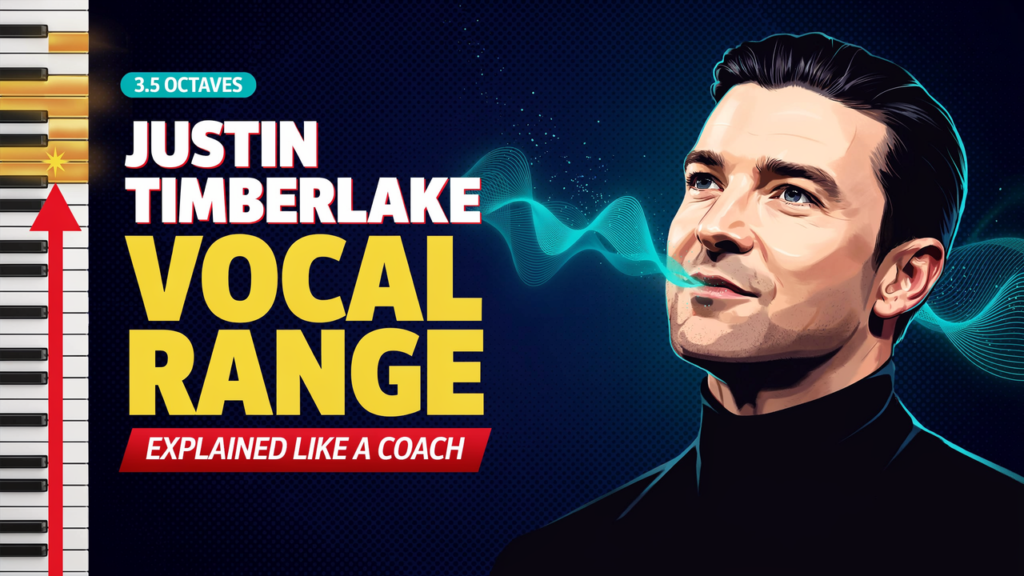
Justin Timberlake’s vocal range is broadly reported as approximately F2 to F♯5, spanning just over three octaves when chest voice, mixed coordination, and falsetto are counted together. A more conservative estimate based on clearly identifiable and repeatable singing is around B♭2 to F5.
The endpoints vary because Timberlake’s recordings contain stacked harmonies, processed vocals, guest singers, and extensive falsetto. His practical strength is not one isolated extreme note. It is his ability to move smoothly through a tenor tessitura while switching between chest voice, mix, head-dominant sounds, and falsetto.
Justin Timberlake Vocal Range at a Glance
| Vocal characteristic | Approximate assessment |
|---|---|
| Broadly reported range | F2–F♯5 |
| Conservative functional estimate | B♭2–F5 |
| Common working range | C3–B4 |
| Voice type | Contemporary lyric tenor |
| Upper extension | Mix, head voice, and falsetto |
| Notable strengths | Falsetto, agility, phrasing, register transitions |
| Main challenges | Breath control, rhythm, upper-register coordination |
The reported F2–F♯5 range spans three octaves and one semitone. However, range totals should always be interpreted alongside vocal register, note quality, and repeatability.
Why Justin Timberlake’s Range Estimates Differ
Online profiles do not agree on Timberlake’s exact lowest and highest notes. Some count only sustained lead vocals, while others include harmonies, brief vocal effects, live improvisations, and layered studio parts.
Printed arrangements can create additional confusion. A score may include backing harmonies, another singer’s part, or a combined vocal line rather than Timberlake’s individual performance. This is especially important when unusually high sixth-octave notes are attributed to his songs.
A responsible analysis should therefore separate:
- Clearly audible lead-vocal notes
- Brief or uncertain studio notes
- Mixed and head-dominant singing
- Falsetto extensions
- Background harmonies and guest vocals
- Notes printed in arrangements but not clearly sung by Timberlake
This approach produces a more useful picture than simply selecting the widest number found online.
What Is Justin Timberlake’s Lowest Note?
Timberlake has been credited with lows around F2, although notes this low are not central to his usual singing style. A more conservative lower boundary is approximately B♭2, with many of his recognizable melodies beginning closer to C3 or D3.
His lower register can sound warm, husky, and speech-like. That darker color occasionally leads listeners to describe him as a baritone. However, reaching a low note does not determine voice type. Tessitura, register transitions, vocal weight, and comfortable upper notes provide more useful evidence.
Timberlake’s low singing is generally used for contrast before a melody rises into his brighter tenor range. Singers interested in a genuinely lower-centered instrument can compare his voice with Michael Bublé’s vocal range.
What Is Justin Timberlake’s Highest Note?
Timberlake’s commonly reported upper endpoint is approximately F♯5, usually reached through a light upper-register coordination rather than a heavy full-voice belt. A more conservative repeatable boundary is around F5.
His falsetto is one of the most recognizable parts of his sound. Rather than using it only for occasional high notes, he treats it as an expressive register for hooks, harmonies, transitions, and sustained phrases.
Claims that he sings C6 or D6 should be treated cautiously. Such notes may come from written arrangements, layered harmonies, processed effects, or vocal parts performed by another singer. They should not automatically be presented as Timberlake’s highest verified lead-vocal notes.
His falsetto-led approach can be compared with The Weeknd’s vocal range, although the two singers use different tonal colors and phrasing styles.
How Many Octaves Can Justin Timberlake Sing?
Using the broad F2–F♯5 estimate, Justin Timberlake covers three octaves and one semitone. Using the more conservative B♭2–F5 estimate, his range spans two octaves and seven semitones.
Both figures can be useful when properly labeled. The broader number describes his total reported output across registers, while the narrower number better represents clearly functional singing.
His common working area is approximately C3 to B4, with excursions above that range through mix, head voice, or falsetto. Most listeners recognize his voice through this practical area rather than its endpoints.
Is Justin Timberlake a Tenor or Baritone?
Justin Timberlake is best described as a contemporary lyric tenor. His voice has the lightness, flexibility, upper-register access, and falsetto facility generally associated with a tenor-based pop instrument.
His tone can become dark or husky in the lower middle register, but tonal color alone does not make someone a baritone. Timberlake’s melodies frequently sit high enough to demand comfortable tenor coordination, particularly when repeated during live performances.
He is not a classical lyric tenor in the strict operatic sense because his music uses amplification, contemporary vowels, microphone technique, and stylistic register changes. The label is most useful as a general description of where his voice functions.
Justin Bieber’s vocal range offers another example of a light male pop voice whose classification depends on more than its lowest note.
Chest Voice, Mix, Head Voice, and Falsetto
Timberlake’s vocal identity depends on how he connects different registers. His lower and middle notes often use a light chest-dominant sound. As the melody rises, he reduces weight and shifts toward mixed or head-dominant coordination.
Falsetto provides a softer, thinner, and often airier contrast. It is particularly important in his R&B-influenced material, where a quick register change can become part of the rhythm and emotional delivery.
His high notes should not all be placed in one category. Depending on the phrase, he may use:
- A light chest-dominant sound
- A brighter mixed coordination
- A head-dominant upper register
- An airy or focused falsetto
- Layered harmonies combining multiple vocal qualities
This flexibility connects his singing to artists such as Prince, who also used falsetto as an essential expressive color rather than a decorative effect.
Vocal Ranges of Popular Justin Timberlake Songs
Song ranges vary according to the arrangement, transcription, vocal layer, and live key. These estimates focus on the primary melodic demands.
| Song | Approximate range | Main vocal challenge |
|---|---|---|
| “Cry Me a River” | C3/C♯3–B4 | Low-to-high transitions and layered phrasing |
| “Mirrors” | E3–C5 | Sustained upper phrases and stamina |
| “What Goes Around… Comes Around” | D3–C5 | Register balance and long-form phrasing |
| “Can’t Stop the Feeling!” | E3–E5 | High energy, repeated upper notes, and movement |
| “SexyBack” | E3–A4 | Rhythmic precision and processed vocal style |
| “Rock Your Body” | Varies by counted vocal part | Falsetto, groove, and vocal layering |
| “Suit & Tie” | Tenor-centered with falsetto | Smooth transitions and controlled dynamics |
“Cry Me a River” does not have the widest melodic range, but its layered production, breathy textures, rhythmic entrances, and shifts in vocal weight make it difficult to reproduce convincingly.
“Can’t Stop the Feeling!” reaches higher and demands sustained energy. The challenge increases when the singer performs choreography at the same time.
What Makes Justin Timberlake’s Singing Difficult?
Timberlake rarely depends on raw vocal power alone. His style requires rhythmic control, clean register changes, accurate harmonies, breath management, and the ability to preserve tone while moving.
The main technical challenges include:
- Switching into falsetto without a disruptive break
- Returning from falsetto to a connected middle register
- Maintaining precise syncopated phrasing
- Singing softly without losing pitch stability
- Performing repeated high passages without excess pressure
- Coordinating vocals with physically demanding choreography
A singer may reach every note in one of his songs and still struggle to reproduce its groove. Timberlake frequently places consonants, breaths, slides, and vocal attacks in precise rhythmic positions.
His blend of R&B agility and pop performance can be compared with Usher’s vocal range, particularly when evaluating the added demands of singing while dancing.
How Has Justin Timberlake’s Voice Changed?
Timberlake’s early recordings emphasized a youthful, light tenor sound with frequent falsetto and tightly layered harmonies. His solo career added more lower-register color, rhythmic experimentation, and soul-influenced phrasing.
Later performances can sound heavier or more textured than his earliest work. Changes in repertoire, age, touring, production, and artistic preference all affect how a singer uses the voice. A darker tone or altered live key does not automatically indicate vocal decline.
Timberlake continues to be identified more by phrasing, register flexibility, and falsetto than by the size of his vocal range.
Can You Sing Justin Timberlake’s Songs?
Singers comfortable between C3 and B4 may be able to approach several Timberlake songs, but the original keys can still be demanding. “Mirrors” and “Can’t Stop the Feeling!” require more reliable upper-register coordination, while “SexyBack” depends heavily on rhythm and stylistic delivery.
Practice the lead melody before attempting the recorded harmonies. Use a lighter sound as the pitch rises, and avoid forcing chest voice upward to imitate the intensity of the production.
The Pitch Accuracy Test can help determine whether difficulty comes from reaching the notes or matching them consistently.
Frequently Asked Questions
What is Justin Timberlake’s vocal range?
His broadly reported range is approximately F2 to F♯5, although B♭2 to F5 is a more conservative functional estimate.
How many octaves can Justin Timberlake sing?
F2–F♯5 spans three octaves and one semitone. The more conservative B♭2–F5 estimate covers two octaves and seven semitones.
What voice type is Justin Timberlake?
He is best classified as a contemporary lyric tenor.
Does Justin Timberlake sing in falsetto?
Yes. Falsetto is one of the defining features of his vocal style and appears throughout his solo and group recordings.
What is Justin Timberlake’s highest note?
F♯5 is a commonly reported upper endpoint. Higher claims require caution because they may involve arrangements, background vocals, or studio effects.
What is his hardest song to sing?
“Mirrors” and “Can’t Stop the Feeling!” are demanding because of their upper tessitura and stamina requirements. “Cry Me a River” is challenging for its layered phrasing and register control.
Final Assessment
Justin Timberlake’s vocal range is broadly estimated at F2–F♯5, with B♭2–F5 serving as a more conservative functional range. He is a contemporary lyric tenor whose strengths include falsetto, agility, rhythmic accuracy, and smooth movement between registers.
His artistry is better measured by coordination than by extreme notes. The ability to combine tenor singing, expressive falsetto, layered harmonies, precise phrasing, and choreography is what makes his vocal style distinctive and difficult to imitate.

Harlow is a vocal analysis and singing tools writer at Voice Range Test. She focuses on vocal range testing, voice type analysis, pitch recognition, and singing education tools for singers, musicians, choir performers, and beginners.