
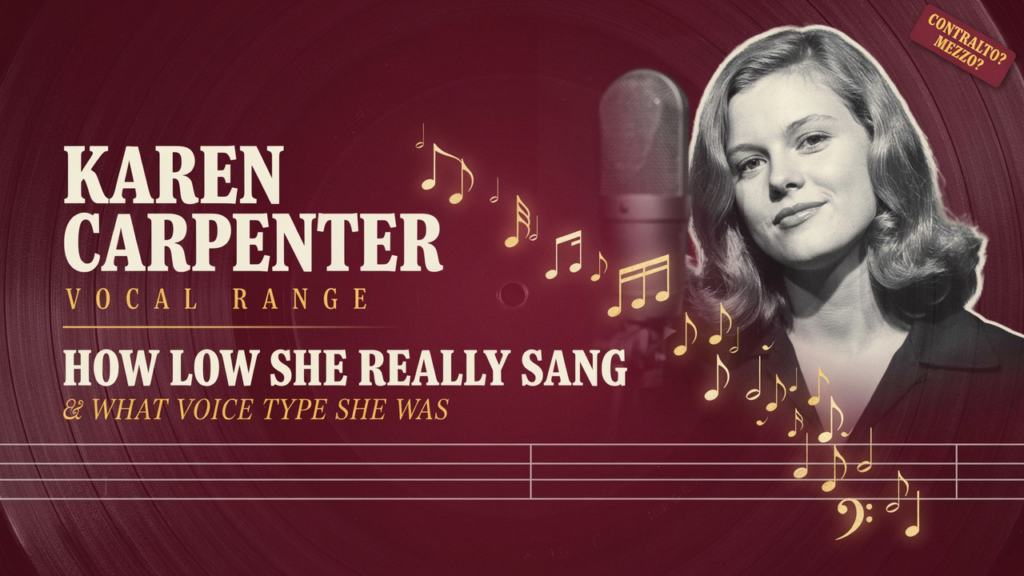
Karen Carpenter is widely associated with a low, warm vocal sound, but a precise full-career range needs more evidence than a descriptive voice label. This review does not certify D3–F5 or a three-octave total as her complete range. One identifiable published “Close to You” arrangement lists E3–A4.
A song’s written requirements, a singer’s recorded extremes, and comfortable tessitura describe different things. Keeping them separate makes Carpenter’s music easier to understand and more useful for singers choosing a cover.
What the Published Notes Establish
The Musicnotes edition of “(They Long to Be) Close to You”, product MN0085854, lists E3–A4 for the voice part in G major. The span is 17 semitones: one octave plus a perfect fourth.
This is a specific two-page arrangement. Other editions, fuller transcriptions, and transposed copies may have different limits. It should not be presented as a complete transcription of every vocal detail in the original recording.
E3 is therefore a documented lower note in this edition, not proof of Carpenter’s absolute lowest note. A4 is its listed upper boundary, not proof that she could sing no higher.
Was Karen Carpenter a Contralto?
Contralto is a familiar description of Carpenter in popular-music discussion. The cautious interpretation is that it describes the low-voiced character listeners associate with her work, rather than a formal operatic assessment established here.
“Alto” often identifies a choir part. It is not automatically interchangeable with contralto as a solo classification. The guide to alto and contralto explains why the distinction matters.
A chart cannot establish classification from one low note. Comfortable tessitura, sustained musical use, vocal weight, and transitions provide additional context. A singer can cover low notes without having the same tone or voice type as Carpenter.
What to Listen for Beyond the Lowest Note
When studying a Carpenters performance, listen separately to the melody, the duration of vowels, and the placement of consonants. Notice how a phrase ends and whether its quieter notes remain intelligible. These are practical observations you can make without claiming to measure the singer’s anatomy.
Warmth is a listening description, not proof of a particular overtone balance or airflow pattern. Microphones and production also affect the recorded result. Avoid turning an impression such as “effortless” into a claim that no physical work is involved.
A comparison with Linda Ronstadt is more useful when it considers the particular song and arrangement. Their catalogue totals alone cannot explain differences in phrasing or delivery.
Lead Singing and Layered Harmonies
A finished recording can contain several vocal parts. Before attributing a high or low sound, identify whether it belongs to the lead melody, a harmony, or another performer. The most prominent pitch in a mix is not always the lead singer’s note.
A range compilation should retain the track, release, timestamp, and vocal context for each endpoint. Repeating a number on several websites does not provide independent verification if all of them use the same unexamined claim.
This standard also matters in comparisons with Barbra Streisand’s vocal range. Compare evidence collected under similar rules.
Choosing a Comfortable Carpenters Arrangement
Start with a short phrase in your chosen score. Sing it with clear words at a comfortable intensity. If the lower notes become indistinct, test a higher key and then recheck the top.
For the cited E3–A4 arrangement, raising the melody two semitones gives F-sharp3–B4. The width stays 17 semitones. Raising the low notes may help, but the upper phrases must still fit your voice.
Do not artificially darken the sound by pressing downward or tightening the throat. Learn the melody in your own voice, then work on smooth connections and deliberate phrase endings.
The pitch accuracy test can help you check repeated notes, but it cannot determine tone quality, comfort, or health. Use recordings and your physical experience alongside the display.
Does Accurate Singing Prove Perfect Pitch?
No. Singing accurately with accompaniment, learning a melody well, and recognizing a note without a reference are different abilities. This article does not certify that Carpenter had absolute pitch.
Similarly, a controlled phrase does not establish a numerical breath capacity or prove that every note of a claimed range was equally easy. Keep the description matched to what the evidence actually shows.
Studying Luther Vandross offers another way to ask useful questions about phrasing and continuity without reducing musicianship to extreme notes.
Frequently Asked Questions
Did Karen Carpenter have three octaves?
That description is frequently repeated, but this review does not establish exact verified endpoints for it. Do not invent a low and high note to fit the number.
Was D3 her lowest note?
It is not certified here as an absolute limit. A specific recording and timestamp are needed to evaluate the claim.
Why does a score show a smaller range?
A song uses only part of a singer’s available notes, and editions can differ. The cited arrangement documents its own requirements.
Can a higher voice sing her music?
Yes, with a suitable arrangement and key. Preserve clear phrasing rather than forcing a lower vocal color.

Harlow is a vocal analysis and singing tools writer at Voice Range Test. She focuses on vocal range testing, voice type analysis, pitch recognition, and singing education tools for singers, musicians, choir performers, and beginners.