
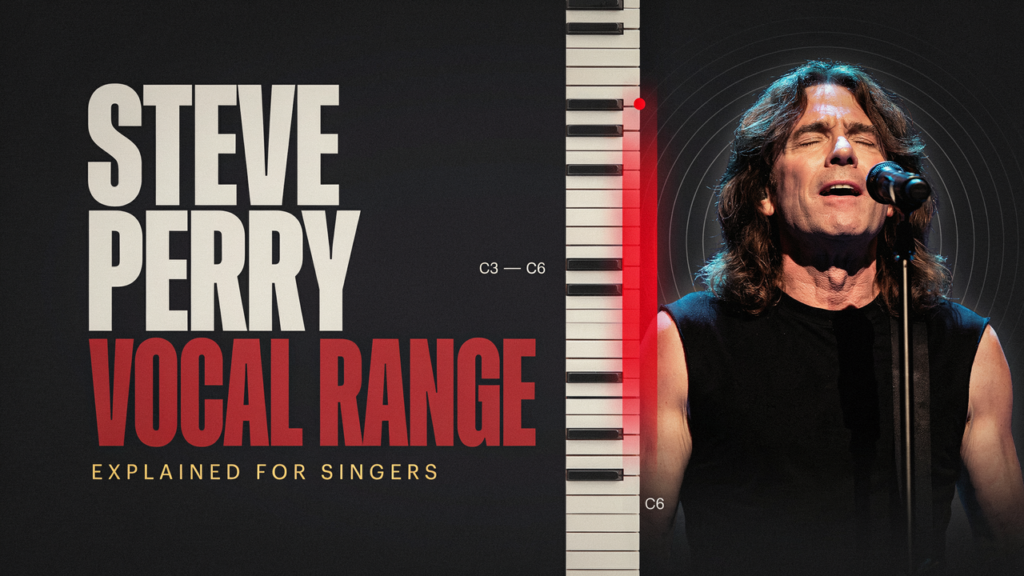
Steve Perry’s clearly documented career range extends approximately from E2 to D♯5, spanning two octaves and eleven semitones—one semitone short of three octaves. Some broader profiles credit him with notes reaching A5, but those upper extremes are less consistently tied to identifiable lead-vocal performances.
Perry’s range is impressive, but his defining achievement was his high tenor tessitura. During his peak years with Journey, he repeatedly sang demanding fourth- and fifth-octave melodies with clarity, power, controlled vibrato, and a remarkably smooth tone.
What Is Steve Perry’s Vocal Range?
A practical evidence-based estimate for Steve Perry is E2–D♯5. The E2 lower endpoint appears in catalogued solo material, while D♯5 is commonly associated with the climactic ending of Journey’s “Faithfully.”
| Vocal-range detail | Approximate result |
|---|---|
| Evidence-based career range | E2–D♯5 |
| Total span | Two octaves and eleven semitones |
| Catalogued solo-song range | E2–C5 |
| Broader reported range | Approximately F2–A5 |
| Common voice type | High tenor |
| Characteristic singing area | Upper third through fifth octave |
The wider F2–A5 estimate may include live variations, harmonies, brief upper-register sounds, or notes whose precise context is not consistently documented. It should not be presented as three-plus octaves of equally repeatable full voice.
Perry’s range is close enough to three octaves to be substantial by any practical standard. The guide to whether a three-octave vocal range is good explains why usability matters more than reaching a numerical milestone.
Evidence for His Lowest and Highest Notes
Perry’s solo catalog contains several clearly identified lower notes. E2 is associated with “Stand Up,” while “Missing You” reaches approximately F2. “Foolish Heart” and “Melody” also demonstrate his lower register.
His Journey recordings provide stronger evidence of his famous upper range. “Open Arms” reaches approximately C5, and the ending of “Faithfully” is commonly analyzed at D♯5.
| Note or range | Song | Context | Evidence status |
|---|---|---|---|
| E2 | “Stand Up” | Solo recording; low vocal endpoint | Catalogued |
| F2 | “Missing You” | Low melodic area | Catalogued |
| G2–C4 | “Foolish Heart” | Lower and middle registers | Catalogued |
| F3–C5 | “Oh Sherrie” | Solo upper-register singing | Catalogued |
| C5 | “Open Arms” | Strong chest/mixed coordination | Commonly supported |
| D♯5 | “Faithfully” | Climactic Journey-era high note | Commonly supported |
| Up to A5 | Various broader claims | Brief or source-dependent material | Not consistently verified |
This evidence also demonstrates why one database may report E2–C5 while another article gives a wider figure. A database focused on Perry’s solo songs will not necessarily include Journey performances, live improvisations, demos, or background harmonies.
What Is the High Note at the End of “Faithfully”?
The climactic note near the end of “Faithfully” is commonly identified as D♯5, also written as E♭5. It is one of the clearest examples of Perry’s upper range during his Journey years.
The note is impressive because it appears after a demanding song that already sits high for many male voices. Perry does not merely touch the pitch in isolation; he reaches it as part of a sustained emotional climax while preserving a recognizable vowel, stable intonation, and his characteristic vibrato.
“Open Arms” provides another useful comparison. Its famous upper phrase reaches approximately C5, but the song repeatedly approaches the top of a typical male modal range. The challenge is therefore not only the C5—it is sustaining the entire melody without accumulating tension.
Is Steve Perry a High Tenor or Countertenor?
Steve Perry is best classified as a high tenor, not a countertenor.
His lower notes overlap baritone territory, but range overlap does not determine voice type. Perry’s recurring tessitura, bright resonance, upper-register strength, and ability to sustain high rock melodies support the tenor classification.
The comparison becomes clearer when considering how he produced his high notes. Perry frequently used a connected chest-to-mix coordination rather than relying exclusively on a detached falsetto. His upper notes retained vocal weight, clear lyrics, and tonal continuity with the middle register.
Countertenor generally refers to a specific type of male classical singing that relies heavily on reinforced falsetto or related upper-register coordination. Simply possessing high notes does not make a pop or rock singer a countertenor.
The distinction between Perry’s high tenor placement and a warmer lower male voice is explained further in the tenor versus baritone comparison. A basic overview is also available in what is a tenor.
Why Steve Perry’s Upper Register Sounded So Powerful
Perry’s high notes did not depend on volume alone. Several vocal qualities worked together to create his distinctive upper-register sound.
Connected mixed coordination
He reduced some chest-voice weight as the melody rose while maintaining enough vocal-fold connection for the sound to remain strong. This produced high notes that felt powerful without sounding like a sudden switch into a weak falsetto.
Bright resonance
Perry’s focused resonance allowed his voice to cut through guitars, keyboards, drums, and dense harmonies. A bright tone can create acoustic intensity without requiring the singer to push maximum breath pressure.
Controlled vowels
Journey’s upper melodies contain vowels that can become difficult when sung too openly. Perry adjusted their shape while preserving understandable lyrics, helping high notes remain focused.
Consistent vibrato
His vibrato added warmth and movement to sustained pitches without obscuring their center. It was especially effective at the ends of long power-ballad phrases.
Dynamic control
Perry could begin a phrase gently and build toward a high climax. This contrast made his upper notes sound larger than they would if every line were sung at maximum intensity.
These qualities demonstrate that increasing vocal power is not the same as singing louder.
Journey Songs That Demonstrate His Range
Perry’s most revealing performances show how he used his range across complete songs.
- “Faithfully” demonstrates a sustained high tessitura and the climactic D♯5.
- “Open Arms” reaches approximately C5 and requires controlled mixed singing.
- “Separate Ways (Worlds Apart)” demands repeated upper-middle intensity and stamina.
- “Don’t Stop Believin’” combines bright resonance, phrasing, and repeated high placement.
- “Any Way You Want It” requires agility, rhythmic accuracy, and energetic upper-register singing.
- “Oh Sherrie” demonstrates Perry’s solo-era range up to approximately C5.
- “Foolish Heart” reveals a warmer lower and middle register that is sometimes overlooked.
His repertoire shows why tessitura matters. Many singers can touch C5 once, but far fewer can spend an entire performance repeatedly approaching it with consistent tone.
How His Voice Changed in Later Recordings
Perry’s later recordings generally use a lower tessitura and fewer prolonged fifth-octave climaxes than his peak Journey material. The tone also carries more weight and maturity.
This does not erase his earlier range or imply that every high note became unavailable. It shows that a singer’s performed range, preferred keys, registration, and tonal choices can change over time.
Later material should therefore be evaluated on its own terms instead of being judged solely against recordings made decades earlier. A lower arrangement can preserve phrasing, emotional communication, and vocal quality more effectively than forcing an original key.
Why Steve Perry Songs Are Difficult to Sing
Journey songs are challenging because the vocal line often stays high before reaching its most famous note. This creates cumulative fatigue.
Common difficulties include:
- Carrying too much chest weight upward
- Spreading vowels on C5 and nearby notes
- Using excessive breath pressure
- Losing pitch during long sustained phrases
- Allowing the jaw or tongue to tighten
- Copying Perry’s tone instead of finding a suitable coordination
- Practicing in the original key before the melody is stable
Singers should establish reliable breathing techniques and learn how to sing higher gradually. Transposing a Journey song is preferable to forcing high notes.
Stop practicing if the voice becomes painful, unusually rough, or increasingly difficult to control. A high note is not usable if it causes the rest of the range to deteriorate.
Frequently Asked Questions
How many octaves could Steve Perry sing?
The evidence-based E2–D♯5 span covers two octaves and eleven semitones, nearly three octaves. Wider estimates approaching F2–A5 remain more source-dependent.
What was Steve Perry’s highest supported note?
D♯5 is a strongly recognized upper note, associated with the climax of “Faithfully.” Higher notes have been reported, but their exact context is less consistently documented.
What was Steve Perry’s lowest documented note?
E2 is the lowest catalogued endpoint in his solo material, associated with “Stand Up.” “Missing You” also contains an approximately F2 lower note.
What note does Steve Perry sing at the end of “Faithfully”?
The climactic note is commonly identified as D♯5, enharmonically equivalent to E♭5.
Was Steve Perry a tenor or countertenor?
Perry was a high tenor. His upper register was unusually strong, but singing high notes does not automatically make a male singer a countertenor.
Did Steve Perry use falsetto?
Yes, he could use lighter upper-register sounds, but many of his famous Journey high notes rely on a connected mixed coordination rather than falsetto alone.

Harlow is a vocal analysis and singing tools writer at Voice Range Test. She focuses on vocal range testing, voice type analysis, pitch recognition, and singing education tools for singers, musicians, choir performers, and beginners.