
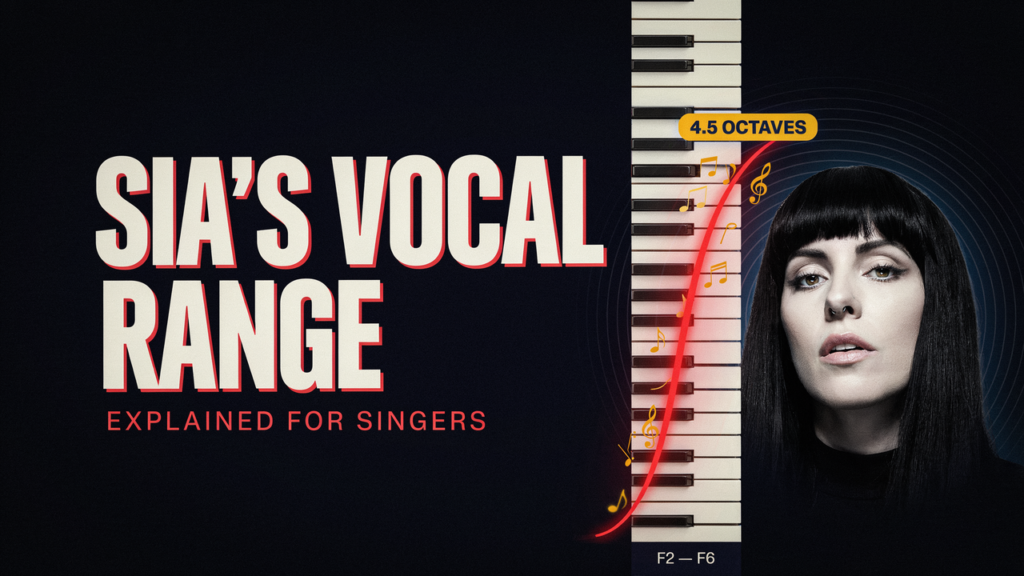
Sia’s complete career vocal range is not established by the sources reviewed here. D3–A5 is a reported estimate rather than a verified set of absolute limits. A specific published example is “Chandelier,” whose cited arrangement lists A-flat3–G-flat5.
The distinction is useful for singers: a song’s requirements can be checked directly, while a career-wide range needs evidence from multiple performances. Neither measurement tells you whether every note is equally comfortable or repeatable.
What Is the Range of “Chandelier”?
The Musicnotes Piano/Vocal/Guitar, Singer Pro edition, product MN0133326, lists A-flat3–G-flat5 in B-flat minor. This identifies the exact arrangement rather than assuming all versions have the same notes.
Its listed span is 22 semitones: one octave plus a minor seventh. G-flat5 is enharmonically equivalent to F-sharp5 on an equal-tempered keyboard. The different spelling does not make one note higher than the other.
This score documents its own requirements. It does not establish Sia’s lowest or highest career note, or identify the vocal mechanism used for every pitch.
What About the D3–A5 Estimate?
D3–A5 spans 31 semitones, or two octaves plus a perfect fifth. To verify it, an analysis would need identifiable performances for both endpoints, including timestamps and the nature of each sound.
Broader sixth-octave claims require the same evidence. A sustained lyric, backing part, slide, and brief effect should not be combined without explaining what the range includes.
A vocal range chart can help interpret the note positions, but it cannot confirm that an artist actually produced those endpoints.
Why “Chandelier” Can Be Difficult
Range width is only part of the task. Repeated high phrases, sustained vowels, rhythm, breath locations, and the approach to the chorus affect difficulty.
A singer may produce the top note easily in isolation but struggle when it follows a long phrase. Test the preceding line and the recovery afterward rather than repeating only the peak.
A score’s upper boundary also does not tell you how loudly you must sing. Begin at a comfortable intensity and learn the melody before attempting the dramatic effect of a recording.
Belt, Mix, and Rasp Are Not Instructions to Push
Listeners may describe Sia’s sound using words such as belt, mix, rasp, or vocal break. These describe heard qualities and pedagogical ideas; they do not reveal every muscular action in a commercial recording.
A rough sound does not by itself establish whether production is safe, and the absence of immediate pain is not a guarantee that a demanding effect is appropriate to repeat. Do not manufacture rasp by squeezing or shouting.
For clean upper-note coordination, use the guide to singing higher. If an easy middle-range phrase is already uncomfortable, an extreme chorus is not the next practice step.
Is Sia a Mezzo-Soprano or Soprano?
Both labels appear in discussions of her voice, but this review does not certify a classical Fach. A bright high note does not automatically establish soprano status, while a dark low phrase does not establish mezzo-soprano.
The guides to mezzo-soprano voices and soprano voices explain why sustained tessitura and repertoire matter. Pop singing and formal operatic classification are not identical systems.
Voice type should also not be inferred from how demanding another singer finds the original key. Difficulty for your voice is information about song fit, not proof of the artist’s classification.
A Practical “Chandelier” Key Check
Using the cited range, lowering the arrangement by three semitones gives F3–E-flat5. The width stays 22 semitones. The top is lower, but the bottom also moves down, so both ends need testing.
Try the verse, the repeated upper passage, and the transition between them. If a lower key fixes the chorus but makes the verse indistinct, consider a different key, a revised arrangement, or different repertoire.
Learn a small section on an easy vowel. Restore the lyrics, then the intended rhythm and accompaniment. Change one condition at a time so you can identify what causes difficulty.
Measuring Progress Without Maximum-Note Tests
Record the same short phrase under similar conditions on different days. Look for more consistent pitch, clearer words, and less unnecessary effort. A single louder take is not enough to show improvement.
The vocal tension release guide can help you recognize practice habits worth adjusting. It is not a treatment for persistent pain or hoarseness; ongoing symptoms belong with an appropriate healthcare professional.
You do not need to reproduce the exact roughness of a famous vocal to perform the song convincingly. An arrangement that fits can communicate the lyric through timing and dynamics.
Frequently Asked Questions
What is the highest note in “Chandelier”?
The cited arrangement lists G-flat5 as its upper boundary. Other editions and transpositions must be checked separately.
Does Sia have three octaves?
D3–A5 is two octaves plus seven semitones, not three complete octaves. This review does not certify that estimate as her career total.
Does a powerful high note prove chest voice?
No. Perceived strength is not sufficient evidence to identify a precise vocal mechanism.
Should I imitate the rasp first?
No. Establish comfortable, accurate melodic singing before exploring demanding effects with qualified guidance.

Harlow is a vocal analysis and singing tools writer at Voice Range Test. She focuses on vocal range testing, voice type analysis, pitch recognition, and singing education tools for singers, musicians, choir performers, and beginners.