
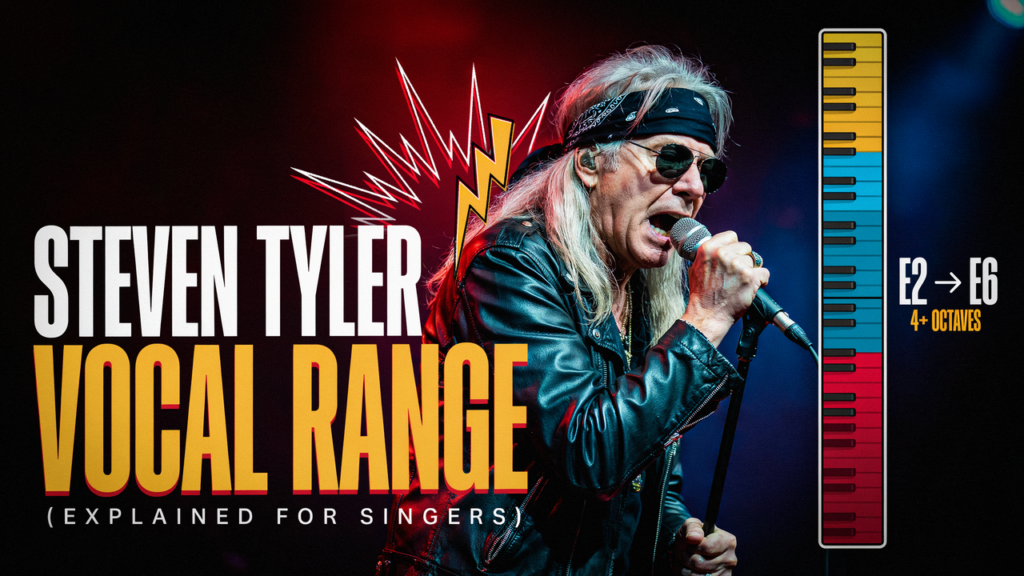
Steven Tyler’s broadly catalogued recorded vocal range is approximately D2 to E6, spanning four octaves and two semitones. That figure includes low second-octave sounds and extreme sixth-octave vocal effects, not four octaves of equally repeatable full-voice singing.
Tyler’s practical melodic range is narrower but still exceptional for a rock singer. He is generally classified as a tenor, known for strong upper-middle notes, head-dominant screams, gritty falsetto, dramatic register changes, and an unusually bright, cutting vocal tone.
What Is Steven Tyler’s Vocal Range?
The broadest commonly reported range for Steven Tyler is D2–E6. This equals 50 semitones, or four octaves and two semitones.
| Vocal-range detail | Approximate result |
|---|---|
| Broad recorded range | D2–E6 |
| Total span | Four octaves and two semitones |
| Catalogued solo-song range | C♯3–D5 |
| Common voice type | Tenor or low tenor |
| Characteristic singing area | Upper third through fifth octave |
| Signature upper production | Head-dominant, falsetto-like and distorted rock sounds |
The difference between D2–E6 and the narrower C♯3–D5 estimate comes from the recordings included and the rules used to count notes. The broader figure draws from Aerosmith’s extensive catalog and may include spoken lows, slides, backing vocals, screams, and brief extreme pitches. The narrower estimate reflects a limited selection of Tyler’s solo material.
A vocal range chart can help place D2, E5, and E6 in context.
Evidence for Steven Tyler’s Lowest and Highest Notes
Tyler’s lowest widely catalogued pitch is approximately D2, associated with “Just Push Play.” Other analyses identify second-octave sounds in songs including “Walk on Water,” “I Love Trash,” “F.I.N.E.,” and “Hoodoo/Voodoo Medicine Man.”
These lows do not all have the same musical value. Some are clearly sung, while others are spoken, slid into, placed in background layers, or produced as character effects.
His highest catalogued pitch is approximately E6, associated with “Lay It Down.” This extreme should be described as a high vocal effect or head-dominant scream rather than an ordinary chest-voice note.
| Note or area | Song or context | Vocal production | Interpretation |
|---|---|---|---|
| D2 | “Just Push Play” | Very low vocal sound | Broad-range endpoint |
| E2–G2 | Several Aerosmith recordings | Sung, spoken, sliding or layered | Context varies |
| C♯3 | “Love Is Your Name” | Clear melodic singing | Solo-song lower endpoint |
| C5–E5 | Multiple rock songs | Mix, head-dominant singing or gritty falsetto | Frequent upper extension |
| E6 | “Lay It Down” | Extreme high scream or effect | Broad-range endpoint |
This separation matters. A singer who can produce an E6 scream does not necessarily possess a comfortable E6 tessitura. Likewise, touching D2 in a spoken or sliding sound does not make D2 part of the singer’s everyday melodic range.
What Is the High Note in “Dream On”?
The famous climax of “Dream On” is commonly analyzed around E5, not E6. Individual live performances may vary, and Tyler may add slides, screams, or altered phrases, but the original song should not automatically be cited as the evidence for his career-high E6.
The final section sounds even higher because of several acoustic factors:
- A bright, narrow resonance
- Reduced vocal weight
- Strong intensity and distortion
- Repeated ascending phrases
- Sustained vowels
- Dense instrumental accompaniment
- A sharp contrast with the restrained opening
The climax is often described loosely as belting, falsetto, head voice, or screaming. In practice, it combines a lighter upper-register coordination with compression and stylistic distortion. It does not sound or function like a conventional heavy chest-voice belt.
Does Steven Tyler Really Have a Four-Octave Range?
Yes, D2–E6 mathematically covers more than four octaves, but the claim needs context.
The calculation is straightforward:
- D2 to D6 equals four octaves.
- D6 to E6 adds two semitones.
- The total is four octaves and two semitones.
However, this measurement combines different types of vocal production. Tyler’s D2 and E6 are not equivalent to the consistent pitches he uses through most Aerosmith melodies.
A useful vocal profile separates at least three measurements:
- Overall recorded range: Every attributable pitched sound, properly labelled
- Melodic range: Notes used clearly within songs
- Usable range: Notes that can be repeated with control, suitable tone, and reliable intonation
Tyler’s overall recorded span belongs in discussions of singers with the widest vocal ranges, but its endpoints should not be presented as four octaves of continuous full voice.
Is Steven Tyler a Tenor or Baritone?
Steven Tyler is best described as a tenor, sometimes more specifically as a low tenor with an unusually extensive upper register.
His dark grit and strong low notes can create a baritone-like impression. Voice type, however, is not determined by tone color or the lowest isolated pitch alone.
Tyler’s tenor qualities include:
- Frequent high chorus placement
- A bright, projecting resonance
- Repeated fourth- and fifth-octave singing
- Flexible movement into lighter registers
- Strong upper-middle intensity
- Repertoire written around a high male lead voice
He is not accurately classified as a countertenor merely because he produces sixth-octave sounds. Countertenor is a specific vocal category and performing practice, not a general label for any man who sings high.
The guide to what a tenor is explains how tessitura, register behavior, and vocal weight contribute to the classification.
How Steven Tyler Produces His High Rock Vocals
Tyler does not use one coordination for every high note. His upper singing includes different balances of modal voice, mixed coordination, head-dominant production, falsetto, and distortion.
Bright resonance
A bright, focused tone helps the voice remain audible over electric guitars and drums without relying only on greater volume. This brightness can make a pitch sound more piercing and apparently higher.
Reduced weight
As the melody rises, Tyler often allows the voice to become lighter rather than trying to carry the same lower-register weight upward. This makes fifth-octave singing more manageable.
Controlled distortion
The rasp and scream-like quality are stylistic layers added to the pitch. Distortion does not create the note by itself; the underlying coordination still needs stability.
Register flexibility
Tyler can move quickly between speech-like delivery, full singing, lighter upper notes, and screams. Those transitions contribute as much to his sound as the range endpoints.
Understanding how the vocal cords work helps explain why a clear sung note, falsetto note, distorted sound, and scream should not be treated as identical productions.
Songs That Demonstrate Different Parts of His Voice
Tyler’s range is better understood through complete performances than through one high-note compilation.
- “Dream On” demonstrates dramatic register changes and a famous upper-register climax.
- “Walk This Way” covers approximately E3–C♯5 and demands rhythmic precision.
- “Crazy” reaches approximately A3–E5, combining sustained high phrases with stylistic grit.
- “Amazing” covers approximately G3–C5 and requires controlled dynamic development.
- “Janie’s Got a Gun” demonstrates both lower phrasing and strong upper notes.
- “Love Is Your Name” shows a clearer melodic lower register in his solo work.
- “Lay It Down” is associated with the E6 extreme in broad range databases.
These songs reveal that Tyler’s difficulty comes from stamina, register changes, intensity, phrasing, and distortion—not merely the ability to touch a particular pitch.
Why His Songs Are Difficult and Risky to Imitate
Steven Tyler’s vocal effects can sound spontaneous, but forcefully copying them is risky. Shouting harder does not reproduce a coordinated rock scream.
Before attempting demanding Aerosmith material, establish the melody in a clear tone and a comfortable key. Use a gradual vocal warm-up routine before adding volume or upper-register intensity.
Stop if singing causes pain, burning, worsening tightness, sudden voice loss, or a rough speaking voice that persists after practice. A loss of normally easy notes is also a reason to rest and reassess. Persistent symptoms warrant evaluation by a qualified voice professional.
For most singers, transposing “Dream On” is more useful than forcing the original climax. The musical goal is a controlled performance—not matching Tyler’s extreme notes at any cost.
Frequently Asked Questions
What is Steven Tyler’s highest note?
E6 is his commonly catalogued highest pitch, associated with “Lay It Down.” It is an extreme scream-like or head-dominant sound rather than a conventional full-voice note.
What is Steven Tyler’s lowest note?
D2 is the broadly reported lower endpoint, associated with “Just Push Play.” Some of his second-octave sounds are spoken, sliding, layered, or effect-based.
How many octaves can Steven Tyler sing?
His broad D2–E6 recorded range spans four octaves and two semitones. His repeatable melodic range is narrower.
Is the high note in “Dream On” E6?
The famous original climax is more commonly analyzed around E5. Tyler’s career-high E6 is associated with other material, especially “Lay It Down.”
Is Steven Tyler a tenor or countertenor?
He is best classified as a tenor or low tenor with exceptional upper extension. Producing sixth-octave effects does not by itself make a singer a countertenor.
Does Steven Tyler use whistle register?
Some of his highest shrieks may sound whistle-like, but they are more cautiously described as extreme head-dominant, falsetto-like, or scream-based sounds unless true whistle-register production is clearly established.

Harlow is a vocal analysis and singing tools writer at Voice Range Test. She focuses on vocal range testing, voice type analysis, pitch recognition, and singing education tools for singers, musicians, choir performers, and beginners.