
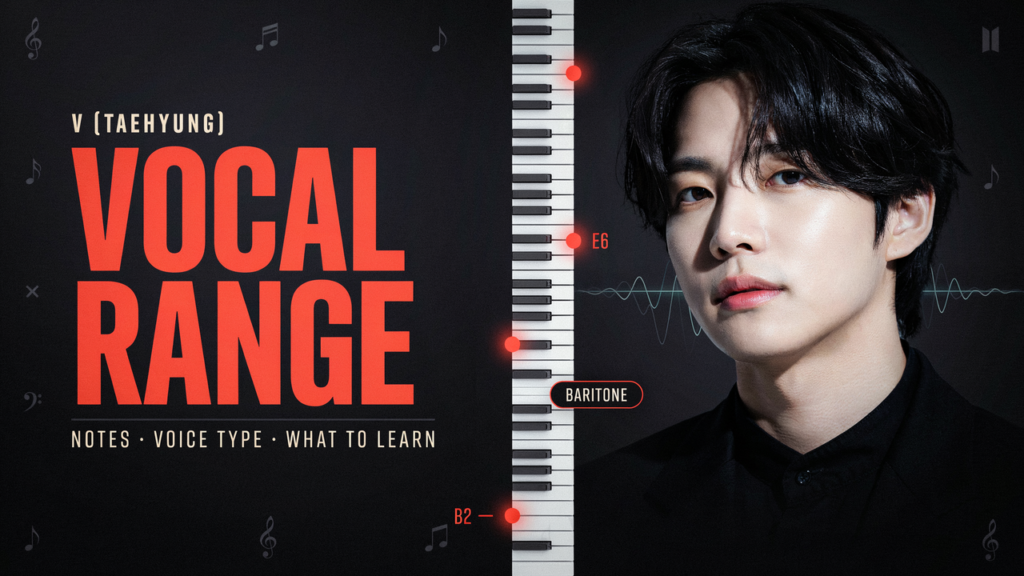
Taehyung Vocal Range (V from BTS): Notes, Voice Type, and What Singers Can Learn

Taehyung’s vocal range refers to the lowest and highest notes he can produce in real singing, across different registers like chest voice and falsetto. It’s not just about the “highest note” — it’s also about where his voice sounds strongest and most comfortable (his tessitura), and how he uses tone and style to make notes feel expressive.

If you want the fastest practical takeaway: Taehyung is known for a warm, low-leaning color, a speech-like chest voice, and smooth transitions into lighter coordination.

If you’re new to vocal range, start with this primer: vocal range notes and keep it open as you read.


What Is Taehyung’s Vocal Range?

Different sources online give different numbers, and that’s normal — because “vocal range” changes depending on:

  • live vs studio
  • supported singing vs quick, squeezed notes
  • whether falsetto counts
  • how clean the pitch is

A practical way to treat Taehyung’s range is to separate it into usable singing range vs absolute extremes.

Usable range vs extreme notes (why both matter)

A singer’s usable range is where they can sing with consistent tone, control, and repeatability. Their extreme notes are the “I can hit it once” notes — often in falsetto or in a pushed coordination.

If you want to measure this in your own voice, use a vocal range calculator so you’re not guessing.


What Voice Type Is Taehyung?

This is where the internet gets messy.

Taehyung is often described as a baritone, mainly because of his vocal color and the way his speaking and singing voice sit lower than many pop tenors. But in modern pop, “baritone vs tenor” is not always a clean label — because pop singing uses a lot of mixed voice, stylistic vowels, and mic technique.

Baritone vs tenor in pop terms

In classical voice, “baritone” is about more than low notes — it’s about tessitura, passaggi, and how the voice behaves across the middle.

In pop, you can think of it like this:

  • A “tenor-ish” singer tends to feel at home higher, with easy brightness.
  • A “baritone-ish” singer tends to feel at home lower, with more weight and warmth.

Taehyung’s voice is famous for its rounded, darker tone, which is one reason people hear him as baritone-leaning. If you want the full breakdown of those categories, read tenor vs baritone and compare it to your own voice.

Tessitura: the part that actually matters

Most singers obsess over “highest note,” but your real identity lives in tessitura — the notes you can sing comfortably and repeatedly.

Taehyung’s musical identity tends to sit in a comfortable mid-lower pocket, where he can use tone, breathy softness, and emotional phrasing without strain.

If you’ve never learned tessitura properly, you’ll get a lot of value from what is tessitura.


The 3 Big Skills Taehyung Uses (That You Can Learn)

Taehyung’s vocal “wow factor” isn’t just range. It’s how he uses the range.

1) Warm chest voice without shouting

Many singers try to sound “deep” by pushing their larynx down or over-darkening vowels. Taehyung’s low-leaning tone usually sounds like it comes from relaxed resonance, not brute force.

A good rule: if your throat feels tight, you’re not getting “depth” — you’re getting tension.

2) Light coordination (falsetto/heady tone) for color

He often uses lighter coordination to create softness and intimacy. That doesn’t require huge range — it requires control.

If you want to train that safely, build the coordination slowly with slides and gentle onset, not sudden jumps.

3) Smooth transitions instead of “gear shifts”

A lot of singers have two voices: low and high. The gap between them feels like a broken elevator.

Taehyung’s style often sounds smoother because he uses:

  • smaller vowel changes
  • less jaw tension
  • controlled breath flow

If you want to improve that skill, practice scales using a tone generator so you can stay honest about pitch.


How to Find Your Range (The Right Way)

Before you compare yourself to any singer, you need your own baseline. Comparing without data is like comparing heights while sitting down.

Step 1: Find your lowest comfortable note

Start in your speaking voice and descend slowly on “uh.”
Stop when you feel either:

  • vocal fry creeping in
  • breathy collapse
  • throat pressure

That stopping point is usually your lowest usable note.

Step 2: Find your highest comfortable note (without pushing)

Go up on “gee” or “noo” in a light, easy voice.
Stop when:

  • you feel squeezing
  • your neck tightens
  • pitch gets shaky

If you have to “fight,” it’s not your usable range.

Step 3: Check your pitch accuracy

Many singers think they “hit the note,” but they’re 30–60 cents flat or sharp.

Use a pitch detector and make sure the note is actually centered.

Step 4: Mark your tessitura (the money zone)

Sing a simple melody in different keys and notice where you feel:

  • most control
  • best tone
  • least fatigue

That zone matters more than extremes.


Use the vocal range calculator to find your lowest and highest comfortable notes.

A Practical Range Table (So You Don’t Misread the Numbers)

A lot of confusion comes from mixing registers. This table keeps it clear.

Range TypeWhat It MeansWhat It’s Good For
Lowest usable noteLow note with stable toneSong key choices, comfort
Lowest extremeFry/breathy low noteFun trivia, not reliable
Highest usable noteHigh note without strainReal singing range
Highest extremeFalsetto/strained highBragging rights, risky
TessituraWhere you live musicallyVoice type + stamina

If you want a reference for typical male ranges, compare yours to male vocal ranges.


How to Train Toward Taehyung-Style Range

This is the part most people get wrong: they chase notes instead of coordination.

What you should train first

You want three things:

  • consistent breath flow
  • stable vowel shapes
  • smooth register blending

Then the notes expand naturally.

The best exercise for Taehyung-style smoothness

Exercise: Sirens on “ng” (as in “sing”)

  1. Start on a comfortable mid note
  2. Slide up gently, then back down
  3. Keep volume medium-soft
  4. Keep jaw loose

This trains connection without forcing.

The best exercise for warm lows (without pressing)

Exercise: Spoken-to-sung “uh-huh”
Say “uh-huh” like you’re agreeing with a friend.
Then sustain the second syllable on a note.

This keeps the larynx neutral and stops you from manufacturing depth.

One bullet list: signs you’re training correctly

  • Your throat feels the same before and after
  • Notes get easier over weeks, not minutes
  • You can repeat the note 5–10 times without fatigue
  • Your tone stays stable even when quiet
  • You don’t need to “psych yourself up” to sing high

Quick Self-Check (2 Minutes)

This is a fast way to see whether you’re chasing the wrong thing.

Self-check test

Do this once, then stop.

  1. Sing a comfortable 5-note scale up and down
  2. Repeat it 1 semitone higher
  3. Continue until you feel strain or instability
  4. Write down the last comfortable top note

Now answer these questions honestly:

  • Did the tone change suddenly (like a switch)?
  • Did you get louder as you went higher?
  • Did your neck tighten?
  • Did you lose pitch accuracy?

If “yes” to any of these, your limit is coordination, not talent.

If you want to drill accuracy specifically, the pitch accuracy test is the fastest reality check.


Common Mistakes (That Ruin Range Progress)

Mistake 1: Counting falsetto as “my range” without context

Falsetto is real singing, but it’s not the same as chest/mix.
If you claim a range that’s mostly falsetto, you’ll choose song keys that don’t match your real voice.

Mistake 2: Forcing lows by depressing the larynx

This creates a fake “deep” sound and often causes:

  • muffled tone
  • tongue tension
  • loss of pitch clarity

Taehyung’s lows sound warm, not swallowed.

Mistake 3: Forcing highs by pushing volume

If you have to get loud to go high, you’re likely over-driving the folds.
That’s how singers build strain instead of range.

Mistake 4: Comparing your voice type to a celebrity too literally

Taehyung’s recordings are produced, mixed, and stylized.
Your job is not to copy his anatomy — it’s to learn coordination principles.

Mistake 5: Training range while ignoring posture and breath

If your ribs collapse and your neck juts forward, you’ll hit a ceiling fast.

If posture is a weak spot, study best posture for singing and apply it during every scale.


Realistic Expectations (And Vocal Health Notes)

Range expands, but it expands like flexibility: slowly, with consistency.

Most singers can gain:

  • a few reliable low notes
  • several reliable high notes
  • better stamina in the middle

…over months, not days.

If you ever feel:

  • sharp pain
  • burning
  • sudden hoarseness
  • loss of voice

Stop immediately and rest. “No pain, no gain” is not a vocal rule — it’s a shortcut to injury.


What Taehyung’s Range Teaches You (Even If Your Voice Is Different)

You don’t need Taehyung’s exact note limits to learn from him.

You can learn:

  • how to use tone as a stylistic tool
  • how to sing softly without losing pitch
  • how to keep the voice warm without pressing
  • how to transition smoothly between registers

And if you want to expand your usable notes long-term, follow a structured plan like how to extend vocal range rather than random “hit high notes” drills.


FAQs

1) What is Taehyung’s vocal range in notes?

Different analyses list different note limits depending on whether falsetto is included and whether the note is clean and repeatable. The best way to think about it is in two layers: his usable singing range and his extreme notes. Focus on what he can sing consistently, not one-off peaks.

2) Is Taehyung a baritone or a tenor?

He’s commonly described as baritone-leaning because of his vocal color and where his voice sits comfortably. In pop music, those labels are less strict than classical voice, and many singers sit between categories. Tessitura and comfort matter more than a single label.

3) What is Taehyung’s highest note?

People often cite his highest moments in lighter coordination (falsetto/heady tones) rather than full chest voice. A high note is only truly meaningful if it’s stable, in tune, and repeatable. If it sounds squeezed or shouty, it’s not a safe benchmark.

4) What is Taehyung’s lowest note?

His low notes are part of what makes his tone distinctive, but low-note claims online often include vocal fry. A usable low note should still have pitch clarity and control. If it collapses into fry, treat it as an extreme, not your baseline.

5) Does Taehyung use falsetto?

Yes — he uses lighter coordination for softness and color, which is common in modern pop. Falsetto isn’t “cheating,” but it’s a different mechanism than chest voice. Training it gently can improve flexibility and control.

6) Can I learn to sing like Taehyung if my voice is higher?

You can learn many stylistic elements even if your natural voice sits higher. Focus on tone choices, phrasing, breath control, and smooth transitions rather than trying to force your voice lower. Copying timbre too literally usually creates tension.

7) How can I safely expand my range toward his style?

Train coordination, not force. Use gentle slides, controlled scales, and consistent daily practice, and stop if you feel strain or hoarseness. Over time, your usable range grows — and your tone becomes more flexible without injury.

Scroll to Top