
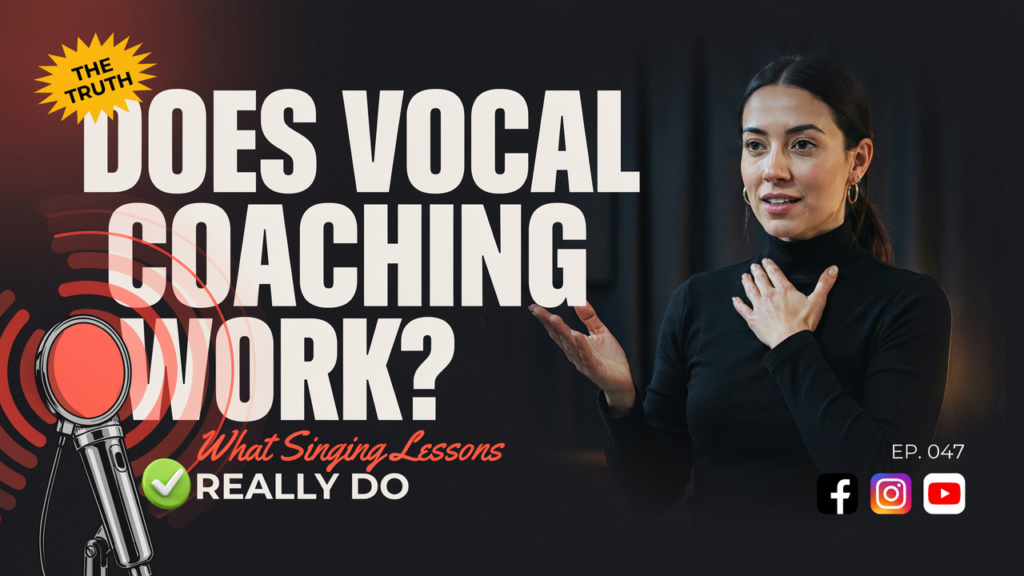
Yes, vocal coaching can work when the instruction matches your goal, the coach gives useful feedback, and you practice consistently between lessons. A good coach can hear habits you may not notice, choose exercises for your specific voice, and help you apply those changes to real songs.
Coaching does not guarantee fame, a specific vocal range, a celebrity tone, or instant results. It works best as a feedback system: sing, observe, adjust, practice, and repeat until the improvement becomes reliable.
What Vocal Coaching Can Improve
Vocal coaching can help with the parts of singing that are hard to diagnose alone. You may feel that a note is “too high,” while a coach hears that the vowel is too wide, the volume is too heavy, the breath is late, or the song key is poorly chosen.
- Pitch accuracy and ear training
- Breath coordination
- Register transitions
- Vocal control and consistency
- Tone, resonance, and vowel shaping
- Range accessibility
- Song interpretation and phrasing
- Performance confidence
- Microphone technique
- Audition or recording preparation
If your main issue is breath management, start with breath support for singers. If the voice changes unpredictably from phrase to phrase, vocal control techniques may be the more useful focus.
What Vocal Coaching Cannot Guarantee
A vocal coach cannot replace your anatomy with someone else’s. Training can improve coordination, efficiency, musicianship, and confidence, but it cannot promise that you will sound exactly like a favorite singer.
Be cautious of anyone who guarantees:
- A fixed number of new notes in a fixed time
- Professional-level singing for every student
- Permanent progress without practice
- Industry success or audition wins
- Safe results while singing through pain
- Treatment for an undiagnosed voice injury
Range is especially easy to overpromise. Coaching may help you access more usable notes, but a reliable phrase is more valuable than one strained extreme.
Vocal Coach, Voice Teacher, and Voice Therapist
| Role | Typical focus | Use when |
|---|---|---|
| Voice teacher | Singing technique and long-term development | You want to build the instrument |
| Vocal coach | Songs, style, interpretation, auditions, performance | You want to prepare material |
| Singing voice specialist | Technique with deeper voice-health knowledge | Your demands are high or complex |
| Speech-language pathologist | Clinical voice rehabilitation within scope | You have a diagnosed voice issue |
| ENT or laryngologist | Medical examination and diagnosis | You have pain, hoarseness, or voice loss |
Titles are not always used consistently. Ask what the instructor actually does, how they assess students, and when they refer singers to medical professionals.
What Happens in a Lesson?
A first lesson usually includes questions about your experience, goals, style, practice habits, and current problems. The coach may ask you to sing scales, simple patterns, and part of a song.
A useful lesson normally includes:
- A short warm-up
- One or two targeted exercises
- Real-time adjustments to vowel, airflow, resonance, or intensity
- Application to a song phrase
- A brief explanation of what changed
- A focused practice plan for the week
You should leave knowing what to practice and what warning signs mean you are doing the exercise incorrectly.
How Long Does Vocal Coaching Take to Work?
Some singers notice a change in the first lesson. That does not mean the skill is fully developed. A lesson can reveal a better coordination quickly, but the singer still has to make it repeatable across songs, keys, volumes, and emotional situations.
Early results might include less throat effort, clearer pitch, easier breathing, or a better key choice. Longer-term results may include stronger stamina, smoother register transitions, wider usable range, better tone consistency, and more expressive singing.
Weekly lessons are common for beginners because they give enough time to practice while keeping feedback regular. Advanced singers may schedule coaching around auditions, tours, recording sessions, or specific technical problems.
Online vs In-Person Vocal Coaching
Online coaching can work well for technique, repertoire, practice planning, and performance feedback. It gives you access to more teachers and makes scheduling easier.
Its limits include latency, compressed audio, microphone quality, and reduced physical observation. In-person lessons give the coach a more natural acoustic impression of your voice and make accompaniment easier.
The better choice depends on teacher quality. A strong online teacher is usually better than a local teacher who does not understand your goals.
How to Choose a Good Vocal Coach
Before booking, define your goal. A beginner, musical-theatre singer, worship vocalist, rock singer, and classical student may need different expertise.
Ask these questions:
- Which styles and levels do you teach most often?
- How do you assess a new student?
- How do you choose exercises?
- How will we measure progress?
- What should I practice between lessons?
- What do you do if singing causes discomfort?
- When would you refer a student to an ENT or voice clinician?
A good coach should explain ideas clearly. They do not need to use complex terminology, but they should be able to connect an exercise to a real vocal purpose.
Red Flags
- They tell you to sing through pain.
- They promise a guaranteed range increase.
- They use one method for every student.
- They mock or shame your voice.
- They dismiss persistent hoarseness.
- They cannot explain why you are doing an exercise.
- They force your voice toward their sound.
- They diagnose injuries without proper clinical qualifications.
The NIDCD advises taking ongoing voice problems seriously and seeking appropriate help when symptoms persist in its voice-care guidance. Coaching is education, not medical diagnosis.
A Simple Four-Week Trial
If you are unsure whether coaching is worth it, test it for four weeks.
| Week | Focus | Evidence to track |
|---|---|---|
| 1 | Baseline and goals | Record one song and identify two problems |
| 2 | One technical priority | Write down the exercise and what it changes |
| 3 | Apply to repertoire | Record the target phrase again |
| 4 | Review progress | Compare ease, pitch, tone, and consistency |
You can also document starting notes with the voice type test and vocal range calculator. These tools do not replace a teacher, but they help you track change over time.
When You Need Clinical Voice Care
Choose medical or clinical help before ordinary coaching if you have persistent hoarseness, pain while singing, sudden voice loss, trouble breathing or swallowing, repeated loss of easy notes, or severe fatigue after normal voice use.
A coach can adjust training, but they should not claim to diagnose your vocal folds by listening. After proper assessment, singing lessons and clinical care may work together when appropriate.
Is Vocal Coaching Worth It?
Vocal coaching is worth it when personalized feedback helps you solve problems you cannot identify alone. It is most valuable when the coach understands your style, gives clear assignments, adapts to your response, and measures progress through repeatable singing rather than vague encouragement.
If you want to improve between lessons, combine coaching with steady practice. Use effective singing practice, a sensible warm-up, and recordings that let you hear whether the change is sticking.
Frequently Asked Questions
Does vocal coaching really work?
Yes, it can work when the coach gives accurate feedback and the student practices consistently. It is not an instant fix.
Can a vocal coach make anyone sing well?
Many people can improve, but the level and speed of improvement vary. No coach can guarantee a professional result for every singer.
How often should I take lessons?
Weekly lessons are a common starting point. Some singers use less frequent coaching once they know what to practice.
Can online vocal coaching work?
Yes. Online lessons can work well, though latency and audio quality can make some details harder to judge.
Will coaching increase my vocal range?
It may help you access more usable notes, but range growth should be gradual and comfortable, not forced.

Harlow is a vocal analysis and singing tools writer at Voice Range Test. She focuses on vocal range testing, voice type analysis, pitch recognition, and singing education tools for singers, musicians, choir performers, and beginners.