
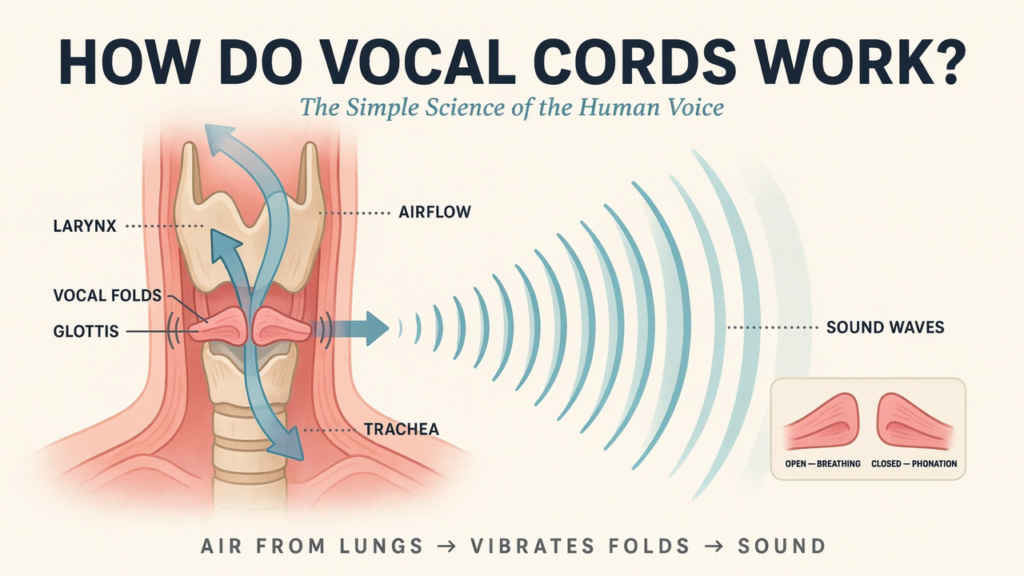
Vocal cords work by coming close together inside the larynx and interacting with air flowing upward from the lungs. That airflow sets the flexible tissue into rapid, repeating vibration, producing the sound source used for speech and singing.
The raw sound created at the larynx is not yet a finished voice. The throat, mouth, tongue, lips, soft palate, and other parts of the vocal tract shape it into recognizable vowels, consonants, and individual vocal tone.
“Vocal folds” is the more anatomically accurate term because these structures are layered folds of living tissue—not strings that are plucked like guitar cords.
Where Are the Vocal Folds?
The vocal folds sit inside the larynx, commonly called the voice box. The larynx is positioned at the top of the trachea, or windpipe.
There are two vocal folds: one on the right and one on the left. Each extends from the front toward the back of the larynx and connects to muscles and movable cartilages that help position it.
The opening between the folds is called the glottis. Its size and shape change according to what you are doing.
When you breathe quietly, the folds remain separated so air can pass through. When you speak or sing, laryngeal muscles bring them toward the center. During swallowing, several protective actions work together to help keep food and liquid out of the airway.
The vocal folds also contribute to coughing and other actions that require controlling pressure or protecting the respiratory tract.
What Are Vocal Folds Made Of?
Each vocal fold contains multiple layers with different mechanical properties. A simplified description includes:
- A thin outer covering called the epithelium
- A flexible middle region called the lamina propria
- A deeper muscular layer containing the vocalis muscle
These layers do not move as a single rigid block. The pliable surface can ripple over deeper tissue, producing what voice specialists call the mucosal wave.
Healthy vibration depends on the tissue remaining flexible enough to oscillate. Swelling, dryness, irritation, lesions, scarring, muscle coordination, and neurological problems can change how the folds meet and move.
How Vocal-Fold Vibration Produces Sound
The vocal folds do not need to be opened and closed by a separate nerve signal for every vibration. Their rapid oscillation results from an interaction among muscular positioning, tissue elasticity, air pressure, airflow, and the changing shape of the glottis.
The basic process works like this:
- Laryngeal muscles bring the vocal folds toward the midline.
- Exhaled air creates pressure beneath them.
- When the pressure and airflow are sufficient, the lower edges begin to separate.
- The opening travels through the flexible tissue rather than occurring everywhere at exactly the same time.
- Elastic recoil and aerodynamic forces help the folds return toward the midline.
- The cycle repeats as long as the conditions support vibration.
This is called self-sustained oscillation. The folds interrupt the outgoing airflow in rapid pulses, creating a complex acoustic signal.
A note at 220 hertz has a fundamental vibration rate of approximately 220 cycles per second. The signal also contains harmonics above that fundamental frequency. The vocal tract then filters this harmonic-rich source to create the tone listeners recognize.
The Six Stages of Voice Production
Voice production can be understood as a connected six-stage process.
1. The Brain Plans the Sound
The nervous system coordinates breathing, laryngeal movement, resonance, articulation, timing, and expression. Voice therefore begins with neurological planning—not simply air entering the throat.
2. The Lungs Supply Air
The respiratory system creates the outgoing airflow used for ordinary voiced speech and singing. The diaphragm, rib cage, abdominal wall, and other respiratory structures coordinate pressure and airflow.
Efficient voice use does not require pushing as much air as possible. Excessive airflow can make coordination harder. The guide to breath support for singers explains how airflow and pressure relate to sustained singing.
3. The Larynx Positions the Folds
Intrinsic laryngeal muscles adjust whether the folds are apart, close together, shortened, lengthened, thickened, or thinned. These adjustments influence when oscillation begins and how the resulting sound behaves.
4. The Folds Vibrate
Airflow and tissue properties create repeated opening and closing patterns. This vibration converts aerodynamic energy from the respiratory system into acoustic energy.
The folds do not function like two hard doors slamming together. Their layered tissue creates a fluid, wave-like movement.
5. The Vocal Tract Filters the Sound
Sound travels through the throat and mouth. These spaces resonate differently according to their changing shape.
Movements of the tongue, jaw, lips, soft palate, and larynx alter the resonant frequencies of the vocal tract. These resonances, called formants, help distinguish one vowel from another and strongly influence vocal tone.
6. Articulation Creates Speech or Lyrics
The tongue, lips, teeth, jaw, and palate shape the resonated sound into consonants, vowels, words, and lyrics. Clear singing therefore depends on coordination across the entire vocal system, not just the vocal folds.
How the Voice Changes Pitch
Pitch is closely related to how quickly the vocal folds repeat their vibratory cycles. Faster vibration produces a higher fundamental frequency, while slower vibration produces a lower one.
The body changes vibration rate by adjusting several interacting properties:
- Vocal-fold length
- Tissue tension and stiffness
- Effective vibrating mass
- Muscular activation
- Air pressure and airflow
- Register and vibratory pattern
Higher pitches commonly involve longer, thinner, and stiffer vocal-fold configurations with less tissue mass participating in the vibration. Lower pitches generally involve a thicker configuration and greater effective vibrating mass.
This is more complex than simply “tightening the cords” for high notes. Healthy pitch changes require coordinated adjustments throughout the larynx and vocal tract.
Individual anatomy, development, hormones, training, and vocal coordination contribute to differences in human vocal range.
How Loudness Changes
Loudness depends partly on the size and speed of the pressure fluctuations produced by the vocal source. Greater respiratory pressure and stronger vocal-fold interaction can increase acoustic intensity, but loud singing is not created safely by squeezing the throat or forcing air.
The amount of closure matters. If the folds do not come together efficiently, more air may escape and the sound may become breathy. If closure is excessively forceful, the sound can feel pressed and the tissues may experience unnecessary collision stress.
The vocal tract can also increase perceived power by shaping resonance efficiently. This is one reason a trained singer may sound loud without using the same degree of brute force as an untrained singer.
How Vocal Tone Is Created
The folds produce the initial buzzing sound, but vocal tone results from the complete system.
A useful model separates the voice into:
- Source: the acoustic signal generated by vocal-fold vibration
- Filter: the resonant vocal tract that shapes the signal
Changes at the source influence breathiness, firmness, register, and harmonic content. Changes in the filter affect vowels, brightness, warmth, clarity, and projection.
Two singers can produce the same fundamental frequency while sounding completely different because their vocal-fold behavior, vocal-tract shape, anatomy, and artistic choices differ.
Vibrato provides another example of coordinated voice behavior. It involves regular variation around a central pitch rather than the folds merely “shaking.” The guide to vibrato in singing explores its practical development.
What Vocal Folds Do During Different Activities
| Activity | General Vocal-Fold Behavior | Main Function |
|---|---|---|
| Quiet breathing | Open and separated | Allows airflow |
| Speaking | Positioned for vibration | Produces voiced speech sounds |
| Singing | Precisely adjusted for pitch, intensity, and tone | Produces sustained musical sound |
| Whispering | Narrowed configuration, usually without regular voiced vibration | Creates turbulent airflow |
| Swallowing | Closes as part of a broader protective sequence | Helps protect the airway |
| Coughing | Closes to build pressure, then releases | Helps clear the airway |
These descriptions are simplified. Actual laryngeal behavior changes across sounds, registers, vocal qualities, and individuals.
Whispering, for example, still involves the larynx even though ordinary whispering usually lacks regular vocal-fold vibration. The detailed guide on whether whispering uses the vocal cords explains this distinction.
How Singing Differs From Speaking
Speaking and singing use the same vocal system, but singing usually demands greater control over pitch, duration, loudness, and resonance.
Speech pitch changes continuously according to language and expression. Singing often requires the folds to sustain a specific vibration rate for a defined note and then shift accurately to another.
Singers must also coordinate vowels across a wider pitch range. The vocal tract shape that works comfortably for a spoken vowel may need subtle modification at a high pitch. This does not mean changing the word beyond recognition; it means balancing articulation with the acoustic demands of singing.
Different registers—including chest-dominant, head-dominant, falsetto, and other coordinations—use different patterns of vocal-fold vibration and resonance. At very high pitches, the behavior becomes especially specialized, as discussed in the guide to whistle voice.
Basic Care for the Vocal Folds
Vocal folds are living tissues, so their condition can change with illness, irritation, dehydration, sleep, environmental exposure, medication, and voice use.
Helpful habits include:
- Drinking adequate water throughout the day
- Avoiding prolonged yelling or speaking over loud noise
- Using amplification when appropriate
- Taking breaks during heavy voice use
- Avoiding smoking and secondhand smoke
- Managing reflux or allergy concerns with qualified medical guidance
- Warming up gradually before demanding singing
- Avoiding repeated throat clearing when possible
- Stopping when singing causes pain
A vocal warm-up generator can help structure gradual preparation, but exercises should remain comfortable and appropriate for your current condition.
Drinking water supports overall hydration, but liquid does not directly wash over the vocal folds. During safe swallowing, it is directed toward the esophagus rather than down the airway.
When to Seek Professional Evaluation
Temporary voice changes can occur with respiratory illness or unusual voice use. Persistent or concerning symptoms require professional attention rather than online self-diagnosis.
Consult an appropriate healthcare professional if hoarseness lasts longer than three weeks, particularly without a cold or flu. Seek prompt assessment for breathing difficulty, coughing blood, swallowing difficulty, a neck lump, pain when speaking or swallowing, or complete voice loss lasting more than a few days.
Singers and other professional voice users may benefit from evaluation by an ear, nose, and throat physician—ideally a laryngologist—and a voice-specialized speech-language pathologist.
Frequently Asked Questions
Do vocal cords actually touch when you speak?
During many voiced sounds, the vocal folds come together or nearly together as part of their vibratory cycle. The exact closure pattern varies with pitch, loudness, register, and vocal quality.
Do vocal cords open and close when you breathe?
They remain open during ordinary breathing, widening more during deeper or faster inhalation. They move toward the midline for many types of voice production.
How fast do vocal cords vibrate?
Their vibration rate depends on pitch. A fundamental frequency of 200 hertz represents approximately 200 cycles per second.
Are vocal cords muscles?
They contain muscle, but they are not made only of muscle. They include a surface covering and layered connective tissues that support flexible vibration.
Does sound come only from the vocal cords?
The vocal folds generate the primary sound source. The throat, mouth, tongue, lips, soft palate, and other structures filter and articulate that sound into a recognizable voice.
Can damaged vocal cords heal?
Some irritation and inflammation can resolve, but recovery depends on the cause and severity. Persistent symptoms should be evaluated rather than treated through guesswork or forced exercises.

Harlow is a vocal analysis and singing tools writer at Voice Range Test. She focuses on vocal range testing, voice type analysis, pitch recognition, and singing education tools for singers, musicians, choir performers, and beginners.