
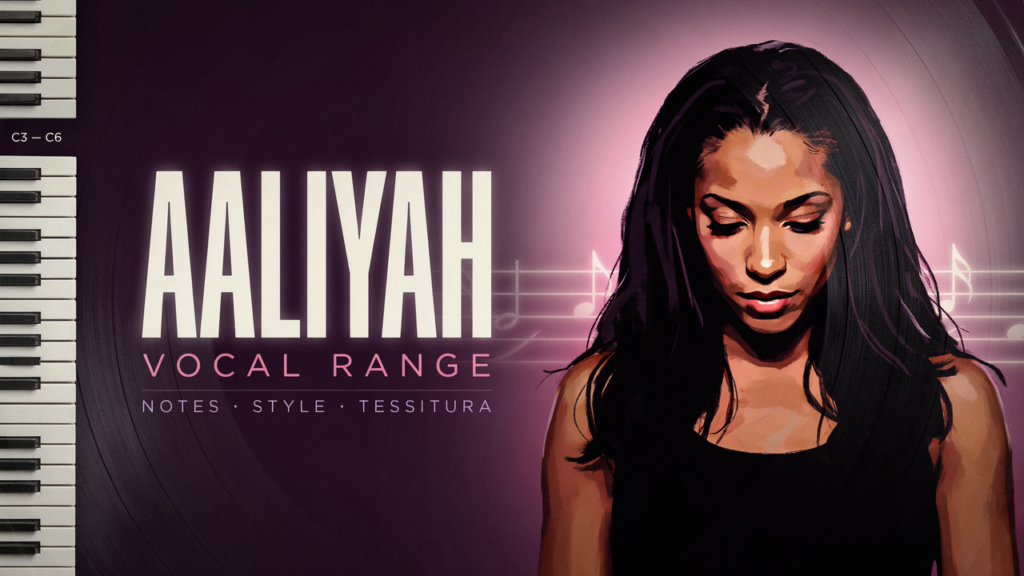
Aaliyah’s vocal range is commonly described as sitting around a mezzo-soprano/contralto-leaning range, with comfortable notes from roughly A3 to E5, and occasional extensions higher in studio recordings. Her impact did not come from extreme range, but from tone, control, rhythmic phrasing, and minimalist delivery.
Note on the keyword: The phrase “vocal rangaaliyah e” appears to be a misspelling or merged query. In search behavior, this intent aligns with “Aaliyah vocal range.” This article addresses that intent directly and accurately.
Who was Aaliyah (and why her vocal range matters)
Aaliyah Dana Haughton (1979–2001) was an American singer whose influence reshaped modern R&B and pop. Her voice became a template for soft, controlled, rhythm-driven vocals that prioritize feel over power.
Because many singers equate success with wide ranges or belting, Aaliyah is often studied for a different reason: how much she achieved with restraint.
Aaliyah’s vocal range (technical overview)
There is no officially published, lab-verified range for Aaliyah, but analysis of recorded material and live performances points to a moderate, controlled range.
Commonly cited working range
- Lower notes: around A3
- Upper comfortable notes: around E5
- Occasional higher tones: up to G5 in layered studio vocals
These figures should be understood as:
- Approximate
- Context-dependent
- Based on recorded usage, not theoretical extremes
Aaliyah did not sing at the edges of her range often—by choice.
Tessitura: where Aaliyah actually lived vocally
Range tells you what notes are possible. Tessitura tells you where a singer chooses to live.
Aaliyah’s tessitura sat mostly in the:
- Lower to mid female register
- Smooth, speech-like zone
- Comfortable, repeatable pitch area
This is why her vocals sound:
- Effortless
- Intimate
- Consistent across songs and performances
She rarely pushed upward for drama—and that restraint became part of her signature.
Voice type: soprano, mezzo, or contralto?
You’ll see Aaliyah labeled in different ways online. The most accurate description is:
- Mezzo-soprano leaning contralto in color
- Not a true classical contralto
- Not a high, bright soprano
Her voice had:
- A darker, smoky timbre
- Soft edges rather than brilliance
- Strong midrange presence
This tonal quality mattered more than the exact label.
Why Aaliyah didn’t need a big vocal range
Aaliyah’s music was built around:
- Subtle melodies
- Syncopated rhythms
- Atmospheric production
- Emotional understatement
In that context, a wide range or loud belting would have worked against the aesthetic.
Instead, she relied on:
- Micro-phrasing (small rhythmic shifts)
- Breathy control without strain
- Pitch precision
- Tone consistency
This is why her vocals still sound modern decades later.
Studio technique vs raw range
Another reason Aaliyah’s range is often misunderstood is her studio approach.
She frequently used:
- Layered harmonies
- Doubled lead vocals
- Soft background stacks
- Call-and-response textures
These techniques create the impression of a wider or more complex range without requiring extreme notes from the lead line.
It was a production-voice partnership, not vocal gymnastics.
Comparing Aaliyah to other R&B singers (carefully)
Aaliyah is often compared to singers with:
- Larger ranges
- Stronger belts
- More melismatic styles
But range size does not equal:
- Musical impact
- Emotional resonance
- Longevity
Aaliyah’s influence can be heard in artists who favor:
- Minimalism
- Lower tessituras
- Conversational delivery
Her legacy is about control and taste, not scale.
Common myths about Aaliyah’s vocal range
- “She had a small or weak voice”
- “She couldn’t sing high”
- “Her vocals were studio-dependent”
In reality:
- She chose not to oversing
- She worked within her most expressive range
- Her consistency was a strength, not a limitation
What singers can learn from Aaliyah
Aaliyah is often cited in vocal pedagogy discussions for one key lesson:
Your artistic ceiling is not determined by how high you sing.
Practical takeaways:
- Develop your comfortable range first
- Prioritize tone and control
- Let production and arrangement support you
- Choose notes that serve the song
Many singers with moderate ranges achieve more longevity than those who constantly push extremes.
Frequently asked questions
What was Aaliyah’s vocal range?
Approximately A3 to E5 as a comfortable working range, with occasional higher notes in studio contexts.
Was Aaliyah a soprano?
Not typically. She is more accurately described as a mezzo-soprano with a darker tonal color.
Did Aaliyah belt?
Rarely. Her style favored smooth, controlled delivery over belting.
Why did her voice sound so unique?
Because of her tone, phrasing, rhythmic precision, and minimalistic approach—not range size.
Is vocal range essential for success?
Aaliyah’s career is strong evidence that it is not.
- Her relaxed, smooth delivery is easier to understand when learning how tessitura influences vocal comfort.
- Range discussions benefit from context around whether a two-octave vocal span is considered typical.
- Voice type comparisons become clearer when reviewing differences between alto and mezzo-soprano voices.
- Subtle control and tone production are easier to grasp after understanding how the vocal cords work during singing.
- Listeners comparing modern R&B styles often explore another contemporary female vocal range profile.
- Studio-focused vocal consistency is supported by fundamentals like proper posture techniques for singing.
- Broader classification questions are easier to answer after reviewing how the vocal fach system categorizes voices.

Harlow is a vocal analysis and singing tools writer at Voice Range Test. She focuses on vocal range testing, voice type analysis, pitch recognition, and singing education tools for singers, musicians, choir performers, and beginners.