
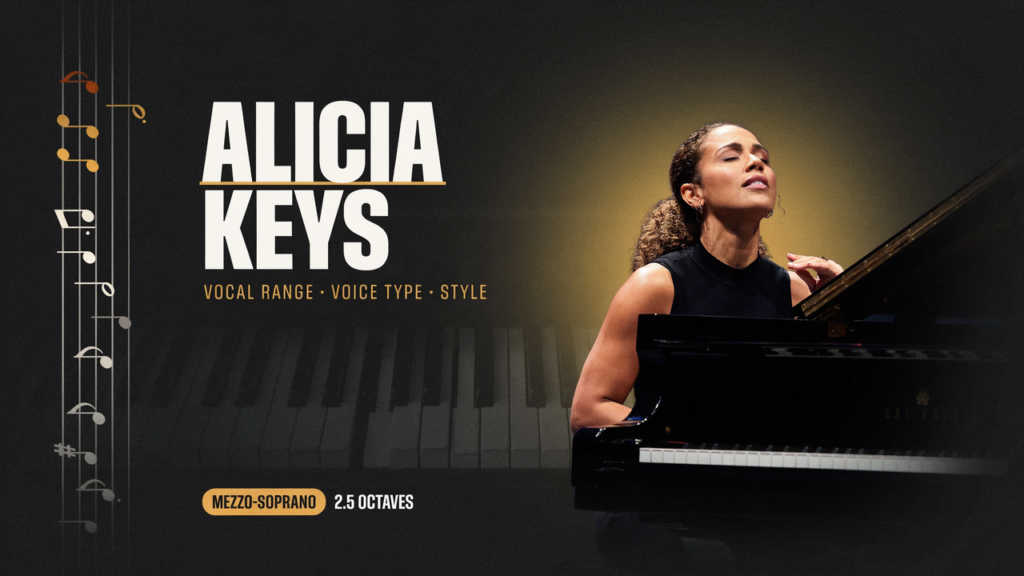
Alicia Keys’ vocal range is commonly estimated at approximately C3 to E6, spanning about three octaves and a major third. Some vocal analyses extend her lower limit to B♭2 or A2, while more conservative assessments place her highest consistently documented note around B5 or C6.
These differences arise because vocal-range estimates may count different recordings, live improvisations, background layers, and lightly produced head-voice notes. A practical description is that Keys has a wide mezzo-soprano range with a rich lower register, a chest-dominant middle, strong belts, and an expressive upper extension.
Alicia Keys’ Vocal Range at a Glance
| Vocal characteristic | Approximate description |
|---|---|
| Commonly cited full range | C3–E6 |
| Wider claimed range | A2/B♭2–E6 |
| Approximate span | More than three octaves |
| Practical singing range | Roughly D3–E5 |
| Voice type | Mezzo-soprano |
| Lower-register quality | Dark, warm, and smoky |
| Upper-register quality | Bright, intense, and sometimes raspy |
| Signature strengths | Chest voice, soulful phrasing, dynamics, and rhythmic delivery |
The C3–E6 estimate should not be interpreted as a promise that every note within that span carries equal strength. Keys spends considerably more time in her lower-middle and middle registers than at either extreme.
Her practical tessitura—the area where she can sustain phrases most naturally—is more important to her recognizable sound than an isolated low or high note.
What Is Alicia Keys’ Lowest Note?
Alicia Keys’ lowest clearly usable notes generally appear around C3, although some listener-produced analyses identify occasional notes as low as B♭2 or A2.
Her lower register is especially noticeable in restrained verses and intimate piano-led performances. Songs such as “The Life” demonstrate how comfortably she can work near the bottom of her recorded range without losing the dark color that defines her voice.
The lowest claimed pitches should be treated cautiously. A brief low sound may be affected by vocal fry, layering, studio processing, or pitch interpretation. C3 is therefore a more defensible lower boundary for a conservative range estimate, while B♭2 and A2 represent possible extended notes rather than the center of her voice.
Keys’ low notes are not merely there to expand a statistic. They give her ballads warmth and conversational intimacy. This lower-middle richness also explains why listeners sometimes assume that she is a contralto.
For comparison, Aaliyah’s vocal range reflects a lighter and more delicate approach to R&B phrasing, despite some overlap in pitch.
What Is Alicia Keys’ Highest Note?
The highest note associated with Alicia Keys is frequently listed as E6, with “Why Do I Feel So Sad” often cited as an example. However, this represents an upper extension rather than the register she uses most frequently.
Depending on the recording and the criteria used, some analyses set her more conservative upper limit at B5 or C6. These pitches are generally produced with head voice or a lighter coordination, not with the heavy chest-dominant quality heard in her biggest choruses.
Her most recognizable high singing usually occurs lower, around the fourth and fifth octaves. In that area, she combines chest resonance with a strong mixed coordination to produce urgent, emotionally charged climaxes.
This distinction matters: an E6 head-voice note and an E5 belt are different vocal events. The lower pitch may sound more powerful and be substantially more demanding because of the vocal weight carried into it.
Listeners interested in a more explosive belt-centered instrument can compare Keys with Jennifer Hudson’s vocal range.
Is Alicia Keys a Mezzo-Soprano or Contralto?
Alicia Keys is most accurately described as a mezzo-soprano with contralto-like warmth.
Her dark tone, comfortable lower-middle register, and weighty chest voice can create the impression of a contralto. However, vocal classification depends on more than the lowest available note. It also considers tessitura, timbre, vocal weight, register transitions, and where the singer can perform consistently.
Keys regularly carries melodies through the middle and upper-middle parts of the female voice. She can also access upper notes that extend beyond a typical low female tessitura. These characteristics make mezzo-soprano the more practical classification.
“Alto” may still describe the part she could sing in a choir, but alto is a choral role rather than a precise solo voice type. Our guide to what a mezzo-soprano is explains why singers with similar note spans can receive different classifications.
How Alicia Keys Uses Her Vocal Registers
Keys’ vocal identity comes from the way she moves between registers, not simply from the distance between her lowest and highest notes.
Her lower register has a smoky, grounded quality. She frequently uses it for quieter verses, allowing the lyric to sound personal and speech-like. The tone remains recognizable even when the volume is restrained.
Her middle register is the core of her voice. It is full, rhythmically direct, and closely connected to her speaking tone. This is where her gospel, soul, blues, and contemporary R&B influences are most apparent.
As melodies rise, Keys often uses a chest-led mix. The sound can become brassy, raspy, or deliberately urgent. She does not always pursue a perfectly smooth classical tone; controlled roughness and tonal contrast are important parts of her expression.
Her head voice is lighter and used more selectively. It provides contrast above her heavier middle register and accounts for some of the highest pitches included in full-range estimates.
A useful stylistic comparison is Brandy’s vocal range. Both singers use layered R&B phrasing, but Brandy is particularly associated with intricate vocal arrangements, while Keys often favors a more direct, piano-centered delivery.
Alicia Keys’ Range in Famous Songs
Several well-known Alicia Keys songs reveal more about her working voice than a list of extreme notes.
“If I Ain’t Got You” is commonly estimated to span approximately F3 to E5. Its difficulty comes from more than the endpoints. A singer must control the quiet opening, navigate rising phrases, sustain the upper melody, and preserve emotional intensity without pushing.
“No One” sits largely in the middle and upper-middle voice, with the melody rising toward approximately E5. The repeated chorus requires consistent breath coordination and a stable mix. Because the words and pitches repeat, tension or poor placement becomes immediately noticeable.
“Fallin’” showcases Keys’ lower-middle color, gospel-influenced phrasing, dynamic changes, and register contrast. Its recognizable vocal character depends heavily on rhythmic precision and tone rather than exceptionally high notes.
“Girl on Fire” emphasizes sustained upper-middle singing and a powerful chorus. It can feel demanding because its climactic phrases require both intensity and endurance.
Her soulful foundations also make Aretha Franklin’s vocal range a relevant comparison, although Franklin’s gospel-rooted agility and upper-register attack are distinctly her own.
What Makes Alicia Keys’ Voice Distinctive?
Keys’ voice is distinctive because it balances weight with vulnerability. She can begin a phrase with an intimate, almost spoken quality and gradually develop it into a firm, ringing belt.
Her piano playing also shapes her vocal delivery. Rather than treating the accompaniment as a separate background element, she frequently places vocal phrases in conversation with the harmony and rhythm of the piano. This creates natural pauses, accents, and dynamic changes.
Other recognizable characteristics include:
- A warm, slightly husky lower register
- Strong chest resonance through the middle voice
- Gospel- and blues-influenced vocal turns
- Clear dynamic movement from soft crooning to intense belts
- Purposeful rasp and tonal roughness
- Direct, speech-like articulation
- Emotional phrasing that prioritizes meaning over ornamentation
Her range overlaps with many singers listed in the broader female vocal ranges guide, but her tone and register balance make her immediately recognizable.
Is Alicia Keys Difficult to Sing?
Many Alicia Keys songs are harder to sing than their written ranges suggest.
The challenge usually lies in sustaining a chest-dominant sound while moving into the upper-middle register. Trying to reproduce her intensity with pure chest voice can create unnecessary throat pressure. Singers need an efficient mix, controlled airflow, and well-planned vowel adjustments.
Her softer passages present a different challenge. Quiet singing still requires stable breath control and accurate pitch. It should not collapse into an unsupported or excessively airy sound.
Singers covering Alicia Keys should focus on the song’s practical tessitura rather than asking whether they can touch its highest note once. Transposing a song is often more effective than forcing the original key.
Frequently Asked Questions
How many octaves can Alicia Keys sing?
Her commonly cited C3–E6 range spans about three octaves and a major third. Wider estimates that begin at B♭2 or A2 produce a larger total, but those low extremes are disputed.
What is Alicia Keys’ lowest note?
C3 is a reasonable conservative answer. Some analyses report B♭2 or A2, although these pitches appear to be rare extensions rather than frequently used notes.
What is Alicia Keys’ highest note?
E6 is one of the highest notes attributed to her, reportedly associated with “Why Do I Feel So Sad.” B5 or C6 may be more conservative upper limits depending on which notes and vocal layers are counted.
Is Alicia Keys a contralto?
She is sometimes called a contralto because of her dark timbre and strong lower register. Mezzo-soprano is generally the more useful classification because her tessitura and upper extension extend well beyond her lowest notes.
Does Alicia Keys belt?
Yes. Chest-led and mixed belts are central to songs such as “No One,” “Girl on Fire,” and “If I Ain’t Got You.” Her belts often have a bright, urgent, slightly raspy quality.
What is the vocal range of “If I Ain’t Got You”?
The lead melody is commonly estimated at approximately F3–E5. Exact measurements can vary with the arrangement, performance, and treatment of embellishments.

Harlow is a vocal analysis and singing tools writer at Voice Range Test. She focuses on vocal range testing, voice type analysis, pitch recognition, and singing education tools for singers, musicians, choir performers, and beginners.