
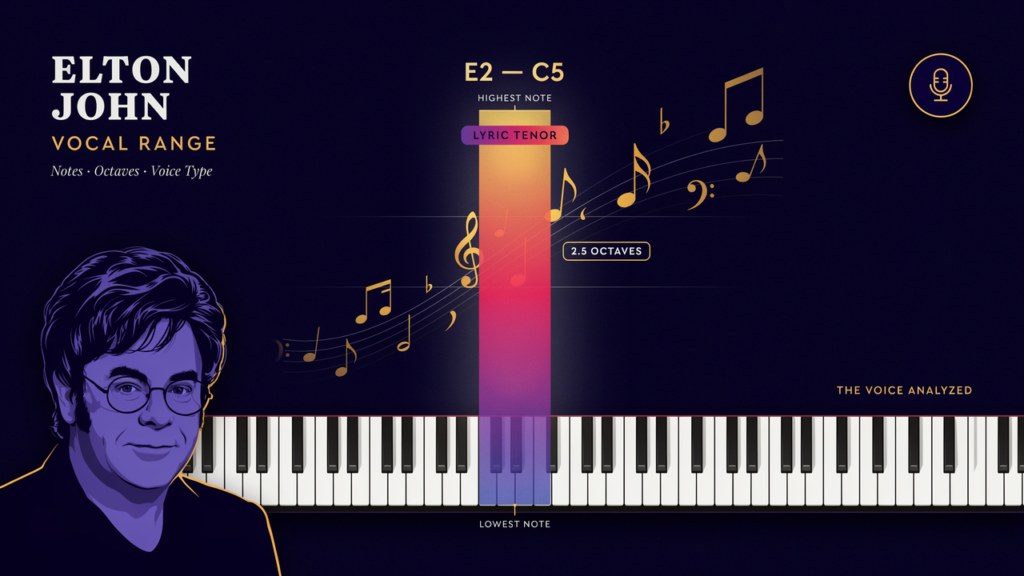
Elton John’s lifetime recorded vocal range is commonly estimated at approximately E2 to D6, spanning nearly four octaves. That widest measurement includes low notes, early-career falsetto, layered backing vocals, and isolated studio extremes. A more representative practical range is roughly F2 to F5, or about three octaves.
No single range describes every stage of John’s career. His 1970s voice was a bright, flexible tenor with a strong upper register and easy falsetto. After vocal problems and throat surgery in 1987, his voice became deeper, heavier, and more baritone-like. Understanding those two vocal eras is more useful than treating his voice as an instrument that never changed.
What Is Elton John’s Vocal Range?
John’s vocal range can be divided into several categories:
| Vocal measurement | Approximate range |
|---|---|
| Widest reported lifetime range | E2–D6 |
| Representative practical range | F2–F5 |
| Early-career voice type | Tenor |
| Later-career voice type | Baritone or baritenor |
| Early upper extension | Falsetto into the fifth and sixth octaves |
| Later strength | Chest-dominant lower and middle register |
E2–D6 covers 46 semitones, equal to three octaves and ten semitones. The more conservative F2–F5 range covers exactly three octaves.
The D6 boundary should not be interpreted as a sustained lead-vocal belt. It comes from the extended studio vocabulary of John’s early career, which included falsetto, overdubbed harmonies, and high backing-vocal effects. His most musically representative singing occupied a narrower range.
Readers can compare these measurements with a standard vocal range chart, but voice category cannot be determined from note boundaries alone.
What Is Elton John’s Lowest Note?
An E2 associated with “Mona Lisas and Mad Hatters” is often cited as the bottom of John’s recorded range. Other songs contain controlled notes around F2, making F2 a useful lower boundary for his practical range.
His early low notes were relatively light compared with the deeper sound he developed later. They extended below his comfortable tenor tessitura but did not define the center of his 1970s voice.
After his vocal transformation, lower notes became more substantial and easier to recognize as part of his normal sound. Songs recorded from the late 1980s onward reveal greater chest resonance, darker vowels, and more weight through the second and third octaves.
John’s developing lower register can be compared with David Bowie’s vocal range. Both singers’ mature voices displayed more depth and weight than their earlier recordings, though their stylistic approaches remained different.
What Is Elton John’s Highest Note?
The widest range compilations place John’s upper limit around D6, often connected with the early track “Social Disease.” That note belongs to an extended falsetto or studio-vocal context rather than his ordinary lead-vocal tessitura.
John’s practical upper range is more reasonably placed around F5 when controlled falsetto and repeatable early-career singing are considered. Songs such as “The Cage,” “Goodbye Yellow Brick Road,” “Someone Saved My Life Tonight,” and “Crocodile Rock” reveal different aspects of this upper extension.
“Crocodile Rock” is particularly important because John performed the famous falsetto backing vocals himself. These notes demonstrate genuine upper-register access, but they should remain separate from his chest and mixed range.
“The Cage” also contains unusually high falsetto singing. Its vocal demands help explain why the song was not a regular part of his concert repertoire. A studio performance can capture an extreme that is impractical to reproduce throughout a long live show.
Was Elton John a Tenor or Baritone?
Elton John was initially a tenor, but his later voice is more accurately described as a baritone or baritenor.
Early recordings such as “Your Song,” “Rocket Man,” and “Goodbye Yellow Brick Road” show a bright upper-middle register, relatively light vocal weight, and easy access to falsetto. His melodies frequently sat in a range associated with contemporary tenors.
His post-1987 voice had a lower center, thicker tone, and stronger chest-dominant quality. Although he could still sing above the typical baritone range, he approached those notes differently and often performed older songs in lower keys.
This change demonstrates why the tenor vs baritone distinction cannot be made by looking only at a singer’s highest pitch. Tessitura, vocal weight, timbre, and register transitions are equally important.
John’s early range can also be compared with John Lennon’s vocal range. Both used bright upper-middle singing, but John relied more heavily on sustained falsetto and theatrical shifts in vocal color.
What Happened to Elton John’s Voice?
John developed vocal problems during the 1980s and underwent throat surgery in Australia in 1987. Vocal nodules or a related abnormality are commonly identified as the reason for the procedure.
The operation became a major dividing line in his recorded sound. His voice afterward was noticeably deeper and rougher, with less effortless access to the brilliant tenor range of his early albums.
It would be too simple to attribute every change to surgery. Several factors likely contributed:
- Years of demanding recording and touring
- Existing vocal-health problems
- The effects of surgery and healing
- Natural maturation and aging
- Changes in technique and lifestyle
- Repeated performances of demanding material
The result was not merely a damaged version of his younger voice. John developed a new vocal identity with greater lower-register authority. His later performances often sound fuller and more grounded, even when they lack the floating falsetto of the 1970s.
How Elton John Adapted His Songs
John adapted his older repertoire by lowering keys, changing melodies, redistributing difficult phrases, and relying more on his chest-dominant middle register.
Transposition was especially important. A song written for his younger tenor voice could become unnecessarily tiring if performed in its original key decades later. Lowering it by one or more semitones allowed the melody to sit closer to his mature tessitura.
This practice is not a weakness. Professional singers routinely modify songs as their voices change. The goal of a live performance is to deliver the entire piece consistently, not to reproduce one historical high note at any cost.
Billy Joel has also adjusted the way he approaches older material, making Billy Joel’s vocal range a relevant comparison. Long careers require singers to balance recognizable melodies with present-day vocal function.
Elton John’s Falsetto and Vocal Technique
John’s early falsetto was one of his most useful vocal tools. It allowed him to create dramatic contrasts between grounded verses and soaring choruses or backing parts.
“Goodbye Yellow Brick Road” demonstrates his ability to move from a clear lead tone into a lighter upper coordination. The change adds emotional lift without requiring every high pitch to carry the weight of a full belt.
His technique also relied on:
- Clear consonants and conversational diction
- Bright, forward resonance
- Gospel- and soul-influenced phrasing
- Controlled rasp
- Rhythmic flexibility
- Strong chest voice
- Falsetto used for contrast and emphasis
John’s piano playing influenced his vocal phrasing as well. He often shaped lines around chord changes and rhythmic accents, making the vocal and keyboard parts feel like one coordinated performance.
Early Voice Versus Later Voice
John’s early and later voices each offered different strengths.
The early voice had greater lightness, agility, and upper extension. It could move rapidly between chest voice and falsetto while retaining a youthful brightness. The later voice gained weight, authority, and a more textured emotional quality.
This evolution differs from a simple decline. His high range became less accessible, but his lower and middle registers developed a stronger identity. Songs such as “The One” and “Can You Feel the Love Tonight” were written for this deeper instrument rather than attempting to recreate the sound of Goodbye Yellow Brick Road.
A similar contrast between unconventional early tone and mature expression appears across Bob Dylan’s vocal range, although Dylan’s technique and repertoire are substantially different.
Frequently Asked Questions
How many octaves could Elton John sing?
His widest reported E2–D6 range spans three octaves and ten semitones. A more representative practical estimate is F2–F5, which covers three octaves.
What was Elton John’s highest note?
D6 is frequently cited as an early studio extreme associated with “Social Disease.” It appears in an extended falsetto or studio context and does not represent his normal lead-vocal range.
What was Elton John’s lowest note?
E2 in “Mona Lisas and Mad Hatters” is commonly identified as his lowest recorded note. F2 is a more conservative lower boundary for his practical range.
Was Elton John a tenor or baritone?
He was a tenor during his early career. Following vocal problems, surgery, and natural maturation, his voice became more baritone-like.
Why did Elton John’s voice become deeper?
The change is associated with his 1987 throat operation, earlier vocal problems, extensive touring, and natural aging. Surgery was important, but it should not be treated as the only factor.
Did Elton John use falsetto?
Yes. Falsetto was a prominent feature of his early recordings, including the high backing vocals in “Crocodile Rock” and upper passages in “The Cage.”

Harlow is a vocal analysis and singing tools writer at Voice Range Test. She focuses on vocal range testing, voice type analysis, pitch recognition, and singing education tools for singers, musicians, choir performers, and beginners.