
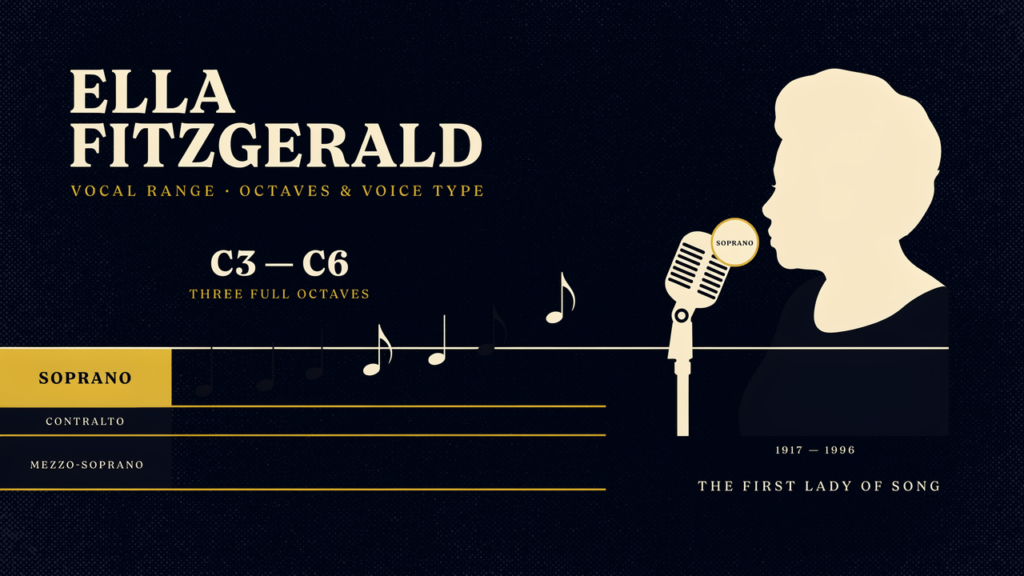
Ella Fitzgerald is often described as having a vocal range of about three octaves, with commonly reported estimates placing her somewhere around the lower third octave up into the sixth octave. Those exact note claims should be treated as estimates, because jazz recordings, live performances, scat passages, keys, and pitch sources can vary. What is much easier to confirm is the musical reality: Fitzgerald had an unusually flexible, accurate, and agile voice that could move from warm low phrases to bright upper notes with exceptional ease.
For singers, the most important part of Ella Fitzgerald’s vocal range is not just “how many notes” she could sing. It is how freely she moved through the range. Her voice stayed clear, rhythmically precise, and melodically controlled even during fast scat singing, wide interval jumps, and long improvised lines.
Ella Fitzgerald’s Vocal Range at a Glance
Ella Fitzgerald’s range is commonly summarized as roughly three octaves. In practical terms, that means she could cover a wide span for jazz standards, ballads, swing tunes, and improvisational scat passages.
| Range Area | Common Description | What It Means |
|---|---|---|
| Low range | Warm, spoken, alto-like color | Useful for intimate phrasing and conversational jazz delivery |
| Middle range | Clear, centered, highly musical | Her main storytelling and swing phrasing area |
| Upper range | Bright, agile, soprano-like ease | Used for climactic notes, scat lines, and melodic lifts |
| Full range | Often estimated around three octaves | Best treated as a general estimate, not a fixed classical range label |
A good way to understand her voice is to separate total range from usable range. Her total range may have extended very high in certain recordings, but her usable range was the area where she could phrase beautifully, swing naturally, and stay expressive without sounding forced.
That distinction matters for any singer studying female vocal ranges. A big note span is impressive, but Ella Fitzgerald’s greatness came from control, tone, timing, and musical intelligence.
Evidence for Her Lowest and Highest Notes
Many online vocal range discussions list Ella Fitzgerald around D3 to D6, sometimes with nearby variations depending on the source. This is a reasonable broad estimate to mention, but it should not be treated as a single final measurement unless each note is tied to a specific recording, timestamp, and pitch analysis.
Jazz also makes range harder to pin down than studio pop or classical repertoire. Fitzgerald changed keys, improvised melodies, used scat syllables, bent pitch, and sang live versions differently from studio versions. A note that appears in one performance may not represent the center of her voice, and an improvised high note may not tell us her normal tessitura.
| Claim Type | Example Context | Evidence Status |
|---|---|---|
| “About three octaves” | General descriptions of Fitzgerald’s voice | Strong as a broad summary |
| “Around D3 to D6” | Common online range estimate | Plausible, but should be qualified |
| High scat notes | Songs such as “How High the Moon” and “Blue Skies” | Strong evidence of agility and upper-range access |
| Low jazz phrasing | Ballads and relaxed standards | Strong evidence of lower-color control |
| Exact highest note | Varies by source and performance | Best treated as disputed or recording-specific |
So, the safest answer is: Ella Fitzgerald likely had about a three-octave vocal range, with reported note estimates often clustering around the low third octave to the high fifth or sixth octave. Her demonstrated musical range is beyond dispute, but exact endpoints are best handled carefully.
What Voice Type Was Ella Fitzgerald?
Ella Fitzgerald is not easy to classify using strict classical voice types. She was a jazz singer, not an opera singer working inside the soprano, mezzo-soprano, contralto, tenor, baritone, or bass system.
That said, her voice often sits in soprano or mezzo-soprano territory, depending on the song and period. She had the brightness and upper flexibility many listeners associate with a soprano, but she also had warmth, roundness, and conversational ease in the middle and lower parts of her voice.
If you are comparing her to classical categories, she is probably best described as a light, agile female jazz voice with soprano-like upper extension and mezzo-like warmth. For a clearer explanation of that middle female category, see what a mezzo-soprano is.
The key point is that Ella Fitzgerald’s voice type should not be decided by her highest note alone. Voice type depends on tessitura, tone, passaggio behavior, comfort zone, and musical function. Fitzgerald’s comfortable singing area was often more important than her extremes.
Why Her Scat Singing Showed So Much Vocal Control
Ella Fitzgerald’s scat singing is one of the clearest examples of her vocal ability. Scat requires more than speed. A singer has to invent melodic lines, stay in tune, keep time, articulate cleanly, and react musically in the moment.
Fitzgerald could sing improvised lines with the accuracy of an instrumentalist. Her phrasing often sounded like a horn solo: quick turns, rhythmic syncopation, clean attacks, and playful melodic shapes. This is why her range feels larger than a note chart can show. She was not just reaching notes; she was using them with total musical command.
Songs such as “How High the Moon,” “Smooth Sailing,” and “Blue Skies” show this especially well. The most impressive thing is not only the pitch span, but how relaxed she sounds while moving quickly through it.
That combination of range, precision, and improvisation is what separates Fitzgerald from singers who simply have high notes. A high note can be measured. Ella’s phrasing had architecture.
Songs That Show Ella Fitzgerald’s Range
If you want to hear Ella Fitzgerald’s vocal range in context, start with recordings that show different parts of her voice rather than chasing one isolated highest note.
“How High the Moon” is essential for her scat vocabulary, upper movement, and rhythmic control. It shows how freely she could move through melodic ideas without losing pitch accuracy.
“Blue Skies” is another strong example of her improvisational singing. Her scat lines are fast, light, and clean, making the performance a useful study for agility.
“Misty” and “Someone to Watch Over Me” reveal the softer side of her voice. These ballads show her breath control, legato phrasing, and emotional restraint.
“Summertime” brings out a warmer and more dramatic tone. It is a good reminder that Fitzgerald was not only a bright, nimble singer; she could also sing with depth and gravity.
“Spring Can Really Hang You Up the Most” is useful for hearing her controlled middle range and expressive jazz phrasing. It is not about vocal fireworks. It is about placement, timing, and tone.
How Ella Fitzgerald Compares With Other Great Singers
Ella Fitzgerald’s vocal identity is different from many powerhouse singers because she did not rely on heavy belting or theatrical intensity. Compared with Aretha Franklin, Fitzgerald’s sound is lighter, smoother, and more improvisational, while Aretha’s voice is more gospel-rooted and emotionally explosive.
Compared with Gladys Knight, Fitzgerald had a more horn-like jazz agility, while Knight is known for soul phrasing, warmth, and grounded emotional delivery.
Compared with Patti LaBelle, Fitzgerald’s approach is less about dramatic high belts and more about effortless melodic invention. LaBelle’s upper notes often feel explosive; Fitzgerald’s often feel airborne.
A closer theatrical comparison might be Barbra Streisand, another singer known for clarity, intonation, and musical intelligence. But Fitzgerald’s genius was rooted more deeply in swing, jazz rhythm, and improvisation.
If you want to compare your own range with singers like Fitzgerald, a tool such as the vocal range calculator can help you identify your lowest and highest comfortable notes. Just remember: Ella Fitzgerald’s lesson is not only range size. It is what you can do musically inside that range.
Frequently Asked Questions
What was Ella Fitzgerald’s vocal range?
Ella Fitzgerald is commonly described as having about a three-octave vocal range. Exact note claims vary, but many estimates place her somewhere around the low third octave up into the high fifth or sixth octave.
Was Ella Fitzgerald a soprano?
Ella Fitzgerald is often described as having soprano-like brightness and upper flexibility, but she was a jazz singer rather than a classical soprano. A safer label is an agile female jazz voice with soprano and mezzo-soprano qualities.
How many octaves could Ella Fitzgerald sing?
She is widely reported to have had about a three-octave range. More important than the number itself was her ability to use that range with clean pitch, swing feel, and improvisational freedom.
What was Ella Fitzgerald’s highest note?
Her exact highest note is disputed because different recordings and live performances produce different claims. It is better to describe her high range as extending into very bright upper territory rather than naming one unquestioned highest note.
Why was Ella Fitzgerald so good at scat singing?
Ella Fitzgerald had extraordinary pitch accuracy, rhythmic control, articulation, and melodic imagination. Her scat singing worked because she could improvise like an instrumentalist while keeping the sound clear, relaxed, and musical.

Harlow is a vocal analysis and singing tools writer at Voice Range Test. She focuses on vocal range testing, voice type analysis, pitch recognition, and singing education tools for singers, musicians, choir performers, and beginners.