
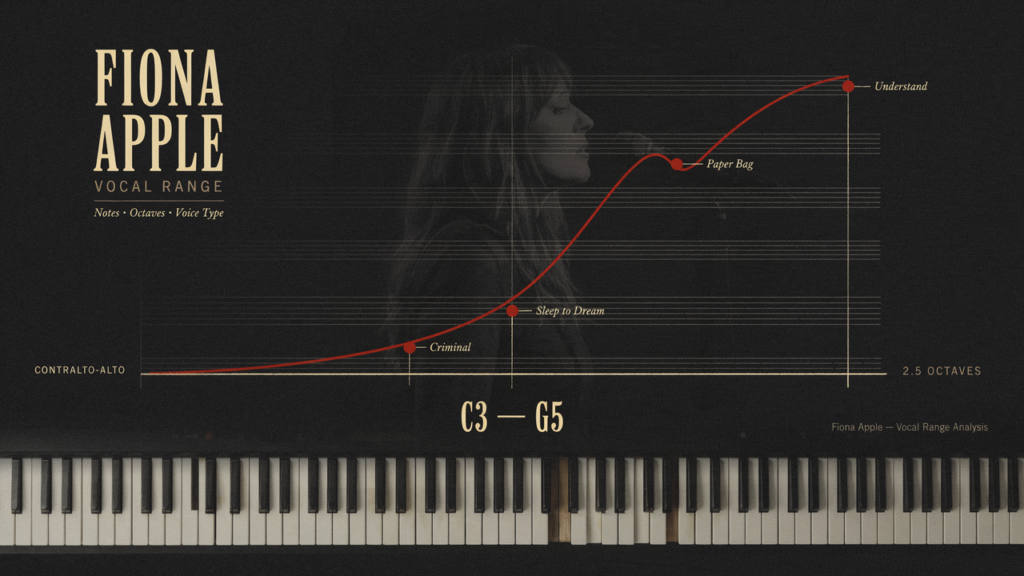
Fiona Apple’s reliably documented vocal range is approximately D3 to E5, spanning two octaves and two semitones. Some vocal profiles propose a wider range of around C3 to A5, but those boundaries may include brief sounds, harmonies, live variations, or notes that are not equally repeatable.
Apple is frequently described as a contralto because of her dark tone and strong lower register. A more careful description would be a low mezzo-soprano or contralto-leaning contemporary voice. Her classification cannot be settled from range alone, and her practical tessitura is more informative than her highest and lowest notes.
What Is Fiona Apple’s Vocal Range?
The most defensible working range for Fiona Apple is D3–E5. That equals 26 semitones, or two octaves and two semitones.
Her vocal profile can be summarized as follows:
| Vocal characteristic | Approximate assessment |
|---|---|
| Supported range | D3–E5 |
| Wider claimed range | C3–A5 |
| Practical tessitura | Lower-middle female range |
| Likely voice type | Low mezzo-soprano or contralto-leaning voice |
| Strongest register | Chest and lower-middle voice |
| Common techniques | Speech-like phrasing, growls, cracks, slides, and dynamic contrast |
The wider C3–A5 estimate would cover two octaves and nine semitones. However, a credible range should not include every pitched sound without considering its register, duration, clarity, and musical function.
Apple’s voice is best understood through how she uses a relatively compact core range. She can make the same pitch sound intimate, sarcastic, fragile, or confrontational by changing its weight and articulation.
What Is Fiona Apple’s Lowest Note?
A D3 in “Paper Bag” is commonly identified as one of Apple’s clearest low notes. Some profiles extend her lower boundary to C3, but that claim needs stronger song-level evidence before it should replace D3 as the more defensible limit.
The D3 matters because it fits naturally with Apple’s vocal identity. It does not sound like an isolated low effect added merely to increase her range measurement. Her lower register has recognizable tone, intelligible words, and enough stability to function melodically.
Apple often brings chest resonance into low and middle phrases. This contributes to the smoky, grounded quality listeners associate with her voice. However, a dark color does not necessarily mean that every low sound is fully supported. Breathiness, vocal fry, and deliberate roughness can make a pitch appear lower or heavier than it is.
Her lower-centered delivery invites comparison with Tracy Chapman’s vocal range. Both singers demonstrate how resonance, phrasing, and tonal depth can create a commanding sound without constant high belting.
What Is Fiona Apple’s Highest Note?
An E5 in “Never Is a Promise” provides a practical candidate for Apple’s supported upper boundary. The song moves from a controlled middle register into emotionally intense upper phrases without relying on a conventional pop-diva belt.
Some range profiles credit Apple with notes reaching A5. Those pitches may belong to live performances, harmonies, cries, or lighter vocal effects. Unless a clear lead-vocal example can be consistently identified, A5 is better treated as a claimed extension rather than the established top of her usable range.
Apple’s strongest singing is not concentrated around extreme high notes. As she ascends, she often allows her tone to become thinner, sharper, rougher, or deliberately unstable. That change is part of her expressive vocabulary.
This approach differs from the smoother, more sustained upper singing associated with Alicia Keys’s vocal range. Apple frequently prioritizes textual intensity and dramatic color over producing a conventionally polished high note.
Is Fiona Apple a Contralto?
Fiona Apple is widely called a contralto, but the classification requires qualification.
A contralto is not simply a woman with a dark voice. The category usually involves a naturally low tessitura, substantial lower-register resonance, characteristic vocal weight, and transition points that sit lower than those of most mezzo-sopranos.
Apple displays several contralto-like qualities:
- A dark and earthy timbre
- Comfortable lower-middle singing
- Strong chest-register presence
- Limited reliance on sustained high belting
- A naturally grounded vocal center
At the same time, contemporary singers are not trained or cast according to classical categories in the same way as opera singers. Apple’s voice can also reasonably be described as a low mezzo-soprano with a contralto-like color.
The distinction between these labels is explored more fully in our guide to alto vs contralto. Alto usually refers to a choral part or range, while contralto describes a vocal type. The mezzo-soprano vs contralto comparison also explains why tessitura and vocal weight matter more than a single low pitch.
Fiona Apple’s Practical Tessitura
Apple’s practical tessitura sits mainly in the third and fourth octaves. Songs such as “Criminal,” “Sleep to Dream,” “Paper Bag,” and “Carrion” keep much of their melodic writing within this lower-middle territory.
“Criminal,” for example, is centered around a compact range rather than dramatic extremes. The vocal remains compelling because Apple manipulates rhythm, consonants, breath pressure, and tonal color. She can lean behind the beat, attack a word abruptly, or let a phrase collapse into breathiness without losing its emotional direction.
“Sleep to Dream” similarly demonstrates the authority of her chest voice. Its relatively narrow melodic span reinforces the song’s confrontational mood. The performance proves that vocal impact does not depend on covering several octaves.
Her approach shares some expressive qualities with Amy Winehouse’s vocal range. Both singers use a dark lower register, unusual rhythmic placement, and deliberate changes in tone, although their influences and vocal identities remain distinct.
How Fiona Apple Creates Her Vocal Sound
Apple’s singing blends technical control with sounds that can appear uncontrolled. Vocal cracks, growls, rough attacks, slides, and sudden changes in volume are often intentional parts of the interpretation.
Her chest voice provides weight in lower phrases. Instead of maintaining a consistently rounded tone, she may narrow a vowel, distort a word, or allow breath to enter the sound. These choices make the lyric feel immediate and conversational.
Her phrasing is influenced by jazz, blues, cabaret, and theatrical storytelling. She frequently treats the written rhythm as flexible, stretching one word and compressing the next. The result feels spontaneous even when the phrasing is carefully shaped.
A useful comparison can be made with Lana Del Rey’s vocal range. Both singers use low placement and breathy colors, but Apple’s delivery is generally more percussive, rhythmically unsettled, and openly abrasive.
Did Fiona Apple’s Voice Change Over Time?
Apple’s early recordings already displayed a mature, dark vocal character. On Tidal, her delivery was controlled and polished, but songs such as “Sleep to Dream” and “Criminal” revealed the tension beneath that surface.
Later albums placed less emphasis on conventional smoothness. Her singing became more percussive, conversational, and willing to expose strain-like textures for artistic effect. The Idler Wheel and Fetch the Bolt Cutters contain abrupt attacks, chants, shouts, whispers, and intentionally raw vocal layers.
This development does not necessarily indicate a major expansion in range. Instead, Apple expanded the number of colors available within her core register. Her artistic growth is heard in her control of texture, rhythm, and emotional intensity.
Demonstrated Range Versus Expressive Sounds
Apple’s demonstrated range should include clearly pitched lead vocals that function as part of a melody. Growls, exclamations, vocal fry, spoken phrases, and layered backing parts require separate treatment.
A useful interpretation is:
- Supported range: Approximately D3–E5
- Lower claimed extension: C3
- Upper claimed extension: A5
- Usable tessitura: Primarily the third and fourth octaves
- Primary strength: Tonal and emotional flexibility within a compact range
This framework explains why different sources produce different totals. A broad lifetime compilation measures something different from the range Apple could use repeatedly with clarity and control.
Frequently Asked Questions
How many octaves can Fiona Apple sing?
Her supported D3–E5 range spans two octaves and two semitones. Wider estimates of C3–A5 would produce two octaves and nine semitones, but the extreme boundaries are less firmly established.
What is Fiona Apple’s voice type?
She is best described as a low mezzo-soprano or contralto-leaning contemporary singer. Her dark tone and low tessitura support the contralto comparison, but she has not been formally classified within a classical system.
What is Fiona Apple’s lowest note?
D3 in “Paper Bag” is a commonly identified and defensible low note. C3 appears in some wider range claims but requires clearer evidence.
What is Fiona Apple’s highest note?
E5 in “Never Is a Promise” is a practical supported high. A5 has been claimed as an extended upper note, though it may not represent her regular melodic range.
Why does Fiona Apple’s voice sound so deep?
Her dark timbre, chest-register emphasis, lower tessitura, vowel choices, and restrained use of bright upper resonance create the impression of unusual depth.
Does Fiona Apple have a large vocal range?
Her supported range is moderate rather than exceptionally wide. Her strength lies in how many emotional colors, textures, and rhythmic effects she creates within it.

Harlow is a vocal analysis and singing tools writer at Voice Range Test. She focuses on vocal range testing, voice type analysis, pitch recognition, and singing education tools for singers, musicians, choir performers, and beginners.