
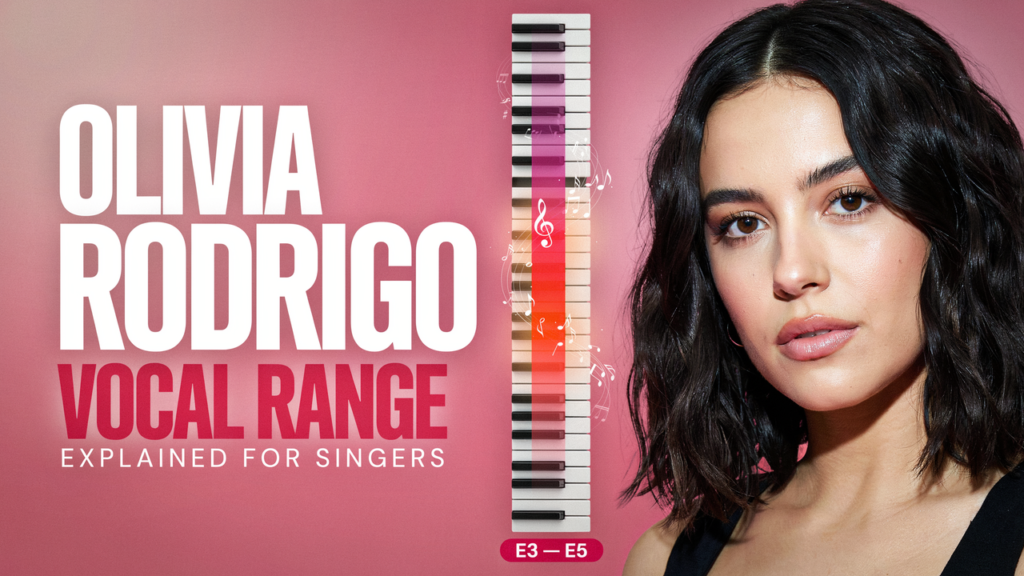
Olivia Rodrigo’s documented vocal range is approximately E♭3 to A♭5, spanning two octaves and five semitones. The lower boundary appears in “Ballad of a Homeschooled Girl,” while “Traitor” contains the highest clearly cataloged pitch in her released songs.
This range does not include every sound that may appear in background harmonies, layered studio vocals, live improvisations, or vocal effects. Rodrigo’s most recognizable singing generally occupies a narrower area, moving between a conversational lower-middle register and an emotionally intense upper mix.
What Is Olivia Rodrigo’s Vocal Range?
Based on identifiable lead-vocal notes across her catalog, Olivia Rodrigo’s range is:
E♭3–A♭5: 29 semitones, or two octaves and five semitones
Some online profiles credit Rodrigo with ranges such as B2–C6. Those wider estimates are difficult to verify because they rarely identify recordings that clearly demonstrate both endpoints. The notes may come from backing vocals, layered harmonies, screams, vocal fry, or incorrectly identified frequencies.
The E♭3–A♭5 estimate is more useful because its boundaries can be connected to specific songs. It should still be described as a documented catalog range rather than a permanent limit. Rodrigo may demonstrate additional notes as she releases new recordings and performs different arrangements.
Olivia Rodrigo’s Lowest and Highest Notes
Rodrigo’s lowest clearly documented note is E♭3 in “Ballad of a Homeschooled Girl.” Her highest cataloged pitch is A♭5 in “Traitor.”
| Song | Approximate range | What it demonstrates | Evidence status |
|---|---|---|---|
| “Ballad of a Homeschooled Girl” | E♭3–E♭5 | Lowest cataloged lead note and a two-octave song span | Strongly supported |
| “Vampire” | F3–E5 | Low opening phrases and an increasingly intense upper register | Strongly supported |
| “Drivers License” | G3–F5 | Dynamic build from conversational singing to high emotional phrases | Strongly supported |
| “Good 4 U” | A3–E5 | Bright, chest-connected pop-rock delivery | Strongly supported |
| “Traitor” | B♭3–A♭5 | Light high extension above the song’s central tessitura | Strongly supported |
| Claimed total range | B2–C6 | Frequently repeated without clear endpoint evidence | Unverified |
This evidence also shows why octave count alone cannot describe a singer. “Drivers License” does not cover Rodrigo’s entire catalog range, yet it is difficult because of its long build, sustained phrases, exposed opening, and transition into a stronger upper register.
Olivia Rodrigo’s Lowest Note
E♭3 in “Ballad of a Homeschooled Girl” is the lowest reliably cataloged lead-vocal pitch in Rodrigo’s released repertoire. It sits in a relatively low area for many young female pop singers, but she does not produce it with the heavy, dark quality associated with a contralto.
Her lower register is usually conversational, lightly textured, and closely connected to speech. She may add breathiness, vocal fry, or a restrained onset to make a phrase sound private and emotionally exposed.
That approach is also present in Conan Gray’s intimate pop singing, although the singers have different ranges and tonal characteristics. Rodrigo’s low notes function primarily as storytelling tools and as contrast for the louder sections that follow.
Olivia Rodrigo’s Highest Note
A♭5 in “Traitor” is Rodrigo’s highest clearly cataloged note. It is part of a lighter upper extension rather than the heavy belt that listeners may associate with songs such as “Good 4 U” or “Vampire.”
This distinction matters. A high note can be produced through chest voice, a chest-dominant mix, a lighter mix, head voice, falsetto-like coordination, or an effect. The pitch alone does not identify the register.
Rodrigo’s most characteristic powerful notes generally sit below A♭5. Her E5–F5 area is especially important because she can use it for emotional climaxes while maintaining recognizable words and a bright, urgent tone.
Demi Lovato’s upper-register singing offers a useful contrast. Lovato often favors a heavier, more sustained belt, while Rodrigo frequently alternates between breathy restraint, sharp attacks, lighter mix, and deliberately raw pop-rock intensity.
Does Olivia Rodrigo Have a Three-Octave Range?
The currently supported E♭3–A♭5 range covers two octaves and five semitones, not three full octaves. Rodrigo would need to reach E♭6 above the same lower note—or descend below E♭3 while retaining A♭5—to demonstrate three complete octaves.
Wider claims may result from counting:
- Background harmonies that are difficult to isolate
- Layered or pitch-processed studio vocals
- Vocal fry without a stable musical pitch
- Screams and spoken sounds
- Notes performed by another vocalist
- Harmonics mistaken for the fundamental pitch
A range below three octaves is not a weakness. Most songs use a much smaller pitch span, and a singer’s musicianship depends on control, tone, phrasing, stamina, rhythm, and expression—not merely the distance between two extreme notes.
Is Olivia Rodrigo a Soprano or Mezzo-Soprano?
Olivia Rodrigo is often described as a mezzo-soprano, although her bright upper extension and high pop melodies lead some listeners to classify her as a soprano. The available recordings do not establish a formal operatic voice type.
Her E♭3–A♭5 range overlaps both mezzo-soprano and soprano territory. However, voice classification depends on more than extremes. Tessitura, passaggio behavior, vocal weight, tone, and the area where a singer works most comfortably are also important.
Rodrigo’s repertoire commonly centers on the middle and upper-middle voice. She has enough warmth and speech connection to support a mezzo-soprano description, but she can lighten her coordination as she moves higher. Our explanation of the mezzo-soprano voice provides more context for why a singer cannot be classified from a range number alone.
How Olivia Rodrigo Uses Her Registers
Rodrigo’s singing is built around contrast. She frequently begins with an intimate, speech-like sound and gradually increases intensity as the lyrics become more emotionally charged.
Her main vocal tools include:
- Chest voice: Used for grounded, conversational lower and middle phrases
- Chest-dominant mix: Creates the firm, urgent sound in pop-rock choruses
- Lighter mix: Helps her approach higher notes without carrying full vocal weight
- Head voice: Adds softness and extension in high or vulnerable passages
- Vocal fry: Appears as a stylistic onset or emotional texture
- Breathy tone: Makes quiet phrases sound personal and exposed
- Controlled rasp or cries: Adds urgency, particularly in rock-influenced material
Similar contrasts can be heard in Tate McRae’s vocal style, but McRae often maintains a softer, breathier coordination. Sabrina Carpenter’s voice provides another contemporary comparison, with generally lighter articulation and more polished vocal layering.
Songs That Best Demonstrate Her Range
“Ballad of a Homeschooled Girl” provides the clearest example of Rodrigo’s lower boundary while also showing her pop-rock attack. Its E♭3–E♭5 span demonstrates how she can move from lower speech-like phrases into a forceful upper section.
“Traitor” contains her highest cataloged pitch and shows a gradual transition from restraint to a lighter high extension. “Drivers License” is particularly valuable for studying dynamic development: the voice begins exposed and controlled before opening into sustained emotional phrases up to F5.
“Vampire” follows a similar expansion but with greater theatrical intensity. Its approximately F3–E5 melody does not use Rodrigo’s full range, yet the changing volume, sustained upper phrases, and accelerating arrangement make it demanding.
“Good 4 U” emphasizes rhythmic precision, chest-connected energy, and a bright pop-punk tone. Singers can use the song key finder before attempting these tracks, since transposing a song may be safer and more musical than forcing the original key.
Why Olivia Rodrigo’s Songs Are Difficult to Sing
Rodrigo’s songs are challenging because they combine emotional delivery with technical contrasts. A singer may need to move quickly from a breathy verse into a louder chorus without losing pitch or overloading the voice.
Common challenges include:
- Long phrases with limited recovery time
- Repeated notes in the upper-middle register
- Sudden changes in volume and vocal weight
- Exposed quiet singing that reveals pitch instability
- Maintaining clear lyrics during emotional climaxes
- Reproducing rasp or cries without squeezing
Her songs should not be approached as shouting exercises. The recorded intensity often comes from layered production, microphone technique, resonance, and carefully controlled register choices. Pain, burning, or persistent hoarseness indicates that the singer should stop and reassess rather than push harder.
From SOUR to GUTS
On SOUR, Rodrigo frequently used intimate ballad phrasing and gradual emotional builds. “Drivers License” and “Traitor” demonstrate the contrast between quiet storytelling and high, open climaxes.
GUTS expanded her rock-influenced delivery. Songs such as “Vampire,” “All-American Bitch,” and “Ballad of a Homeschooled Girl” use sharper attacks, greater tonal variation, and more aggressive dynamics.
This development does not necessarily mean that her anatomical range became dramatically wider. It shows that she became more varied in how she used the range already available to her.
Frequently Asked Questions
How many octaves can Olivia Rodrigo sing?
Her currently documented lead-vocal range spans two octaves and five semitones, from E♭3 to A♭5. Wider claims exist but lack consistently identified song evidence.
What is Olivia Rodrigo’s highest note?
A♭5 in “Traitor” is her highest clearly cataloged note. It is a lighter upper extension rather than a sustained chest-voice belt.
What is Olivia Rodrigo’s lowest note?
E♭3 in “Ballad of a Homeschooled Girl” is her lowest reliably documented lead-vocal pitch.
Is Olivia Rodrigo a soprano?
She is sometimes called a soprano, but mezzo-soprano is also a reasonable popular-music description. Her formal voice type cannot be determined from her highest and lowest notes alone.
Which Olivia Rodrigo song has the widest range?
“Ballad of a Homeschooled Girl” spans approximately E♭3–E♭5, or two octaves. “Traitor” reaches the highest cataloged pitch, while “Drivers License” covers G3–F5.

Harlow is a vocal analysis and singing tools writer at Voice Range Test. She focuses on vocal range testing, voice type analysis, pitch recognition, and singing education tools for singers, musicians, choir performers, and beginners.