
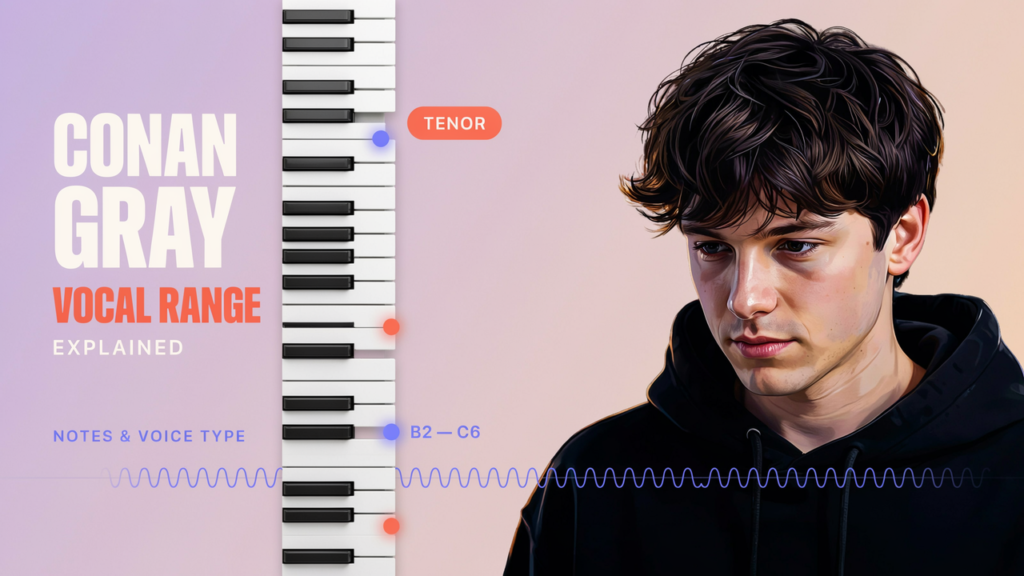
Conan Gray’s reported vocal range extends approximately from C3 to E6, covering three octaves and four semitones when his light upper register is included. A more conservative estimate places his practical modal singing around D3–E5, with head voice and falsetto extending considerably higher.
The difference matters because an airy or momentary E6 is not equivalent to a sustained full-voice note. Gray’s vocal identity comes less from extreme pitches and more from his light tenor placement, intimate delivery, carefully controlled falsetto, and ability to move from conversational verses into emotionally intense choruses.
Conan Gray’s vocal range D3–E5
147–659 Hz · 2 octaves and 2 semitones · Contemporary pop tenor
Practical modal range Wider reported range (C3–E6) You
Don’t know your range? Take the voice range test.
What Is Conan Gray’s Vocal Range?
C3–E6 is the broadest commonly reported estimate of Conan Gray’s recorded range. This span contains 40 semitones, equal to three octaves and four semitones.
That figure combines several forms of vocal production across different recordings. It may include modal singing, mixed coordination, head voice, falsetto, layered studio parts, and very brief upper-register sounds. Gray does not sing throughout the entire C3–E6 span with the same strength or tonal quality.
A useful breakdown is:
| Range category | Approximate notes | Interpretation |
|---|---|---|
| Lower extension | C3–D3 | Accessible lows rather than his primary vocal center |
| Practical modal range | Around D3–E5 | Main area for clear, connected singing |
| Upper extension | Above E5 | Primarily light head voice or falsetto |
| Broad reported range | C3–E6 | Includes the most extreme attributed pitches |
The exact endpoints should remain qualified because no official standardized assessment of Gray’s voice has been published. Online databases also disagree, offering estimates such as A2–E5, C3–G5, D3–E5, and C3–E6.
What Is Conan Gray’s Lowest Note?
C3 is commonly cited as Conan Gray’s lowest recorded note, with “Heather” frequently identified as the relevant song. The note sits one octave below middle C.
“Heather” demonstrates Gray’s lower and middle range more clearly than it demonstrates his overall upper extension. He sings much of the song with a soft, close-miked tone that makes relatively low pitches feel intimate rather than heavy.
C3 is likely an extension below the center of his voice, not the area where most of his songs consistently sit. His lower notes lack the weight normally associated with a baritone, while his tone becomes clearer and more characteristic as he moves through the middle and upper-middle range.
This helps explain the contrast between Gray and other young singer-songwriters. Ed Sheeran’s vocal range, for example, also serves conversational songwriting, but his tonal weight and register balance differ from Gray’s lighter approach.
What Is Conan Gray’s Highest Note?
E6 is the highest pitch attributed to Conan Gray in some vocal-range databases, often connected with “Astronomy” or “The Cut That Always Bleeds.” Other reported high notes include D♯6 in “Memories” and C♯6 in “Jigsaw.”
These pitches should be treated as reported upper extensions rather than established full-voice notes. Several issues can complicate their identification:
- The note may be a brief falsetto ornament.
- A backing vocal may sit above the lead.
- Multiple vocal layers may be present.
- Reverb can obscure the original pitch.
- A pitch detector may follow an instrument or harmony.
- The studio recording may contain tuning or editing.
Even when an E6 is audibly present, its register and role must be identified before calling it Gray’s highest sung lead note. His regularly demonstrated upper-range strength is more apparent below this extreme, where he can use a controlled light mix, head voice, or falsetto as part of a complete phrase.
That strategy differs from singers who carry more chest-dominant weight upward. Comparing Gray with Harry Styles’ vocal range shows how two contemporary male singers can access similar general pitch areas while using different tonal weight and intensity.
Does Conan Gray Really Sing an E6?
Conan Gray may reach an E6 through a light upper-register sound, but the claim is not sufficiently documented to describe it as a sustained, unprocessed lead-vocal note without qualification.
An E6 is exceptionally high for a male pop singer, yet falsetto can extend far above a singer’s modal range. Reaching that pitch would not mean Gray sings comfortably around E6 or has a conventionally soprano-like tessitura.
The distinction should be stated clearly:
- Pitch evidence asks whether an E6 can be heard.
- Performer evidence asks whether Gray sings that pitch rather than a backing part.
- Register evidence asks whether it is modal, mixed, head voice, or falsetto.
- Usability evidence asks whether he can sustain and repeat it musically.
Without all four, E6 remains a plausible reported extreme rather than the best summary of his everyday range.
How Many Octaves Can Conan Gray Sing?
If the C3–E6 estimate is accepted, Conan Gray’s full recorded range covers three octaves and four semitones.
The calculation is:
- C3 to C4: one octave
- C4 to C5: a second octave
- C5 to C6: a third octave
- C6 to E6: four additional semitones
His more conservative D3–E5 modal estimate covers two octaves and two semitones. A C3–G5 estimate covers two octaves and seven semitones.
These totals answer different questions. The broadest span describes the most distant pitches attributed to Gray, while the modal estimate better represents the connected range used through much of his repertoire.
The same distinction applies when comparing him with Shawn Mendes’ vocal range. A singer’s extreme falsetto does not automatically describe the range in which the majority of their melodies are performed.
Is Conan Gray a Tenor?
Conan Gray is generally described as a contemporary pop tenor. His bright tonal color, relative ease above middle C, limited lower-register weight, and frequent use of head voice and falsetto support that description.
Calling him a “light lyric tenor” is more debatable. That term belongs to classical voice classification and considers qualities such as passaggi, projection without amplification, tessitura, timbre, and appropriate operatic repertoire. Gray performs amplified pop music, so a precise classical subtype cannot be confirmed from his recordings alone.
His tenor classification is better understood as a practical description of where his voice tends to function. His songs often rely on emotional vulnerability, vocal lightness, and high phrases rather than the dense lower resonance associated with a baritone.
Justin Bieber’s vocal range offers a useful contemporary comparison. Both singers use a relatively light male voice and upper-register flexibility, but Gray often favors a more fragile, indie-pop presentation.
Modal Voice, Head Voice and Falsetto
Gray changes register according to the emotional shape of a song. His verses may sound close to speech, while his choruses become brighter and more urgent. When the melody rises beyond comfortable modal weight, he can reduce vocal mass and move toward head voice or falsetto.
His falsetto is frequently soft and breathy. That airiness creates vulnerability, but it should not be confused with a lack of control. In studio pop, a deliberately breathy tone can be an artistic choice supported by close microphone placement.
The higher phrases in “Astronomy,” “Memories,” and “The Cut That Always Bleeds” show how Gray uses upper-register sounds to increase emotional pressure. The shift often feels like part of the storytelling rather than a separate technical display.
A useful contrast is The Weeknd’s vocal range. Both singers use light upper-register production, though The Weeknd generally employs a more focused, R&B-influenced falsetto, while Gray often allows greater breathiness and vocal fragility.
Songs That Best Demonstrate Conan Gray’s Range
“Heather” demonstrates his low-to-middle range, controlled softness, and restrained dynamics. The melody is accessible compared with some of his later material, but sustaining its quiet tone evenly can be challenging.
“Astronomy” moves from intimate phrases into a much larger chorus. Its layered production and high vocal moments make it useful for studying his upper extension, though they also complicate exact pitch attribution.
“Memories” reveals a brighter, more urgent upper register. Gray moves between conversational storytelling and emotionally released high phrases.
“Jigsaw” uses increasing intensity and a sharper vocal edge. The performance demonstrates how tone color can change as the lyric becomes more confrontational.
“The Cut That Always Bleeds” contrasts gentle delivery with high, exposed emotional peaks. Its upper parts are often included in discussions of his falsetto range.
“Maniac” stays closer to his practical pop range and highlights rhythmic precision, clear hooks, and a more energetic tone.
“Vodka Cranberry” adds a theatrical, emotionally heightened performance to his later catalog. It is useful for evaluating how his live confidence and upper-register delivery have developed.
Gray’s confessional phrasing and tonal vulnerability naturally vulnerability naturally invite comparison with Olivia Rodrigo’s vocal range, especially because both singers frequently build from conversational verses toward more intense choruses.
What Makes Conan Gray’s Voice Recognizable?
Conan Gray’s sound is identifiable because he combines a youthful tenor color with detailed emotional phrasing. He frequently uses soft onsets, elongated vowels, restrained vibrato, breathiness, and sudden increases in intensity.
His studio performances also make strong use of vocal layering. Background harmonies and doubled lines enlarge the chorus without requiring the lead vocal to remain heavy. This production style must be considered when assigning exact pitches to him.
Listeners checking a relatively isolated passage can use a note identifier, but automatic detection is less dependable when instruments, harmonies, vocal layers, or wide vibrato are present.
Ultimately, Gray’s appeal is not dependent on proving an E6. His strength lies in shaping a lyric so that a change in breathiness, register, or volume feels emotionally meaningful.
Frequently Asked Questions
What is Conan Gray’s vocal range?
Conan Gray’s broad reported range is approximately C3–E6. His more conservative modal singing range is closer to D3–E5, with head voice and falsetto extending above it.
What is Conan Gray’s highest note?
E6 is the highest pitch attributed to Gray in some databases. It should be treated as a reported light upper-register extreme rather than a confirmed full-voice note.
What is Conan Gray’s lowest note?
C3 is commonly reported as his lowest recorded note and is associated with “Heather.” It appears to be a lower extension rather than the center of his voice.
Is Conan Gray a tenor?
Yes, Conan Gray is reasonably classified as a contemporary pop tenor. His bright tone, upper-range comfort, and frequent falsetto use support that description.
Does Conan Gray use falsetto?
Yes. Falsetto is an important part of Gray’s sound, particularly in high, vulnerable, or emotionally exposed passages.
Is “Heather” difficult to sing?
“Heather” is not exceptionally wide, but its soft delivery requires breath control, steady pitch, and smooth phrasing. Singing quietly without becoming unsupported can be more difficult than the melody initially suggests.

Harlow is a vocal analysis and singing tools writer at Voice Range Test. She focuses on vocal range testing, voice type analysis, pitch recognition, and singing education tools for singers, musicians, choir performers, and beginners.