
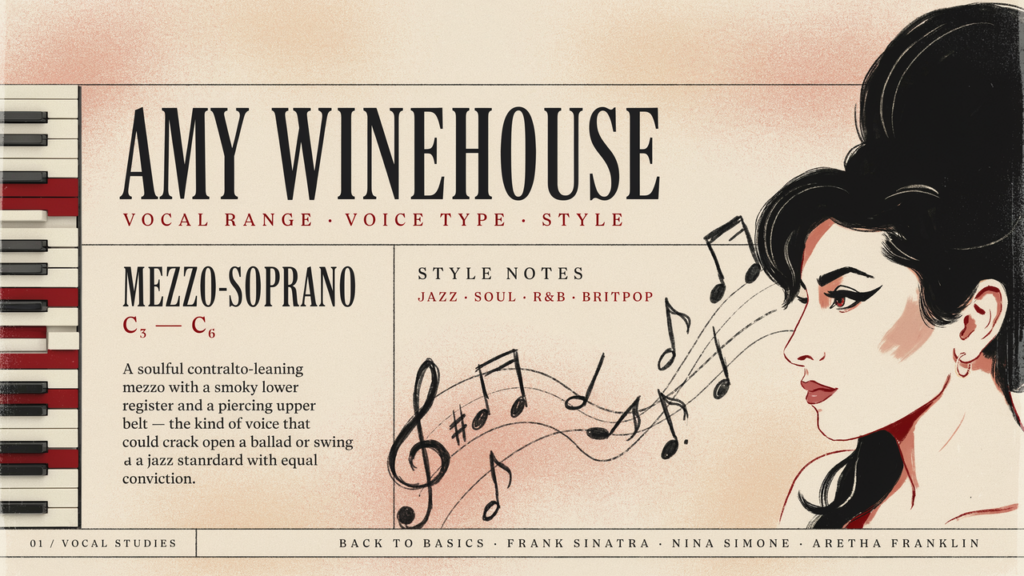
Amy Winehouse’s commonly reported recorded vocal range is approximately D3 to E♭6, spanning three octaves and one semitone. However, the sixth-octave boundary is based on brief upper-register material rather than the area where she normally carried melodies. A more conservative representation of her practical singing is approximately D3 to E5.
Winehouse is frequently described as a contralto because of her dark tone and low tessitura. A low mezzo-soprano with contralto qualities is also a reasonable description. Her voice cannot be classified accurately from range alone, especially because she was a contemporary jazz and soul singer rather than a classical vocalist working within a formal Fach.
Amy Winehouse’s Vocal Range at a Glance
| Vocal detail | Best-supported interpretation |
|---|---|
| Broad reported recorded range | D3–E♭6 |
| Broad range span | Three octaves and one semitone |
| Conservative musical range | Approximately D3–E5 |
| Practical tessitura | Often centered in the third and fourth octaves |
| Common classification | Contralto or low mezzo-soprano |
| Strongest registers | Lower and middle voice |
| Upper extension | Mix, head voice, falsetto and improvised effects |
| Signature qualities | Dark timbre, rhythmic phrasing, bends and tonal variation |
The D3–E♭6 figure describes the widest collection of notes attributed to Winehouse across different recordings and vocal coordinations. It does not mean she sang every note between those endpoints with the same volume, tone or consistency.
Amy Winehouse’s Lowest and Highest Notes
D3 is a strong candidate for the lower boundary of Amy Winehouse’s clearly musical range. Notes around this area appear in songs with low, conversational verses, including “You Know I’m No Good.”
Some databases place her as low as C3 in “A Song for You,” while other sources claim G2. The C3 estimate may be possible in a particular rendition, but G2 is unusually low and lacks sufficiently consistent song-level documentation. Neither should replace D3 as the more cautious published boundary without clearer evidence.
Winehouse’s highest notes are more difficult to define. E5 is a reasonable conservative upper limit for recognizable musical singing. D6 or E♭6 is sometimes associated with “Stronger Than Me” and other early material, but such notes may occur in brief ad-libs, light head voice, falsetto or layered passages.
| Note or area | Song or context | Vocal production | Evidence status |
|---|---|---|---|
| C3 | “A Song for You” | Low modal singing | Reported, performance-dependent |
| D3 | “You Know I’m No Good” | Low chest or modal voice | Strong practical lower boundary |
| E3–B4 | Much of her catalog | Modal and chest-dominant singing | Representative working range |
| C5–E5 | Climaxes and improvised phrases | Mix or upper extension | Conservative musical high range |
| D6–E♭6 | Often linked to early recordings | Brief head voice, falsetto or ad-lib | Commonly reported but source-dependent |
| G2 | Broad range claims | Unclear | Insufficiently supported |
This evidence suggests that Winehouse possessed considerable extension above her characteristic low tessitura, even though she rarely made extreme high notes the focus of a performance.
Did Amy Winehouse Have a Three-Octave Range?
Yes, Amy Winehouse’s broad reported D3–E♭6 range covers slightly more than three octaves. The exact distance is 37 semitones, equal to three octaves and one semitone.
The conservative D3–E5 estimate covers 26 semitones, or two octaves and two semitones. This smaller figure better represents clearly recognizable musical singing, while the wider estimate incorporates occasional upper extensions.
Both figures can be useful when labeled correctly:
- Recorded range: Every credible pitch captured across recordings
- Usable range: Notes that can function reliably in musical phrases
- Tessitura: The region where the voice spends significant time
- Extreme extension: Brief notes outside the usual working area
Winehouse’s practical value as a singer cannot be measured by octave count alone. Her control of rhythm, diction, tone and melodic variation made a relatively compact phrase sound different each time she sang it.
Was Amy Winehouse a Contralto or Mezzo-Soprano?
Amy Winehouse is commonly called a contralto, largely because of her dark timbre, grounded lower register and preference for low female keys. However, low mezzo-soprano is also a credible contemporary description.
A contralto is not simply a woman who can sing a low note. The classification normally involves a consistently low tessitura, substantial vocal weight, characteristic register transitions and a naturally dark tonal center.
Winehouse demonstrated several contralto-like qualities:
- Strong presence in the lower third octave
- A warm and weighty middle register
- Speech-like ease in low phrases
- A dark, mature tonal impression
- Limited dependence on bright soprano resonance
At the same time, she could move upward with agility and access a lighter head voice. Her upper flexibility and changing tone across her short recording career make a rigid classical label difficult to defend.
The alto-versus-mezzo-soprano comparison explains why overlapping notes do not automatically establish one voice type. For a singer working primarily in jazz, soul and contemporary pop, “low mezzo-soprano with contralto color” may be more precise than an unqualified classical label.
Her low-centered approach can be compared with Fiona Apple’s vocal range. Both singers use a dark lower register and highly personal phrasing, though their tonal textures and stylistic influences remain distinct.
Why Amy Winehouse’s Voice Sounded So Deep
Winehouse’s voice sounded deep partly because of pitch, but pitch was only one factor. Timbre, resonance, articulation and phrasing strongly influenced the listener’s perception.
Her characteristic sound included:
- A low-centered tessitura
- Chest-dominant phrasing
- Darkened vowels
- A speech-like vocal attack
- Selective nasality
- Delayed or anticipated rhythms
- Scoops, slides and blues-influenced bends
- Restrained vibrato followed by sudden releases
She could make the same note sound lighter, darker, rougher or more intimate by changing its onset and vowel shape. This tonal flexibility is why her voice could appear larger and lower than its written range suggested.
A useful comparison is Lana Del Rey’s vocal range. Both voices are recognized for low placement and dark color, but Winehouse’s delivery is more rhythmically elastic and rooted in jazz and soul phrasing.
Tracy Chapman’s vocal range offers another comparison involving a naturally grounded female voice. Chapman generally uses a steadier folk-oriented delivery, whereas Winehouse reshapes melodies with more pronounced bends and rhythmic displacement.
Songs That Showcase Amy Winehouse’s Vocal Range
“You Know I’m No Good” is one of the clearest demonstrations of Winehouse’s low tessitura. The verses descend toward D3 and maintain a conversational quality. The regular melody rises toward B4, creating a substantial span without relying on showy high notes.
“Stronger Than Me” displays her early jazz phrasing and freer upper extension. It is often connected with her highest reported notes, although extreme sixth-octave claims should remain qualified unless the precise vocal layer can be isolated.
“Rehab” demonstrates rhythmic accuracy, crisp articulation and control in a relatively compact melodic space. The performance succeeds because of timing and character rather than exceptional range width.
“Back to Black” shows how Winehouse could build intensity without continuously raising the pitch. Her changing tone, dynamics and consonant emphasis make each section feel progressively heavier.
“Love Is a Losing Game” highlights the softer side of her instrument. The restrained delivery reveals breath control, subtle pitch movement and an ability to communicate without relying on rasp or vocal force.
“He Can Only Hold Her” spends considerable time in her lower register, particularly around E3–A3. This makes it useful for understanding where her voice sounded naturally grounded.
“Valerie” demonstrates a brighter and more playful sound. Live versions vary because Winehouse frequently altered the melody, rhythm and placement rather than reproducing the studio phrasing exactly.
Her relationship with jazz can be placed beside Ella Fitzgerald’s vocal range. Fitzgerald displayed greater technical agility and register consistency, while Winehouse developed a rougher, more speech-oriented form of melodic improvisation.
Range Versus Phrasing and Expression
Winehouse’s greatest strength was not the highest note she could reach. It was her ability to transform written melodies into personal statements.
She often delayed a word behind the beat, compressed several syllables into a short space or changed a straight melody into a sequence of bends. These decisions created tension and release without requiring a wide interval.
Her phrasing drew from jazz, blues, soul, doo-wop and girl-group recordings. The influences were recognizable, but the final combination was distinctly her own.
Three qualities made her interpretations especially effective:
- Rhythmic independence: She did not always follow the instrumental accents directly.
- Tonal variation: Clean, breathy, nasal and rough colors could appear within one phrase.
- Emotional restraint: She often avoided oversinging, allowing small inflections to carry the meaning.
Gladys Knight’s vocal range provides a relevant soul comparison. Both singers prioritize lyrical communication and phrasing, although Knight’s delivery is generally cleaner and more technically consistent.
Studio Singing Versus Live Improvisation
Winehouse rarely treated a live melody as fixed. She changed rhythms, inserted ad-libs, altered vowel sounds and occasionally moved into notes absent from the studio version.
That flexibility complicates range measurement. A studio recording offers a clear reference, but a live performance may reveal a lower variation, a higher improvisation or an intentionally rough sound that resists exact pitch classification.
Performance condition also varied throughout her career. One live rendition should therefore not be used to define her complete vocal ability. The strongest evidence comes from notes reproduced clearly across reliable studio recordings and controlled performances.
Was Amy Winehouse’s Rasp Natural?
Winehouse’s tonal roughness was part of a broader collection of vocal colors. Some phrases sound relatively clean, while others contain breathiness, creak, nasality or deliberate roughness.
It is not possible to determine the health or physical cause of a vocal texture merely by listening to a recording. Her “smoky” sound should not automatically be described as damage, nor should listeners imitate it by tightening the throat.
A singer trying to reproduce the emotional effect of Winehouse’s delivery should focus on rhythm, diction and dynamic contrast rather than forcing rasp. Pain, burning, loss of normally easy notes or persistent hoarseness are reasons to stop and seek appropriate professional guidance.
Frequently Asked Questions
What was Amy Winehouse’s vocal range?
Amy Winehouse’s broad reported recorded range was approximately D3–E♭6, covering three octaves and one semitone. A more conservative musical estimate is D3–E5.
What was Amy Winehouse’s highest note?
E♭6 is the most frequently reported extreme, though its exact recording and production are not documented consistently. E5 is a more cautious upper boundary for clearly recognizable musical singing.
What was Amy Winehouse’s lowest note?
D3 is a strong practical lower boundary, particularly in “You Know I’m No Good.” C3 has also been reported in “A Song for You,” while lower claims remain uncertain.
Was Amy Winehouse a contralto?
She is commonly described as a contralto because of her dark timbre and low tessitura. Low mezzo-soprano with contralto qualities is also a reasonable classification.
How many octaves could Amy Winehouse sing?
Her broad D3–E♭6 estimate spans three octaves and one semitone. Her clearly usable range was narrower and centered mainly in the third and fourth octaves.
Was Amy Winehouse’s voice naturally raspy?
Her voice included clean, breathy, nasal, creaky and rough tonal colors. A recording alone cannot establish whether any roughness was anatomical, stylistic or related to vocal condition.

Harlow is a vocal analysis and singing tools writer at Voice Range Test. She focuses on vocal range testing, voice type analysis, pitch recognition, and singing education tools for singers, musicians, choir performers, and beginners.