
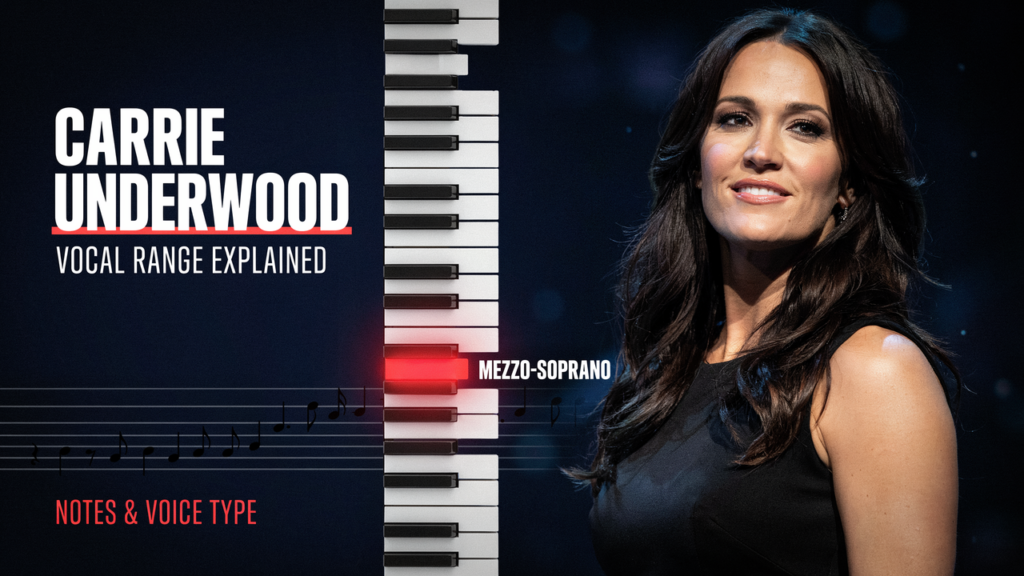
Carrie Underwood’s vocal range is commonly reported at around A2 to F6, though a more practical song-based range is closer to F3/G3 through E5/F5 in many of her biggest recordings. The reason her range gets so much attention is not just the number of notes she can reach. It is the way she belts high notes with power, clarity, and stamina, especially in country-pop songs that demand emotional force.
Carrie is often described as a mezzo-soprano with a strong upper mix and soprano-like extension. Some listeners call her a soprano because she can sing high, bright, ringing notes. Others hear mezzo-soprano qualities because of the weight and color in her lower and middle range. The most useful answer is that she has a powerful contemporary female voice with a huge belt range, excellent projection, and a high extension that goes beyond what most country singers regularly use.
Among modern country and pop vocalists, Carrie sits in the powerhouse lane. Her singing has more edge and attack than many soft pop singers, but more polish and control than a raw rock belter. That makes her a strong comparison point for singers like Kelly Clarkson, Pat Benatar, and Linda Ronstadt, who are also known for high-energy vocal delivery.
What Is Carrie Underwood’s Vocal Range?
Carrie Underwood’s total vocal range is often listed at approximately A2 to F6. If counted as a full claimed span, that gives her more than three octaves of range. However, that number should be understood carefully because not every note in a singer’s total range is used the same way.
A singer’s lowest note, highest head voice note, and strongest belt note are not equal in practical value. Carrie’s reputation is built mainly around her upper mix and belt range, especially notes around the fourth and fifth octaves. She can sing with a strong, bright sound in places where many singers need to lighten, flip, or avoid the note entirely.
A practical way to understand her range is:
| Vocal Area | Approximate Range | How She Uses It |
|---|---|---|
| Low range | A2 to F3/G3 | Occasional lower notes and darker phrases |
| Main range | G3 to D5/E5 | Verses, choruses, and most song melodies |
| Belt/mix range | C5 to F5/G5 | Big country-pop climaxes and sustained high notes |
| Head voice/extension | Above F5 | Higher effects, runs, and less frequent extremes |
This separation is important because Carrie’s most impressive singing is not just “she can reach high notes.” It is that she can reach high notes with strength, pitch focus, and emotional intensity.
Carrie Underwood’s Lowest Notes
Carrie Underwood’s lowest reported notes are around A2, but those lower notes are not the center of her vocal identity. In her major songs, she usually does not rely on a dark contralto-style low range. Her lower notes are more often used for contrast before the chorus opens up.
In songs like “Before He Cheats,” the verse sits low enough to give her voice attitude and bite, but the song’s real energy comes from the way she builds into a stronger upper register. That lower-middle area helps her sound grounded before the belt arrives.
This is one reason people sometimes describe Carrie as a mezzo-soprano. She has enough depth and weight in the middle of the voice to avoid sounding thin, but she also has the high extension and bright top notes that make some people label her a soprano.
Carrie Underwood’s Highest Notes
Carrie Underwood’s highest notes are often reported around F6, with some fan discussions claiming additional live extremes. These highest notes should be treated as upper extensions rather than the main evidence of her everyday singing range.
Her most important high notes are not necessarily the absolute highest ones. The real signature is her ability to sing powerful notes around E5, F5, and sometimes higher with a strong mixed belt. That is where her voice feels explosive but still controlled.
This is different from a singer who mainly uses airy head voice at the top. Carrie’s high notes often carry a bright, ringing country-pop belt quality. She can make the note feel direct and emotional instead of light or decorative.
A singer like Lady Gaga also uses strong theatrical belts, but Carrie’s tone is more rooted in country storytelling, clean vowels, and a polished Nashville sound.
How Many Octaves Can Carrie Underwood Sing?
If we use the broad reported range of A2 to F6, Carrie Underwood has a range of about three octaves and a half. But for a serious vocal range article, it is better to separate total range from usable performance range.
Her usable song range is usually narrower than the full claim. Many of her best-known tracks sit between the lower third octave and the fifth octave, with climactic notes often landing around C5 to F5. That is still extremely demanding, especially when repeated night after night in live shows.
The octave count matters less than the consistency. Carrie is known for being able to sustain high notes, cut through big arrangements, and keep her voice strong during long performances. That kind of stamina is one of the main reasons singers consider her songs difficult.
Is Carrie Underwood a Soprano or Mezzo-Soprano?
Carrie Underwood is most often described as a mezzo-soprano, but with a strong soprano-like upper extension. This is the most balanced classification because it accounts for both the weight in her middle voice and the brightness of her top notes.
Calling her only a soprano can be misleading because her voice has more body and belt weight than many light sopranos. Calling her only a mezzo can also feel incomplete because her upper range is unusually strong and flexible for a country-pop singer.
In contemporary music, voice type is not as strict as classical classification. A pop or country singer is not usually placed into a Fach system the same way an opera singer would be. What matters more is tessitura, tone, registration, and how the voice behaves in real songs.
So the best practical answer is: Carrie Underwood is a powerhouse mezzo-soprano with a bright upper mix and extended high range.
Chest Voice, Mix, Head Voice, and Belt Range
The strongest part of Carrie Underwood’s voice is her mix. Mix is the area where a singer blends chest voice strength with head voice resonance. Carrie uses that blend to make high notes sound full and exciting without becoming completely shouted.
Her chest voice gives her lower and middle notes their punch. Her mixed belt lets her climb into the fifth octave with intensity. Her head voice gives her access to higher notes above the main belt area, though those notes are not always the main focus of her songs.
This is why Carrie’s high notes feel different from soft falsetto-style singing. Her best belts have a clear attack, strong breath support, and a forward country twang that helps the sound cut through the band.
That is also why her songs can be difficult for singers who technically have the notes. Hitting the pitch once is not the same as singing it with Carrie’s tone, strength, and control.
Carrie Underwood Vocal Range in Popular Songs
“Before He Cheats” is one of the best examples of Carrie’s lower-middle attitude and sharp upper delivery. The song does not need her full range to work. Instead, it shows how she can use tone, phrasing, and controlled aggression to make a vocal feel powerful.
“Jesus, Take the Wheel” shows a different side of her voice. It begins with a more restrained emotional delivery and gradually grows into a bigger vocal moment. This kind of ballad singing requires control because the singer has to build intensity without rushing into the highest notes too early.
“Blown Away” is one of her strongest range examples because it combines drama, power, and upper-register intensity. The song is demanding because it needs both storytelling and vocal force.
“Good Girl” shows her energetic belt style. It moves with more attack and edge, making it a good example of her country-rock influence.
“Something in the Water” highlights her gospel-influenced power and ability to make a high vocal climax feel inspirational rather than just technically impressive.
These songs show why Carrie belongs in the same larger conversation as powerhouse singers like Patti LaBelle and Jennifer Hudson, even though her genre and tone are different.
Why Carrie Underwood’s Voice Sounds So Powerful
Carrie Underwood’s voice sounds powerful because of more than range. She uses bright resonance, strong breath support, and clean vowel shaping to keep her high notes focused. Her tone has enough edge to cut through a big country-rock arrangement without sounding buried.
She also has excellent stamina. Many singers can produce a big note once. Carrie’s strength is that she can repeat demanding belts across a full performance while staying clear and controlled.
Another important part of her sound is precision. Her high notes often feel polished rather than loose. Even when the emotion is big, the technique usually sounds organized. That combination of power and control is a major part of her appeal.
For singers testing their own voice, Carrie is a reminder that range numbers do not tell the whole story. A tool like a voice type test can help identify your general category, but your real singing identity depends on where your voice sounds strong, comfortable, and repeatable.
Is Carrie Underwood Hard to Sing?
Yes, Carrie Underwood is hard to sing because her songs demand power, pitch accuracy, and endurance. Many of her choruses sit high enough to challenge the average singer, and the hardest parts often require repeated mixed belts rather than one isolated high note.
Her songs are especially challenging for singers who push chest voice too high. To sing Carrie’s material well, a singer usually needs a balanced mix, steady breath support, and the ability to keep the throat from tightening during big notes.
The hardest Carrie Underwood songs are not difficult only because of range. They are difficult because they combine high notes with emotional intensity, long phrases, and strong projection.
That is why her vocal range is impressive, but her technique and stamina are even more important. Carrie Underwood is not just a singer with a wide range. She is a singer who knows how to use that range in a way that feels bold, emotional, and unmistakably powerful.
FAQ
What is Carrie Underwood’s vocal range?
Carrie Underwood’s vocal range is commonly reported around A2 to F6, though her most practical song range often sits closer to F3/G3 through E5/F5.
What is Carrie Underwood’s highest note?
Her highest reported notes are often placed around F6, but her most important high notes are her powerful mixed belts around E5 to F5.
What is Carrie Underwood’s lowest note?
Carrie Underwood’s lowest reported note is around A2, though her lower range is not the main feature of her singing style.
Is Carrie Underwood a soprano?
Carrie Underwood is sometimes called a soprano because of her high notes, but she is more often described as a mezzo-soprano with soprano-like extension.
Is Carrie Underwood a mezzo-soprano?
Yes, mezzo-soprano is the most balanced label for Carrie Underwood because her voice has weight in the middle range and strong power in the upper mix.
How many octaves can Carrie Underwood sing?
Using the broad reported range of A2 to F6, Carrie Underwood can cover more than three octaves. Her usable performance range is narrower but still very demanding.
Why is Carrie Underwood so hard to sing?
Carrie Underwood is hard to sing because her songs require strong mixed belts, clean pitch, breath control, and stamina across repeated high phrases.

Harlow is a vocal analysis and singing tools writer at Voice Range Test. She focuses on vocal range testing, voice type analysis, pitch recognition, and singing education tools for singers, musicians, choir performers, and beginners.