
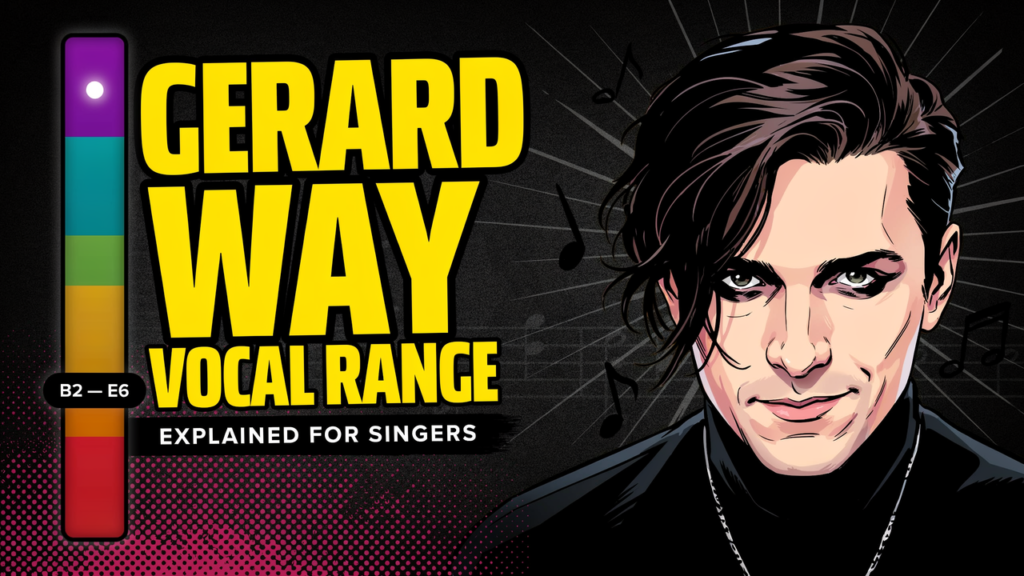
Gerard Way’s vocal range is commonly reported around G2 to D5 for sung vocals, though some sources claim wider ranges when screams, distorted notes, brief pitch peaks, or song-analysis data are included. The safest description is that Gerard Way has a tenor-leaning rock voice with a dramatic upper range, strong emotional projection, and a gritty delivery that makes My Chemical Romance songs feel intense even when the notes are not technically clean in a classical sense.
That qualification matters. Gerard Way is not a polished pop tenor or a classical musical-theater singer. His vocal identity comes from urgency, rasp, theatrical phrasing, shouted belts, and controlled chaos. His range is part of the story, but the bigger reason his voice stands out is how he turns pitch, distortion, and emotion into character.
Gerard Way’s Vocal Range at a Glance
Gerard Way is often described as a tenor or tenor-leaning rock vocalist. His voice can sit high and bright in the middle register, but it also has a raw, darker edge that helps his singing cut through dense guitars.
| Category | Best Description |
|---|---|
| Commonly reported sung range | Around G2–D5 |
| Wider online claims | Source-dependent, especially when screams or extreme pitch readings are included |
| Likely voice type | Tenor-leaning rock voice |
| Signature strength | Emotional belting, rasp, theatrical delivery |
| Main vocal style | Emo, pop punk, alternative rock, post-hardcore |
| Key band context | Lead vocalist of My Chemical Romance |
If you compare his voice with standard male vocal ranges, Gerard Way does not fit neatly into a textbook category. Rock singers often use microphones, distortion, shout-like vowels, and dramatic effects that classical voice-type labels were not designed to measure.
Evidence for His Lowest and Highest Notes
Gerard Way’s range claims should be read carefully because My Chemical Romance songs often include shouting, rasp, layered vocals, and moments where pitch is less clean than in pop ballads. A note can be emotionally effective without being a clean, sustained, repeatable sung note.
| Note/Range | Song or Context | Vocal Use | Evidence Status |
|---|---|---|---|
| G2 area | Lower reported phrases | Low modal/speech-like singing | Commonly reported, source-dependent |
| B3–B4 area | Many MCR choruses and verses | Main usable rock range | Strongly supported by listening pattern |
| C5–D5 area | “Famous Last Words,” “This Is How I Disappear,” high MCR climaxes | Belted/mixed rock notes | Commonly reported and stylistically plausible |
| Above D5 | “Welcome to the Black Parade” and other pitch-analysis claims | May involve high placement, effects, or source-specific interpretation | Should be treated cautiously |
Some online song references list very high vocal ranges for “Welcome to the Black Parade.” That kind of information can be useful, but it does not automatically prove a clean, controlled lead vocal note at the very top of the listed range. In rock music, a pitch tracker or song database may include brief peaks, layered vocals, or high-intensity sounds that are not the same as a sustained sung note.
A stronger practical estimate is this: Gerard Way’s most useful range lives in the middle-to-upper male rock area, with high emotional climaxes around the C5–D5 zone and lower notes used more for contrast than for deep resonance.
Is Gerard Way a Tenor?
Gerard Way is usually best described as a tenor-leaning rock singer, but not in a strict classical sense. His voice has the brightness and upper reach that many listeners associate with tenor singing, especially in My Chemical Romance choruses. At the same time, his tone is gritty, speech-driven, and often distorted, which makes a clean classical label less useful.
A traditional tenor voice is often judged by tessitura, tone, passaggio, and how comfortably the singer sustains upper notes. Gerard’s voice does reach into tenor territory, but his style is built for rock theater, not opera or choral classification.
He also does not sound like a typical smooth pop tenor. His delivery is more urgent and abrasive. That is why some listeners may hear baritone-like darkness in his lower phrases, even though his high-energy MCR singing often points upward.
Clean Singing vs Distortion in Gerard Way’s Range
The biggest mistake in Gerard Way vocal range discussions is treating every sound as the same kind of singing. Clean notes, raspy belts, shouted phrases, screams, and distorted emotional peaks should not all be counted equally.
Clean singing is easier to measure because the pitch is stable. Distorted rock vocals are harder because noise, rasp, and vowel shape can blur the exact pitch. Screamed or shouted notes may still have a pitch center, but they are not always usable in the same way as a clear sustained note.
That is part of Gerard Way’s appeal. His voice often sounds like a character under pressure. In My Chemical Romance songs, the vocal line can move from intimate storytelling to near-collapse intensity within seconds. The sound is theatrical, but it is also intentionally imperfect.
For singers trying to imitate that style, the safer goal is not to copy the strain or harshness. Build control first, then add grit carefully. If a song causes throat pain, tightness, or loss of easy notes afterward, it is worth stepping back and working on vocal tension release before pushing harder.
Songs That Show Gerard Way’s Vocal Style
“Welcome to the Black Parade” is the essential Gerard Way vocal showcase. It begins with dramatic restraint, then grows into a huge rock anthem. The song shows his ability to build intensity, shape a story, and turn a chorus into something theatrical.
“Famous Last Words” is another strong example of his upper rock range. The vocal is forceful, urgent, and emotionally exposed. It is less about smoothness and more about commitment.
“Helena” shows Gerard’s ability to combine melodic hooks with dark theatrical energy. The verses and chorus sit in a range that feels singable on paper, but the phrasing, attack, and stamina make it harder than it looks.
“I’m Not Okay (I Promise)” highlights his punkier delivery. The vocal feels direct and conversational, then lifts into a shout-like chorus. This is where his voice type matters less than his timing, attitude, and ability to keep the performance moving.
How Gerard Way Compares With Other Rock Singers
Gerard Way is useful to compare with other rock and alternative singers because his voice sits between punk urgency and theatrical drama. Compared with Chester Bennington’s vocal range, Gerard sounds less polished and less technically separated between clean singing and extreme distortion, but he has a similar gift for emotional intensity.
Compared with Corey Taylor’s vocal range, Gerard’s sound is lighter, more theatrical, and more emo/punk than metal-rooted. Corey often brings heavier low-mid weight and harsher aggression; Gerard brings character, narrative, and anxious brightness.
A comparison with Ronnie Radke’s vocal range also makes sense because both singers connect rock vocals with theatrical presentation. Gerard’s style, however, is usually less rap-influenced and more tied to emotional punk-rock storytelling.
For higher emo/post-hardcore contrast, Kellin Quinn’s vocal range shows a much lighter, higher-centered voice. And for a powerful pop-punk comparison, Hayley Williams’ vocal range offers a different kind of clean, agile, high-energy rock singing.
Why Gerard Way’s Voice Still Stands Out
Gerard Way’s voice is not famous because it is technically perfect. It is famous because it sounds unmistakably alive. His singing carries panic, humor, grief, anger, and theatrical grandeur, often in the same song.
That is why a simple range number cannot fully explain him. A singer with a similar note span could still sound completely different. Gerard’s real signature is how he uses range: lower phrases for storytelling, upper notes for emotional release, rasp for danger, and dramatic phrasing to make each song feel like a scene.
If you are studying his voice, focus on usable range, not just extremes. The most important question is not “Can I hit Gerard Way’s highest note once?” It is “Can I sing the main phrases clearly, repeat them, and keep the emotion without losing control?”
Frequently Asked Questions
What is Gerard Way’s vocal range?
Gerard Way’s vocal range is commonly reported around G2–D5 for sung vocals, though some online sources claim wider spans when distorted notes, screams, or brief pitch peaks are included.
Is Gerard Way a tenor?
Gerard Way is best described as a tenor-leaning rock vocalist. His upper range and bright emotional delivery point toward tenor territory, but his gritty rock style does not fit strict classical labeling perfectly.
What is Gerard Way’s highest note?
Gerard Way’s highest commonly discussed sung notes are often placed around D5, especially in intense My Chemical Romance performances. Higher claims should be treated carefully unless the source clearly identifies a clean, sustained lead vocal note.
Does Gerard Way scream or sing?
Gerard Way does both. He uses clean singing, shouting, rasp, distortion, and scream-like effects depending on the song. Those sounds should be separated when discussing his true vocal range.
Is Gerard Way’s vocal range wide?
Gerard Way’s range is wide enough for demanding rock singing, but his biggest strength is expression. His tone, theatrical delivery, and emotional attack are more important to My Chemical Romance’s sound than range size alone.

Harlow is a vocal analysis and singing tools writer at Voice Range Test. She focuses on vocal range testing, voice type analysis, pitch recognition, and singing education tools for singers, musicians, choir performers, and beginners.