
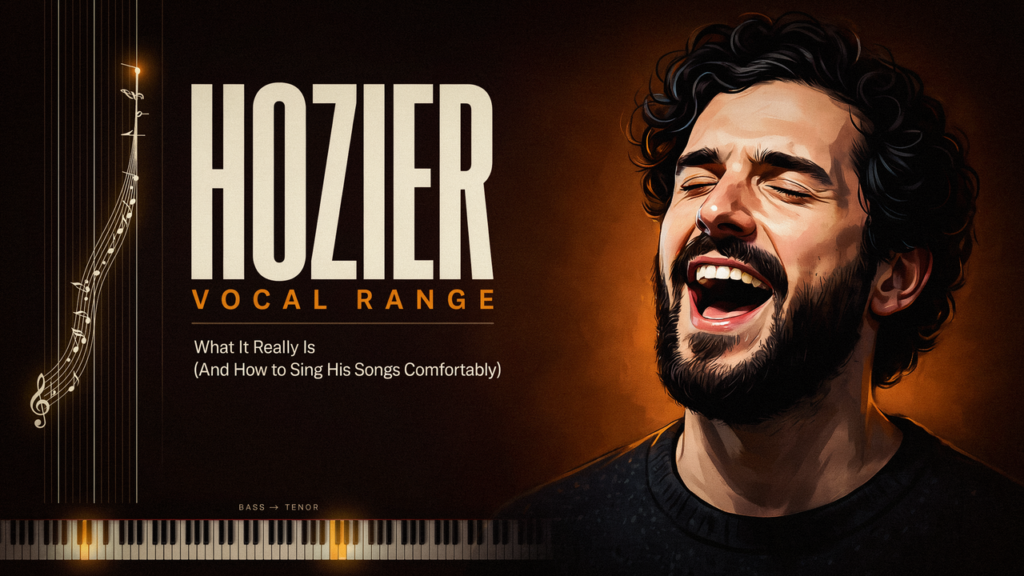
Hozier’s documented recordings and live performances support a conservative vocal-range estimate of approximately C2 to C5, spanning about three octaves. Some performance compilations suggest lower notes or higher falsetto extensions, but these extremes are not consistently documented enough to present as firm boundaries.
Hozier is best described as a baritone-leaning contemporary singer with a flexible upper register. His deep vocal color can make him sound lower than the notes he is actually singing, while his mix and falsetto allow him to move comfortably into territory often associated with higher male voices.
What Is Hozier’s Vocal Range?
Hozier’s practical catalog range is approximately C2–C5, although his most regularly used notes occupy a smaller area. He does not spend entire songs moving between those two extremes.
A useful breakdown of his voice looks like this:
| Vocal area | Approximate notes | Typical use |
|---|---|---|
| Low extension | C2–F2 | Dark phrases and low live variations |
| Lower-middle range | G2–C3 | Intimate verses and speech-like delivery |
| Primary singing range | D3–G4 | Most melodies, sustained phrases and choruses |
| Upper mixed range | A4–C5 | Climactic belts and gospel-influenced peaks |
| Additional extension | Above C5 | Brief falsetto or performance-dependent sounds |
C2 to C5 equals 36 semitones, or exactly three octaves. However, this should be understood as a documented performance span rather than three octaves of equal comfort and power.
Hozier’s most valuable range is the region he can use repeatedly with consistent tone and expressive control. This is his tessitura, which is different from the complete distance between his lowest and highest notes. The distinction is explained more fully in the guide to what tessitura means.
Hozier’s Lowest and Highest Notes
There is no official measurement of Hozier’s range from the singer, his label, or a vocal examination. Exact endpoints are estimates taken from studio tracks and live performances, and different transcriptions may disagree by a semitone.
| Note or area | Song or performance evidence | Register or context | Evidence status |
|---|---|---|---|
| Around C2–D2 | Low passages and live variations associated with “Talk,” “It Will Come Back” and “Too Sweet” | Low chest-dominant production | Estimated and performance-dependent |
| E2–G2 | “Work Song,” “Talk” and other low-set material | Resonant low register | Strongly characteristic of his catalog |
| A4–B4 | “Take Me to Church” and “Nina Cried Power” | Projected upper mix or belt | Strongly supported in studio and live singing |
| Around C5 | “Movement” and climactic live phrases | Mixed or head-dominant production | Supported, though not his normal tessitura |
| Above C5 | Selected live improvisations | Falsetto or brief extension | Source-dependent and not a firm range boundary |
The low end deserves particular care. Hozier’s dark resonance and relaxed articulation can create the impression of exceptionally low notes even when the fundamental pitch remains in an ordinary baritone area. Vocal color is not the same as pitch.
At the upper end, C5 is a reasonable conservative boundary for his clearly pitched singing. Higher sounds may occur in live improvisations, but a momentary falsetto does not prove that the same note is part of his comfortable working range.
Readers can use the site’s pitch detector to identify an individual sung note, although layered instruments, backing singers and reverberation can complicate measurements taken directly from a finished recording.
Is Hozier a Baritone or Tenor?
Hozier is most accurately described as a baritone or high baritone in contemporary music, rather than a bass. “Baritenor” may also be useful as an informal description because he combines baritone weight with a flexible, tenor-like upper extension.
His lower-middle register has several baritone characteristics:
- A dark and warm tonal center
- Substantial weight around the lower third and fourth octaves
- Strong resonance without requiring exaggerated low effects
- Comfortable speech-like phrasing in low-set verses
However, Hozier can also sustain powerful phrases around G4–B4 and move into a lighter upper coordination. Those notes do not automatically make him a tenor. Voice classification also depends on where the singer feels comfortable, how the registers transition, and which notes can be repeated throughout a performance.
A useful comparison is Sam Smith’s vocal range. Both singers can combine a substantial lower color with a lighter upper register, but their tone, phrasing and register balance remain distinct.
Why Does Hozier’s Voice Sound So Deep?
Hozier’s voice sounds deep partly because of timbre rather than range alone. His tone contains a strong lower-harmonic presence, rounded vowels and a relatively weighty chest register. He also frequently uses close-miked, restrained delivery in his verses, making the lower resonance especially noticeable.
His arrangements reinforce that impression. Sparse guitar, bass-heavy production and dark harmony leave space around the voice. When a gospel choir or fuller instrumental section enters, he increases brightness and intensity without completely abandoning the weight of his lower register.
“Too Sweet” is a good example. Its relaxed lower phrases emphasize warmth and rhythmic control rather than extreme low notes. The performance feels deep because of resonance, articulation and production as much as its actual pitches.
George Michael’s vocal range offers another useful comparison. Both singers could maintain warmth while introducing enough brightness to carry higher phrases, although Michael’s pop and soul delivery was generally smoother and more polished.
How Hozier Uses Chest Voice, Mix and Falsetto
Hozier’s chest voice forms the foundation of his sound. It supplies the earthy color heard in “Work Song,” “It Will Come Back,” “From Eden” and “Too Sweet.” He often allows a small amount of breathiness or roughness into quieter passages, but the underlying pitch remains clear.
As melodies rise, he does not simply force the full weight of his low voice upward. He gradually brightens the tone and moves toward a mixed coordination. This is especially noticeable in the climactic phrases of “Take Me to Church,” where the sound remains powerful but becomes more focused and less heavy.
His falsetto provides contrast rather than defining his entire style. It appears in softer transitions, emotional releases and upper embellishments. The lighter register helps him preserve dynamic variety across arrangements that move between intimate folk singing and large gospel-inspired choruses.
This combination resembles some aspects of Jeff Buckley’s range and register use, although Buckley generally employed a lighter, more agile upper voice. Hozier retains more density through much of his middle register.
Best Songs for Hearing Hozier’s Vocal Range
“Take Me to Church” remains the clearest introduction to Hozier’s upper power. The verses begin with controlled, speech-influenced phrasing before the choruses rise into a more projected and urgent coordination.
“Movement” demonstrates smooth register changes and sustained upper-middle singing. It is particularly useful for hearing how he increases intensity without making every phrase equally loud.
“Talk” and “It Will Come Back” highlight the darker end of his voice. These performances show the difference between genuine low resonance and simply manufacturing a breathy or fried low sound.
“Work Song” displays his central tessitura, expressive control and gospel influence. Its difficulty comes less from extreme notes and more from maintaining tone, phrasing and emotional weight.
“Unknown / Nth” reveals a more intimate version of his technique. It places greater attention on breath pacing, controlled dynamics and the way he colors repeated melodic phrases.
For a heavier rock comparison, Chris Cornell’s vocal range demonstrates how another dark-toned male singer could carry considerable weight into a much more aggressive upper register.
Hozier’s Choral Background and Vocal Style
Hozier sang in choirs before his solo career and was a member of the Irish choral ensemble Anúna. He also studied music at Trinity College Dublin. That background does not establish his formal voice type, but it helps explain several recognizable features of his musicianship.
His singing shows a strong awareness of harmony, ensemble balance and sustained phrasing. Background-vocal arrangements in songs such as “Take Me to Church” and “Nina Cried Power” are not merely decorative; they interact with the lead voice in a gospel- and choral-influenced structure.
Hozier’s phrasing also reflects blues, soul, folk and gospel traditions. He may delay a syllable, lean into a consonant or alter a live melody without losing the harmonic center. That flexibility is a more meaningful measure of his ability than any isolated extreme note.
Frequently Asked Questions
What is Hozier’s vocal range?
A conservative estimate is approximately C2–C5, or about three octaves. Lower and higher notes have been reported, but their evidence and vocal context are inconsistent.
What is Hozier’s highest note?
C5 is a reasonable supported upper boundary for his pitched mixed or head-dominant singing. Higher falsetto notes may appear in individual live performances.
What is Hozier’s lowest note?
Notes around C2–D2 have been attributed to low performances, but the exact lowest endpoint remains source-dependent. E2–G2 is a more consistently characteristic low area in his catalog.
Is Hozier a bass or baritone?
Hozier is better described as a baritone-leaning singer. His dark timbre can sound bass-like, but his practical tessitura and flexible upper range are more consistent with a contemporary baritone or baritenor description.
Does Hozier use falsetto?
Yes. Hozier uses falsetto and head-dominant coordination for contrast, softer high phrases and occasional upper extensions.
Is “Take Me to Church” difficult to sing?
Yes. Its challenge comes from the wide dynamic changes, sustained upper phrases, breath demands and need to maintain power without forcing excessive chest-voice weight upward.

Harlow is a vocal analysis and singing tools writer at Voice Range Test. She focuses on vocal range testing, voice type analysis, pitch recognition, and singing education tools for singers, musicians, choir performers, and beginners.