
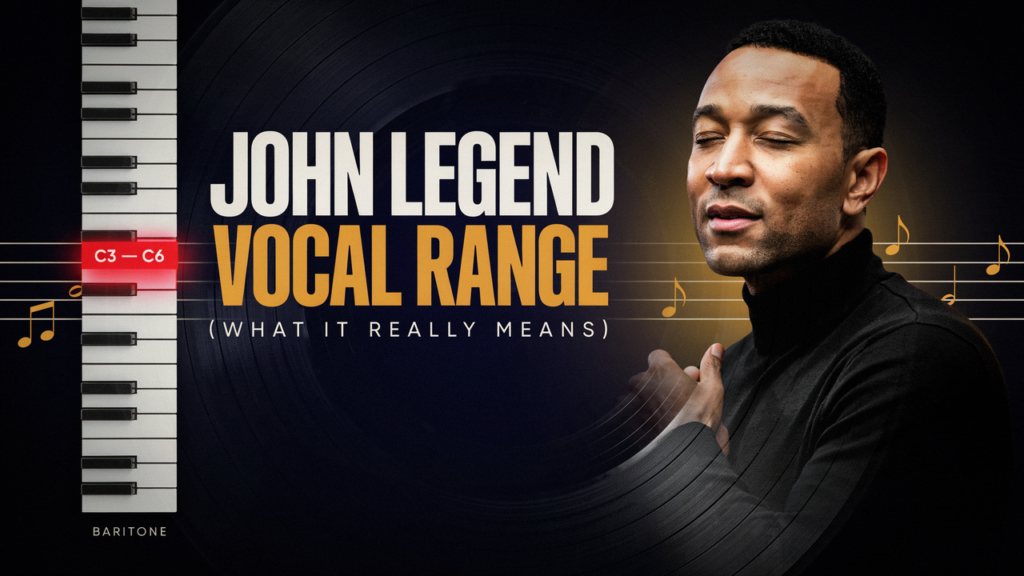
John Legend’s practical recorded vocal range is approximately A2 to C5, spanning two octaves and three semitones. Some vocal compilations extend his range below A2 or considerably above C5, but those wider figures may include quiet low sounds, background parts, falsetto, ad-libs, or pitches that are difficult to attribute confidently.
His most characteristic singing occupies a narrower area, roughly C3 to A4. This is where Legend’s warm tone, controlled vibrato, connected phrasing, and gospel-influenced delivery are heard most consistently. His artistry depends more on tonal control and expression than on displaying extreme notes.
What Is John Legend’s Vocal Range?
The A2–C5 estimate offers a useful summary of John Legend’s stable, musically relevant singing. It includes his resonant lower register, the strong middle voice central to his repertoire, and upper notes produced through a combination of chest-dominant coordination, mixed voice, and lighter registration.
| Range category | Approximate notes | How to interpret it |
|---|---|---|
| Practical recorded range | A2–C5 | A cautious estimate based on clearly musical singing |
| Characteristic working area | C3–A4 | Where much of his lead singing is concentrated |
| Lower register | A2–C3 | Warm, subdued, and sometimes speech-like |
| Upper full-voice area | G4–B♭4 | Stronger notes requiring efficient register balance |
| C5 and above | Variable | Often lighter, brief, improvised, or falsetto-based |
These categories should not be treated as rigid boundaries. A recording captures what a singer performed in a particular key, arrangement, and career period—not every pitch the singer could possibly produce.
Legend’s total range is also different from his tessitura. Range identifies the outer endpoints, while tessitura describes the area he uses repeatedly and can sustain comfortably. His tessitura appears far more relevant to his sound than isolated low or high notes.
John Legend’s Lowest and Highest Notes
Approximately A2 is a reasonable lower boundary for John Legend’s clearly musical recorded singing. Broader databases sometimes place him as low as F2 or even C2, but those claims need careful examination. A pitch near the bottom of a recording may be quiet, fry-like, doubled, processed, or produced by another voice in the arrangement.
His practical upper boundary is commonly placed around C5. Legend can also use falsetto and live ad-libs above his usual full-voice range, but these extensions should be labeled separately rather than presented as equivalent to a sustained C5 in connected singing.
Claims extending his voice to G5, G♯5, or even G6 are difficult to evaluate without identifying the exact recording, vocalist, register, and duration. A very brief detected pitch does not automatically establish a usable sung note.
A reliable John Legend range profile therefore favors clearly attributable lead vocals over the widest number available online. Readers learning to interpret these endpoints can use the site’s pitch detector to identify pitches, but pitch detection still requires human judgment when recordings contain harmonies and instruments.
Is John Legend a Baritone or Tenor?
John Legend is most reasonably described as a contemporary baritone with comfortable access to tenor-range notes. The informal term “baritenor” also communicates the balance between his baritone warmth and upper-register flexibility, although it is not a precise classical voice category.
His lower-middle register carries more depth and weight than that of a typical light tenor. He frequently sounds settled around C3 to E4, while his upper-middle notes maintain warmth instead of becoming sharply brilliant.
At the same time, Legend can sing phrases around G4, A4, and B♭4 with enough clarity and flexibility to overlap tenor repertoire. This overlap does not automatically make him a tenor. Voice classification also considers tessitura, timbre, vocal weight, passaggio behavior, and the singer’s most sustainable register.
The site’s explanation of what defines a baritone provides useful context. Modern R&B singers do not always fit neatly into classical classifications because microphones, amplification, stylistic vowel choices, and falsetto allow them to use their voices differently.
John Legend’s Usable Range and Tessitura
Legend’s likely working area of approximately C3–A4 is more informative than his outer endpoints. It contains the warm verses, rising pre-choruses, and expressive climaxes heard throughout his repertoire.
His lower phrases tend to remain connected to speech, giving the lyrics clarity and intimacy. As the melody rises, he gradually brightens the tone and reduces some vocal weight. This allows him to approach the upper fourth octave without making every high passage sound shouted.
A useful comparison is Luther Vandross’s vocal range. Both singers are associated with warmth, legato, and refined R&B phrasing, but their tonal weight and use of the upper register are not identical. Range overlap does not mean vocal equivalence.
John Legend also shares gospel and soul foundations with Stevie Wonder, whose voice often uses a brighter, more agile upper placement. These comparisons show why tone, rhythm, and register strategy matter alongside note count.
Chest Voice, Mixed Voice, and Falsetto
John Legend does not produce every pitch with the same vocal coordination. His lower and middle notes often retain a chest-led quality, while higher phrases require a lighter balance.
His chest voice supplies the richness heard in conversational verses. As he ascends, he uses a blended coordination commonly described in contemporary singing as mixed voice. The sound remains connected and substantial, but it does not carry the full weight of the lower register upward.
Falsetto provides another color. Legend uses it for softness, vulnerability, contrast, and occasional upper extensions. It should not be confused with his upper full voice, even though both may occur at similar pitches.
This controlled movement between vocal weights distinguishes him from singers whose falsetto is the dominant feature of their sound. Comparing Legend with Sam Smith’s vocal range and register use makes that difference especially clear.
What Is the Vocal Range of “All of Me”?
The published melody of “All of Me” is generally placed around C3 to B4, though arrangements and transcriptions may label the upper pitch as B♭4 depending on the version and notation used. Either way, the song does not represent Legend’s entire vocal range.
Its difficulty comes from more than its endpoints. The verses demand controlled low-volume singing, while the chorus rises into an upper area that must remain connected and emotionally intense. Repeated high phrases can be more demanding than touching one higher note in isolation.
The exposed piano arrangement also leaves little room to hide unstable pitch, uneven breath, or abrupt register changes. This helps explain why the song can challenge singers whose total measured range appears wide enough on paper.
What Makes John Legend’s Voice Distinctive?
John Legend’s voice combines warm resonance, smooth legato, measured vibrato, and rhythmically flexible phrasing. His background in gospel and soul is apparent in his use of dynamic swells, melodic embellishment, and call-and-response-like inflections.
His rounded vowels help preserve warmth, while selective brightness keeps upper notes clear. He can soften the onset of a phrase without allowing the entire performance to become excessively breathy.
His piano-led approach also influences his phrasing. The vocal often interacts closely with harmonic changes rather than simply floating above the accompaniment. A comparison with Alicia Keys’s vocal range reveals a similar relationship between singing, piano accompaniment, gospel vocabulary, and contemporary R&B storytelling.
Why John Legend Range Estimates Conflict
Published estimates vary because analysts count different kinds of sounds. Common sources of disagreement include:
- Full voice versus falsetto
- Stable pitches versus momentary ad-libs
- Sung notes versus vocal fry
- Lead vocals versus layered background parts
- Studio recordings versus altered live performances
- Original melodies versus improvised endings
- Pitch-detector errors caused by instruments or harmonies
This explains how one source can report A2–C5 while another claims C2–G6. The narrower estimate may omit genuine extensions, but the wider estimate becomes misleading if it fails to identify who produced each pitch and how it was sung.
The most responsible conclusion is that A2–C5 represents a credible working estimate, while notes outside that span should be evaluated individually.
Frequently Asked Questions
How many octaves can John Legend sing?
The estimated A2–C5 range spans two octaves and three semitones. His total possible range may be wider when falsetto and disputed extensions are included.
What is John Legend’s highest supported note?
C5 is a reasonable practical upper estimate. Higher notes are sometimes reported, but they may involve falsetto, improvisation, layered vocals, or uncertain attribution.
What is John Legend’s lowest note?
Approximately A2 is a cautious lower estimate for clearly musical singing. Lower claims exist, but they require stronger recording-level verification.
Is John Legend a baritone?
Yes, contemporary baritone is the most useful description. “Baritenor” may also describe his ability to combine baritone warmth with access to upper notes commonly associated with tenors.
Does John Legend sing “All of Me” in falsetto?
Most of the principal melody uses connected modal or mixed coordination rather than sustained falsetto. He may use lighter production and falsetto colors in live variations and ad-libs.

Harlow is a vocal analysis and singing tools writer at Voice Range Test. She focuses on vocal range testing, voice type analysis, pitch recognition, and singing education tools for singers, musicians, choir performers, and beginners.