
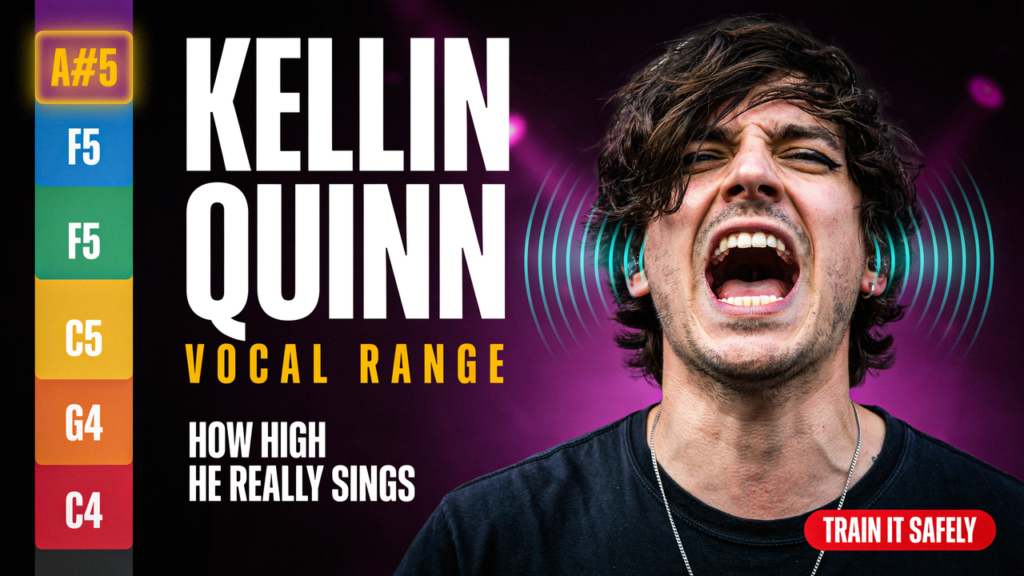
Kellin Quinn’s vocal range is commonly estimated at approximately B2 to A5, spanning nearly three octaves. A more conservative estimate for clearly identifiable clean singing is around C3 to G5. The wider range includes rare low notes and upper-register sounds that may be produced with falsetto or a head-dominant coordination.
Quinn is best classified as a high tenor, not a countertenor. His voice is recognized for its bright timbre, high tessitura, connected mixed register, and ability to alternate between clean singing and aggressive post-hardcore vocals.
| Vocal characteristic | Approximate assessment |
|---|---|
| Broad reported range | B2–A5 |
| Conservative clean range | C3–G5 |
| Approximate span | Nearly three octaves |
| Probable voice type | High tenor |
| Strongest area | Upper fourth and lower fifth octaves |
| Known for | Bright resonance, high mix, falsetto and screams |
What Is Kellin Quinn’s Documented Vocal Range?
Available vocal profiles do not agree on one exact range. Older analyses commonly place Quinn around C3–G5, while broader estimates extend from B2 to A5. An album-specific analysis of Let’s Cheers to This identifies a range of approximately D3–F5.
These figures can all describe different parts of his recorded output. D3–F5 represents material from one album, C3–G5 provides a cautious clean-vocal estimate, and B2–A5 includes less common career-wide extremes.
Quinn’s practical singing range is more important than either endpoint. Many Sleeping with Sirens songs remain high for long stretches, frequently occupying the upper fourth octave and moving into the fifth. That sustained tessitura is what makes his catalog demanding for most male singers.
Kellin Quinn’s Lowest Notes
Quinn can reach the lower part of the third octave and has been credited with notes around B2. However, his low register is not the center of his vocal identity.
His lower notes are generally lighter and less chest-heavy than those of a baritone. They often appear in quieter verses, acoustic arrangements, or passages designed to contrast with a high chorus. The sound retains his naturally bright color rather than becoming especially dark or bass-like.
This matters when interpreting the B2–A5 estimate. The B2 is an edge note, not evidence that Quinn is equally comfortable across the entire second and third octaves.
Kellin Quinn’s Highest Notes
Quinn’s highest commonly cited notes extend to approximately A5. Those extreme pitches should be separated from his forceful mixed singing, since an A5 produced with falsetto does not require the same coordination as an A5 belt.
His more characteristic upper notes fall around B4–F5. He repeatedly uses this area for choruses, climactic phrases, and emotionally intense lines. Notes in this region may combine a light modal foundation, head resonance, and strong twang.
His high range invites comparisons with Brendon Urie’s vocal range. Both singers can work comfortably above the typical male pop center, although Urie often uses a fuller theatrical belt while Quinn favors a thinner, sharper post-hardcore tone.
Is Kellin Quinn a Tenor or Countertenor?
Kellin Quinn is most accurately described as a high tenor, sometimes informally called a leggero tenor because of his light, agile, and bright vocal quality.
A countertenor usually sings primarily through a falsetto or head-dominant mechanism to perform music in an alto-like range. Quinn uses falsetto, but much of his signature singing retains more connection and intensity than pure falsetto.
His classification depends on several characteristics:
- A naturally bright and relatively light timbre
- Ease through the upper fourth octave
- Frequent fifth-octave singing
- A high-centered tessitura
- Strong mixed-register coordination
- Less emphasis on a heavy low register
A voice type test can provide a useful starting point for singers, but range endpoints alone cannot establish whether someone is a tenor, baritone, or countertenor. Timbre, comfort, vocal weight, and register transitions also matter.
Why Does Kellin Quinn’s Voice Sound So High?
Quinn’s vocal sound results from both natural traits and learned coordination. His timbre is naturally light and youthful, but he also uses resonance choices that make the voice sound even brighter.
One important element is twang. This focused resonance helps a singer project through loud guitars without relying entirely on greater breath pressure. It creates the sharp, ringing quality heard in many Sleeping with Sirens choruses.
He also avoids carrying excessive chest weight upward. As the melody rises, his voice becomes lighter and more head-influenced. That transition allows him to sing above the area where many male voices begin to feel heavy.
Matt Bellamy’s vocal range offers another example of a rock singer using light upper coordination and falsetto, though Bellamy’s phrasing and alternative-rock tone differ noticeably from Quinn’s post-hardcore delivery.
Chest Voice, Mixed Voice and Falsetto
Quinn uses several vocal registers rather than producing every high note the same way.
His chest voice appears most clearly in lower and middle passages. It is relatively light, which makes the transition toward his upper register less abrupt than it would be for a heavier voice.
Mixed voice helps him retain intensity above the comfortable limit of ordinary chest voice. The term “mix” does not mean that chest voice and head voice are blended in one fixed percentage. It describes a coordinated transition that preserves clarity and strength while reducing unnecessary weight.
Falsetto extends his range further and creates contrast. It is usually airier and less dense than his mixed notes. Studio layering, compression, and double-tracking can make either coordination sound thicker on a recording.
This versatility resembles the register contrast found in Adam Lambert’s vocal range, although Lambert typically uses a broader, more theatrical resonance and a heavier upper belt.
Do Kellin Quinn’s Screams Count Toward His Range?
Not every scream should be counted as a vocal-range note. A scream belongs in a pitch measurement only when it contains a stable, identifiable fundamental pitch.
Quinn combines clean vocals with distorted singing and more aggressive screams. Some distorted lines retain a clear melody and can reasonably contribute to a documented range. Other screams emphasize texture, noise, and emotional impact rather than one sustained musical pitch.
This is why range compilations can produce different answers. One analyst may include a pitched scream, while another accepts only clean vowels. The article’s B2–A5 estimate therefore describes a broad recorded span, while C3–G5 is a more cautious representation of clear singing.
The separation is also important for vocal safety. Screaming is not simply clean singing performed with more force. Beginners should not imitate distortion by squeezing the throat, pushing excessive air, or continuing through pain.
Songs That Showcase Kellin Quinn’s Voice
“If You Can’t Hang” is one of the clearest examples of Quinn’s high tessitura. The chorus remains bright and elevated, demanding more than a single isolated high note.
“Do It Now Remember It Later” demonstrates the urgency of his mixed register and his ability to cut through a dense arrangement. “A Trophy Father’s Trophy Son” combines clean upper singing with emotional shifts and heavier vocal textures.
“Roger Rabbit” reveals a more exposed side of his technique. Its acoustic setting makes register transitions, phrasing, and tonal changes easier to hear without the protection of a large rock arrangement.
“King for a Day,” his collaboration with Pierce the Veil, contrasts Quinn’s timbre with Vic Fuentes and places both singers in a demanding upper register. “Love Race” creates a different contrast by pairing Quinn’s high, bright tone with Machine Gun Kelly’s lower, rougher vocal delivery.
Listeners interested in another vocalist who moves between melodic singing and aggressive rock textures can compare Quinn’s approach with Gerard Way’s vocal range. Quinn generally sings with a higher, lighter center, while Way often uses more midrange weight.
Studio Vocals Versus Live Performances
Sleeping with Sirens recordings often use vocal doubling, harmonies, compression, reverb, and other production techniques. These processes can make a high vocal line sound denser and more consistent, but they do not manufacture the underlying musical pitch.
Live singing introduces different demands. Quinn must perform several high-tessitura songs consecutively while moving onstage and managing both clean and aggressive vocals. Fatigue, touring schedules, monitor balance, and set-list placement can affect individual performances.
A strained or imperfect live note does not invalidate his recorded range. Likewise, one exceptional studio note does not prove that the same pitch is comfortably repeatable throughout a concert.
What Singers Can Learn From His Technique
Quinn’s most useful lesson is efficient upper-register coordination. His sound relies on brightness, reduced vocal weight, and focused resonance rather than dragging a heavy chest voice as high as possible.
Singers should develop clean notes before adding distortion. Gentle slides, moderate-volume scales, and work with a qualified teacher can help build the transition between chest, mix, and falsetto.
The experimental flexibility associated with Mike Patton’s vocal range shows how many sounds the human voice can produce, but unusual effects still require control. Stop immediately if high singing or screaming causes sharp pain, burning, or persistent hoarseness.
Frequently Asked Questions
How many octaves can Kellin Quinn sing?
His reported B2–A5 range covers almost three octaves. The more conservative C3–G5 estimate covers approximately two octaves and a perfect fifth.
What is Kellin Quinn’s highest note?
A5 is commonly reported as his upper extreme. It is likely associated with a lighter upper-register coordination rather than a full chest-voice belt.
What is Kellin Quinn’s lowest note?
B2 appears in broader career-range estimates, although his more clearly established lower singing begins around C3 or D3.
Is Kellin Quinn a countertenor?
He is better classified as a high tenor. He uses falsetto, but his regular singing also includes modal voice and a connected upper mix.
Does Kellin Quinn sing in falsetto?
Yes. Falsetto contributes to his upper extension, but not every high note is falsetto. Many of his signature lines use a brighter and more connected mixed coordination.
Can most men learn to sing as high as Kellin Quinn?
Training can improve range and register coordination, but anatomy and natural voice type influence the final result. Singers should develop their own comfortable range instead of forcing Quinn’s exact tessitura.
Kellin Quinn’s vocal range is impressive because he does more than touch high notes. He sustains an unusually high tessitura, moves between clean and aggressive textures, and uses a bright mixed register that remains recognizable throughout the Sleeping with Sirens catalog.

Harlow is a vocal analysis and singing tools writer at Voice Range Test. She focuses on vocal range testing, voice type analysis, pitch recognition, and singing education tools for singers, musicians, choir performers, and beginners.