
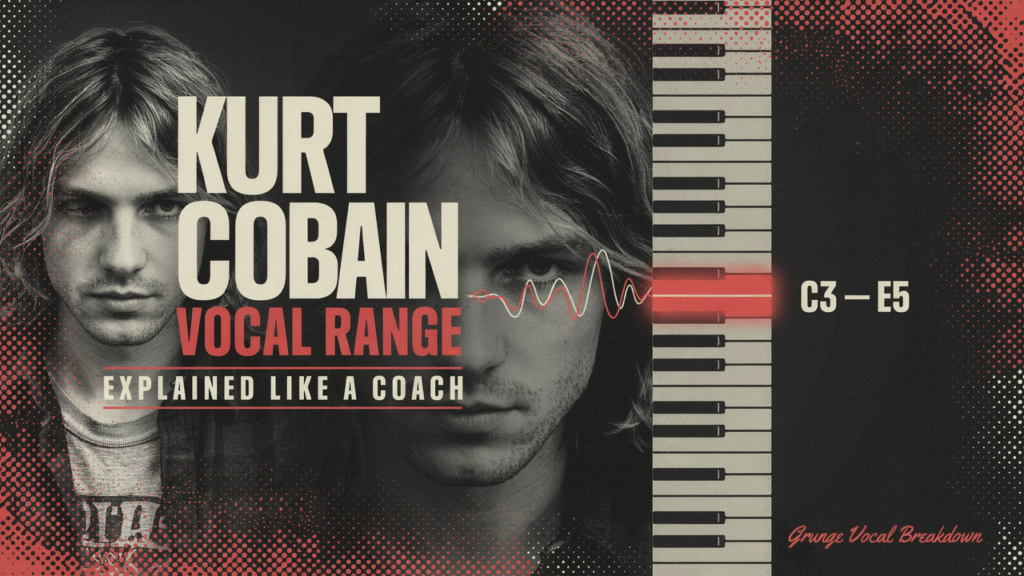
Kurt Cobain’s commonly cited vocal range was approximately F2 to C5, spanning two octaves and seven semitones. The exact endpoints remain debatable because his recordings combine clean singing, shouting, rasp, unstable pitch, vocal fry and heavily distorted screams.
Most Nirvana melodies occupy a narrower and more repeatable range, generally around C3 to A4. Cobain’s voice sounded wider and higher than these notes suggest because he used extreme changes in volume, vocal weight and distortion. A pitch in the fourth octave could sound explosive when delivered with his characteristic rasp.
Kurt Cobain’s vocal range F2–C5
87.3–523 Hz · 2 octaves and 7 semitones · High baritone or baritenor
Documented range You
Don’t know your range? Take the voice range test.
Kurt Cobain Vocal Range Summary
| Vocal characteristic | Approximate assessment |
|---|---|
| Commonly cited complete range | F2–C5 |
| Total span | 2 octaves and 7 semitones |
| More representative melodic range | Approximately C3–A4 |
| Likely voice type | High baritone or baritenor |
| Upper extension | Distorted belt, shout and scream |
| Main register | Chest-dominant modal voice |
| Signature qualities | Rasp, dynamic contrast and emotional intensity |
The F2–C5 estimate includes live variations and aggressively produced upper notes. It should not be interpreted as a consistently clean, comfortable range.
Why Kurt Cobain’s Range Estimates Conflict
Published estimates for Cobain range from fewer than three octaves to spans approaching five octaves. These disagreements usually result from three problems.
First, some analyses count noises, vocal fry and unpitched screams alongside conventionally sung notes. A sound can contain a detectable frequency without functioning as a stable melodic pitch.
Second, live performances changed from night to night. Cobain regularly altered melodies, shouted additional notes or allowed his voice to break intentionally. A single live extension may demonstrate possibility without establishing a repeatable range.
Third, several online transcriptions contain obvious octave errors. Familiar Nirvana melodies have sometimes been labeled an octave or two higher than they sound. Claims placing “Drain You” near B6 or the normal melody of “Aneurysm” around F5 should therefore be treated cautiously.
The F2–C5 estimate is still approximate, but it aligns more plausibly with Cobain’s audible lows, typical song ranges and most famous upper-register performances.
What Was Kurt Cobain’s Lowest Note?
F2 is a reasonable estimate for Cobain’s lowest supported live singing. Notes around this area appear in subdued live passages and altered versions of familiar Nirvana songs.
His better-documented studio lows usually sit higher. “Polly” descends to approximately D3, “Lithium” reaches around C3 and “Come as You Are” stays near E3 at its lower end.
Cobain’s low notes were rarely resonant in the polished, classical sense. He often sang them quietly, with breathiness, fry or a conversational quality. This made the verses feel vulnerable and emotionally withdrawn before the choruses became louder.
For comparison, Eddie Vedder’s vocal range features a more consistently rounded and weighty low register. Cobain’s lower voice was usually thinner, less formal and deliberately fragile.
What Was Kurt Cobain’s Highest Note?
C5 is a reasonable approximate upper limit when Cobain’s intense live singing and distorted screams are included. The climactic section of “Where Did You Sleep Last Night” from MTV Unplugged in New York is frequently associated with this upper area.
That famous final passage is difficult to measure as if it were a clean studio note. Cobain moves through a rough, highly emotional sound in which distortion and pitch instability are part of the performance. C5 is therefore better treated as an approximate distorted extension than a clean sustained high note.
His regular Nirvana repertoire more often peaks between F4 and A4. “Heart-Shaped Box” and “About a Girl” reach approximately A4, while songs such as “Lithium” remain lower on paper despite sounding extremely intense.
The high notes in Layne Staley’s vocal range offer a revealing grunge comparison. Staley generally produced a more focused and sustained upper tone, while Cobain favored instability, breaking texture and raw attack.
Kurt Cobain’s Range in Famous Nirvana Songs
| Song | Approximate vocal range | Main vocal challenge |
|---|---|---|
| “Polly” | D3–E4 | Quiet pitch control and restrained storytelling |
| “Come as You Are” | E3–F4 | Consistent low-mid tone and relaxed phrasing |
| “Lithium” | Approximately C3–F4 | Sudden changes from subdued verses to shouted choruses |
| “Heart-Shaped Box” | A3–A4 | Sustained upper phrases and distorted intensity |
| “About a Girl” | B3–A4 | Melodic accuracy and upper-register energy |
| “Smells Like Teen Spirit” | Primarily middle to upper-middle range | Stamina, attack and repeated rasp |
| “Where Did You Sleep Last Night” | Variable live range, extending toward C5 | Gradual buildup and climactic distorted singing |
The notes do not fully communicate each song’s difficulty. “Lithium,” for example, does not require an exceptionally high clean pitch, but the contrast between its restrained verses and explosive repeated chorus makes it physically and stylistically demanding.
Was Kurt Cobain a Baritone or Tenor?
Cobain is most reasonably described as a high baritone or baritenor. His lower register, vocal weight and darker natural tone suggest baritone qualities. However, much of his repertoire required him to sing with the intensity and placement commonly associated with rock tenors.
“Baritenor” is an informal contemporary term rather than a strict classical category. It describes a singer whose voice combines baritone weight with access to a higher rock tessitura.
Calling Cobain a tenor solely because he reached C5 would be misleading. That pitch was an exceptional distorted extension, not necessarily part of his comfortable clean tessitura. Calling him a conventional baritone also fails to explain how frequently he drove his voice through the upper fourth octave.
The tenor vs baritone distinction depends on comfort, timbre and tessitura—not simply the highest and lowest notes a singer has produced.
Clean Voice vs Rasp and Distortion
Cobain’s clean voice is easiest to hear in quieter recordings such as “Polly,” “Something in the Way” and sections of Nirvana’s MTV Unplugged performance. The tone is direct, speech-like and sometimes deliberately breathy.
His rasp added irregular noise above the sung pitch. This texture made the voice appear larger and more aggressive without necessarily changing the fundamental note.
During the loudest choruses, his production moved toward a chest-dominant shout or distorted belt. The exact balance of vocal-fold vibration, constriction and added noise cannot be diagnosed reliably from a finished recording. It is therefore inaccurate to label every rough sound as one specific modern distortion technique.
Cobain also allowed his voice to crack or destabilize. In conventional training, singers may try to remove such breaks. He used them as expressive events, reinforcing the sense that the performance could collapse at any moment.
A different approach to rock intensity can be heard across Chris Cornell’s vocal range. Cornell combined distortion with a more extended, technically controlled upper register, while Cobain’s identity depended more heavily on emotional unpredictability.
Range vs Working Tessitura
Cobain’s complete F2–C5 span is less important than the area in which Nirvana songs repeatedly placed him. His working tessitura was generally in the middle and upper-middle male range, often rising through the fourth octave during choruses.
The notes themselves are not always unusually high. The difficulty comes from repeating them with substantial volume, chest-dominant weight and rasp over loud guitars.
“Smells Like Teen Spirit” demonstrates this clearly. A singer may possess every required pitch but still struggle with the repeated attacks and sustained intensity. Singing the entire song is different from producing its highest note once.
Cobain’s vocal endurance was a major part of his live identity. Nirvana sets combined loud arrangements, limited recovery time and songs built around abrupt quiet-to-loud transitions.
Why Nirvana Songs Are Difficult to Sing
Nirvana songs can seem simple because their melodies are memorable and often use a limited number of pitches. Their vocal demands include:
- Abrupt changes between quiet and loud production
- Repeated chest-dominant upper notes
- Long phrases with forceful consonants
- Emotional intensity without losing the melody
- Rasp layered over a recognizable pitch
- Maintaining stamina through an entire set
- Singing against dense guitar distortion
The greatest mistake is assuming that matching Cobain’s tone requires squeezing the throat or shouting as loudly as possible. That may create a rough sound briefly, but it does not reproduce the coordination heard on the recordings.
Chester Bennington’s vocal range provides another example of how distorted rock vocals can contain clear pitch and intentional dynamic control. The audible aggression does not mean the singer should ignore technique.
Can Kurt Cobain’s Style Be Imitated Safely?
The melodic elements of Cobain’s style can be practiced cleanly: speech-like phrasing, dynamic contrast, vowel choices and controlled chest-dominant singing. Distortion should be added only after the underlying notes are stable and comfortable.
Singers should not copy the audible effort by forcing air through a tight throat. Pain, burning, loss of range or persistent hoarseness are signs to stop. A rough sound is not successful if normal speaking or singing becomes difficult afterward.
Begin with a comfortable key and reduce the volume of the chorus. A vocal warm-up generator can help prepare the clean range before practicing demanding rock material. Singers who want to develop distortion should work with a teacher experienced in contemporary rock techniques.
Frequently Asked Questions
What was Kurt Cobain’s vocal range?
His commonly cited complete range was approximately F2–C5, spanning two octaves and seven semitones. The endpoints include live and distorted production.
What was Kurt Cobain’s highest note?
C5 is a reasonable approximate upper extension, particularly when the climactic distorted singing in “Where Did You Sleep Last Night” is included.
What was his lowest note?
F2 is often used as his lower live endpoint. His clearly documented studio melodies more commonly descend to notes around C3–E3.
Was Kurt Cobain a baritone?
He likely possessed a high-baritone or baritenor voice. His tone and low register suggest baritone qualities, while his repertoire regularly entered tenor-like rock territory.
Did Kurt Cobain sing or scream?
He did both. His performances combined clean modal singing, breathiness, chest-dominant shouting, rasp, vocal breaks and distorted screams.
Which Nirvana song best demonstrates his range?
“Where Did You Sleep Last Night” displays his dramatic upper extension, while “Lithium” demonstrates the contrast between his quieter lower singing and explosive upper delivery.
Kurt Cobain’s approximate F2–C5 range was useful, but it was not the primary reason his voice became iconic. His ability to transform modest melodic material through dynamics, texture and emotional urgency gave Nirvana a vocal identity that remains difficult to reproduce.

Harlow is a vocal analysis and singing tools writer at Voice Range Test. She focuses on vocal range testing, voice type analysis, pitch recognition, and singing education tools for singers, musicians, choir performers, and beginners.