
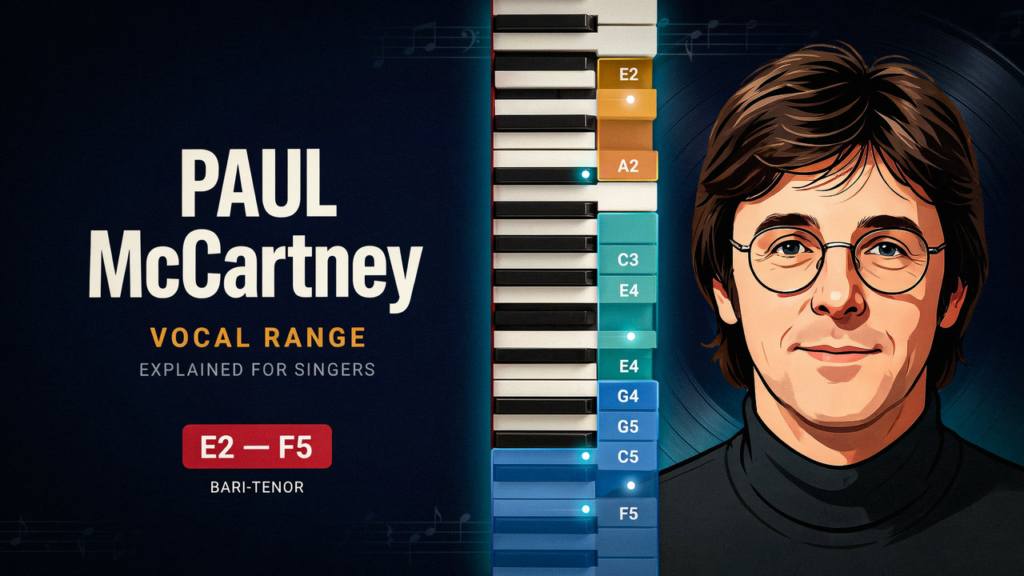
Paul McCartney’s vocal range is conservatively estimated at approximately F♯2 to B5, spanning three octaves and five semitones. Another frequently cited working estimate is E2–A5, which covers the same number of semitones but uses different boundary notes.
Much wider claims extending from A1 to E6 also circulate, but these may include vocal fry, background harmonies, brief screams, studio effects, or uncertain octave identification. McCartney’s confirmed achievement is not one disputed extreme—it is the breadth of controlled styles he demonstrated across Beatles, Wings, solo, and live recordings.
Paul McCartney’s vocal range F♯2–B5
92.5–988 Hz · 3 octaves and 5 semitones · Tenor
Documented range Wider reported range (A1–E6) You
Don’t know your range? Take the voice range test.
What Is Paul McCartney’s Vocal Range?
The F♯2–B5 estimate provides a useful career-wide starting point because both boundaries have been connected to identifiable solo recordings. F♯2 has been associated with “Vanilla Sky,” while B5 has been attributed to “A Love for You.”
These notes should still be examined in context. A background layer, fleeting exclamation, or falsetto pitch does not represent the same vocal ability as a sustained lead note. McCartney’s everyday singing range was narrower than the distance between his absolute recorded extremes.
| Range category | Approximate notes | Span | Evidence assessment |
|---|---|---|---|
| Conservative career-wide estimate | F♯2–B5 | 3 octaves, 5 semitones | Connected to identifiable recordings |
| Common practical estimate | E2–A5 | 3 octaves, 5 semitones | Widely reported but source-dependent |
| Wider fan-reported range | A1–E6 | 4 octaves, 7 semitones | Includes disputed or unusual sounds |
| Primary voice type | Tenor | Best fit for his classic repertoire | |
| Signature strengths | Upper-middle range, stylistic flexibility and harmony | More important than isolated extremes |
McCartney’s range is unusually varied in color. He could move from a gentle, rounded ballad tone to bright pop tenor singing, falsetto, rasp, and an aggressive rock-and-roll scream.
McCartney’s Lowest and Highest Reported Notes
McCartney’s conservative documented low is approximately F♯2. Some profiles begin his range at E2, while fan compilations extend it as low as A1.
An A1 is extremely low for a conventional tenor. If accepted, it would most likely represent vocal fry, a brief effect, an unusual studio sound, or a pitch outside his normal singing coordination. It should not be presented as evidence that McCartney regularly sang bass repertoire.
At the upper end, B5 is associated with “A Love for You.” Claims of C6 or E6 also appear, but the recording, vocal layer, and production type must be verified before those pitches can define his range.
| Note or area | Song or context | Vocal production | Evidence status |
|---|---|---|---|
| A1 | Fan-reported low | Likely fry or unusual effect | Disputed |
| E2–F♯2 | Lower recorded range | Low lead or layered singing | More defensible |
| A4–E5 | Frequent upper extension | Chest-dominant rock singing, mix or falsetto | Strongly demonstrated |
| B5 | “A Love for You” attribution | High studio vocal | Reported with identifiable song |
| C6–E6 | Fan-led extreme claims | Possible scream, backing layer or studio effect | Insufficiently established |
The highest Beatles-era note is a separate question from McCartney’s career-wide high. Falsetto backing vocals in songs such as “Lovely Rita” demonstrate fifth-octave access, but his post-Beatles work provides additional high-note evidence.
How Many Octaves Could Paul McCartney Sing?
Using either F♯2–B5 or E2–A5, McCartney’s range spans 41 semitones, equal to three octaves and five semitones.
The much broader A1–E6 claim covers 55 semitones, or four octaves and seven semitones. That is not five full octaves and should not be rounded upward.
McCartney could therefore sing more than three octaves by a conservative career-wide estimate. Claims approaching five octaves depend on whether extremely low fry, isolated exclamations, background layers, and unusual high effects are counted.
His usable range also changed throughout his career. A note available in a 1960s or 1970s studio session may not have remained equally comfortable decades later. That does not invalidate the earlier performance; it simply means a singer’s demonstrated lifetime range differs from a current touring range.
Is Paul McCartney a Tenor?
Paul McCartney is most reasonably described as a tenor, particularly when evaluating his Beatles and Wings repertoire.
His classic songs frequently occupy a bright upper-middle tessitura. He could sustain phrases above the range where many baritones would need to modify heavily, yet he also possessed enough lower extension to create warmer character voices.
McCartney was not limited to one fixed tone. His smoother tenor can be heard in songs such as “Yesterday,” “Here, There and Everywhere,” and “The Long and Winding Road.” His rock voice appears in “I’m Down,” “Helter Skelter,” and “Oh! Darling.”
Voice type is determined by more than the lowest and highest notes. Tessitura, register transitions, tone color, and vocal weight also matter. The guide to tenor voices explains why an isolated A1 claim would not automatically make McCartney a bass or baritone.
His voice also provides a natural comparison with John Lennon’s vocal range. Lennon often brought a sharper, rawer edge, while McCartney displayed particularly broad control over contrasting character voices and upper-register colors.
Chest Voice, Falsetto and Rock Screams
McCartney’s chest voice could sound smooth, youthful, warm, nasal, bright, or deliberately rough. He modified it according to the musical role rather than maintaining one signature placement in every song.
His upper chest and mixed singing were central to his rock performances. “Maybe I’m Amazed” and “Call Me Back Again” require sustained intensity across high phrases rather than a single spectacular note.
Falsetto gave him another color. He used it in lead and backing vocals for lightness, humor, harmony, or emotional contrast. A falsetto note should be included in the total demonstrated range but distinguished from a full, chest-dominant high note.
His Little Richard-influenced rock scream is heard in songs such as “Long Tall Sally,” “I’m Down,” and “Oh! Darling.” These performances retain recognizable pitches while adding rasp and distortion. However, highly distorted screams can be difficult to measure because their overtones may confuse pitch-detection tools.
McCartney’s expressive upper singing can be contrasted with the sustained rock-tenor sound described in Steve Perry’s vocal-range profile, while Roy Orbison’s range demonstrates a different approach to high male pop singing.
Songs That Best Demonstrate His Range
Several recordings reveal different areas of McCartney’s voice:
- “Yesterday” demonstrates controlled, lyrical singing without relying on extreme notes.
- “Here, There and Everywhere” highlights smooth phrasing, tonal balance, and upper-register ease.
- “I’m Down” showcases his aggressive rock-and-roll voice.
- “Helter Skelter” uses sustained intensity, rasp, and shouted melodic production.
- “Oh! Darling” moves from relatively controlled verses into increasingly forceful upper singing.
- “Maybe I’m Amazed” demonstrates high, emotionally charged lead vocals with sustained power.
- “Monkberry Moon Delight” uses an exaggerated, rough character voice across demanding phrases.
- “Call Me Back Again” is one of his strongest post-Beatles examples of soulful upper-register singing.
- “A Love for You” is associated with the reported B5 career high.
- “Vanilla Sky” has been linked to the conservative F♯2 lower boundary.
His ability to combine piano-led songwriting with diverse vocal colors invites comparison with Elton John’s vocal range and Billy Joel’s range.
How McCartney’s Voice Changed Across His Career
During the Beatles years, McCartney’s voice was youthful, flexible, and capable of both polished pop singing and forceful rock distortion. His upper range remained an important feature during the Wings and early solo years, when songs such as “Maybe I’m Amazed” and “Call Me Back Again” demanded sustained high singing.
Later performances generally developed a rougher, lighter, and less predictable upper sound. He has sometimes adjusted melodies or keys to suit his current instrument. Transposition is a normal performance strategy: it allows an older singer to preserve phrasing and musical communication without treating the original studio key as a test.
McCartney’s lifetime recorded range should therefore be separated from his current comfortable range. A vocal scale finder can similarly help singers explore pitches that fit their present voice rather than forcing a song’s original key.
Frequently Asked Questions
What is Paul McCartney’s vocal range?
A conservative career-wide estimate is F♯2–B5, spanning three octaves and five semitones. E2–A5 is another common estimate, while A1–E6 is a wider but disputed claim.
What is Paul McCartney’s highest note?
B5 has been associated with “A Love for You.” Higher C6 or E6 claims exist but require stronger verification of the recording and vocal production.
What is Paul McCartney’s lowest note?
F♯2 is a defensible lower boundary linked to “Vanilla Sky.” E2 is also commonly reported, while A1 likely involves fry or another unusual production.
Did Paul McCartney have a five-octave range?
Not according to the better-supported calculations. Even the broad A1–E6 estimate equals four octaves and seven semitones, not five complete octaves.
Was Paul McCartney a tenor?
Yes. Tenor is the most practical classification for his classic voice because of his tessitura, bright upper-middle singing, flexibility, and extensive high repertoire.
Which song best demonstrates McCartney’s voice?
No single song shows every register. “Oh! Darling,” “Maybe I’m Amazed,” and “Monkberry Moon Delight” demonstrate power and color, while “Here, There and Everywhere” shows his smoother lyrical control.

Harlow is a vocal analysis and singing tools writer at Voice Range Test. She focuses on vocal range testing, voice type analysis, pitch recognition, and singing education tools for singers, musicians, choir performers, and beginners.