
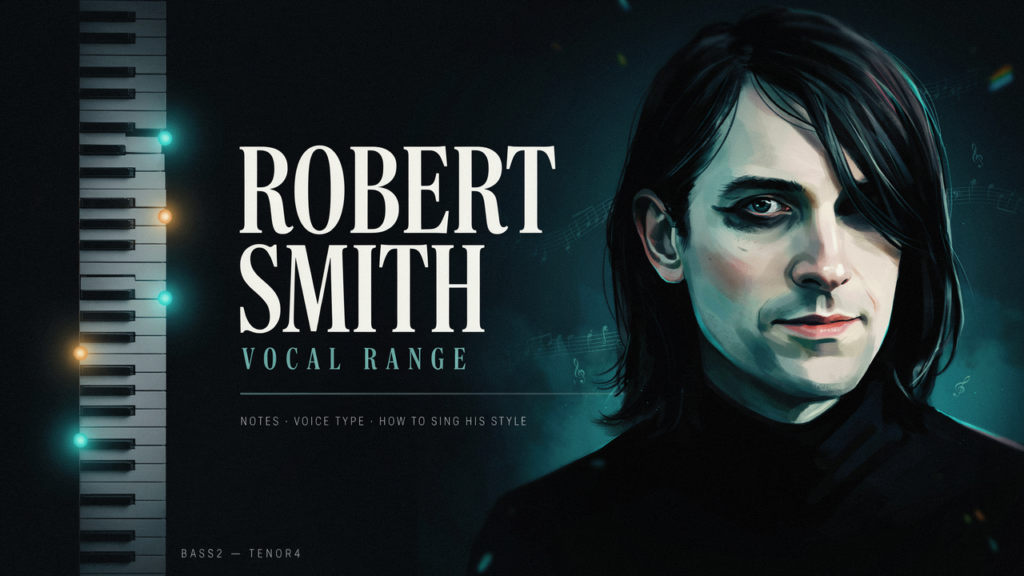
Robert Smith’s commonly reported vocal range is approximately G2 to B4, spanning two octaves and four semitones. Some performances may extend into approximately C5–D5 through falsetto, light upper-register singing, or brief expressive effects, but these pitches are less consistently documented.
The Cure frontman’s voice is recognizable because of its emotional tone, flexible phrasing, vibrato, and contrast between dark lower notes and fragile-sounding highs. His vocal identity depends more on texture and interpretation than on extreme range.
What Is Robert Smith’s Vocal Range?
The most defensible working estimate for Robert Smith is G2–B4, with a possible light or falsetto extension to D5.
| Range area | Approximate notes | Typical use |
|---|---|---|
| Reported low range | G2–A2 | Dark, restrained passages |
| Main working range | B2–G4 | Most melodic singing |
| Upper clean or mixed area | A4–B4 | Emotional climaxes |
| Light or falsetto extension | C5–D5 | Brief, airy upper notes |
| Core documented span | G2–B4 | 2 octaves and 4 semitones |
| Extended reported span | G2–D5 | 2 octaves and 7 semitones |
These figures should be treated as recording-based estimates rather than fixed biological limits. Smith has recorded and performed for decades, and different analyses may count falsetto, backing vocals, shouts, live variations, and studio effects differently.
Claims extending his range to A5 or B5 require clearer song-level evidence before they can be presented as established notes.
Robert Smith’s Lowest and Highest Notes
Robert Smith’s reported G2 is associated with the darker end of his recorded singing. His more representative low notes, however, often sit higher than that and form part of a soft, atmospheric delivery rather than a heavy bass-like sound.
B4 is a reasonable upper boundary for his clearly connected melodic singing. Notes around C5–D5 are better categorized as a reported light or falsetto extension.
| Pitch area | Vocal context | Evidence status |
|---|---|---|
| G2–A2 | Low, dark studio or live phrases | Commonly reported extreme |
| B2–E4 | Core melodic singing | Strongly representative |
| F4–G4 | Intensified upper-middle phrases | Frequently demonstrated |
| A4–B4 | Upper connected or lightly mixed singing | Reported and plausible |
| C5–D5 | Falsetto, light production, or brief effects | Context-dependent |
| Above D5 | Unclear or layered material | Insufficiently supported |
This separation matters because a brief falsetto note does not describe the same ability as a sustained B4 within a complete performance. Range, usable range, and tessitura are related but different measurements.
How Many Octaves Can Robert Smith Sing?
A range from G2 to B4 contains 28 semitones, equal to two octaves and four semitones.
If the reported falsetto extension reaches D5, the total becomes 31 semitones, or two octaves and seven semitones. It should not be rounded up to three octaves.
Smith’s range is not exceptionally wide compared with singers known for three-, four-, or five-octave spans. Its effectiveness comes from how many vocal colors he creates inside it. The same general pitch area can sound intimate, anxious, joyful, exhausted, romantic, or desperate depending on his phrasing and tone.
Is Robert Smith a Tenor or Baritone?
Robert Smith is often described as a baritone because of his dark timbre and low-register color. However, his light delivery and frequent upper-middle singing also produce tenor-like qualities.
A careful contemporary description is a baritone-colored alternative-rock voice with a flexible upper extension.
Characteristics supporting this description include:
- A dark and rounded lower-middle tone
- A main tessitura that is not exceptionally low
- Regular movement into the fourth octave
- A relatively light approach to higher phrases
- Access to falsetto and airy upper notes
- Less vocal weight than a traditional dramatic baritone
The baritone voice guide explains why vocal color and range alone cannot produce a definitive classification. Passaggi, tessitura, resonance, vocal weight, and sustained comfort also matter.
For contrast, Jim Morrison’s vocal range is more consistently associated with a heavy, low-centered rock delivery. Smith often uses less weight and more tonal fragility, even when the two singers occupy overlapping pitches.
What Is Robert Smith’s Comfortable Range?
Robert Smith’s likely working tessitura sits primarily within his middle register, approximately from the upper second or lower third octave into the middle fourth octave.
This area allows him to maintain intelligible lyrics, distinctive vowel shapes, and emotional intensity without depending on extreme notes. Songs such as “Lovesong,” “Lullaby,” “Pictures of You,” and “A Forest” demonstrate how he can sustain interest through tone and phrasing while remaining in a moderate range.
His high notes are often most effective because they emerge from a restrained middle voice. A sudden rise sounds dramatic even when the note itself is not unusually high.
This is one reason his music can be deceptive for singers. The melody may appear manageable on paper, but reproducing the register transitions, sustained breath flow, vowel shapes, and emotional timing can be difficult.
Does Robert Smith Use Falsetto?
Robert Smith uses falsetto and light upper-register production as expressive colors, but not every soft or high note should be classified as falsetto.
Falsetto generally has a lighter vocal-fold closure and a less chest-dominant quality. Smith sometimes uses this lighter sound to create distance, vulnerability, or dreamlike contrast. Elsewhere, he sings softly in a connected register or blends vocal qualities in ways that are difficult to classify from a finished recording alone.
“Just Like Heaven” is a useful example of his ability to move between a conversational middle register and lighter upper phrases. His voice does not suddenly become a conventional power belt; it retains a delicate, slightly unstable character that suits the song.
Thom Yorke’s vocal range provides a relevant comparison. Both singers use falsetto and tonal vulnerability, although Yorke places more consistent emphasis on sustained high falsetto singing.
Why Does Robert Smith’s Voice Sound So Distinctive?
Smith’s recognizable sound comes from several interacting features.
Breathy color: Some phrases contain audible airflow, creating intimacy and fragility. It should not be assumed that every breathy note uses identical vocal coordination.
Vibrato: His pitch movement can be broad and conspicuous rather than classically even. It contributes to the pleading or unsettled quality of his singing.
Vowel shaping: Smith stretches and modifies vowels in a highly personal way. This influences both resonance and emotional meaning.
Flexible timing: He does not always phrase with rigid rhythmic symmetry. Words may arrive slightly early, late, or drawn out across the instrumental texture.
Dynamic contrast: Quiet verses can build into open, urgent climaxes without becoming conventionally polished rock belting.
Emotional roughness: Small cracks, tonal edges, and fluctuations can remain in the performance when they strengthen the song’s mood.
Like Bob Dylan’s vocal approach, Smith’s phrasing and tonal identity matter more than conventional smoothness. Unlike Dylan, Smith frequently incorporates a more floating upper register and prominent vibrato.
Songs That Best Demonstrate Robert Smith’s Voice
| Song | Vocal feature demonstrated |
|---|---|
| “Pictures of You” | Sustained atmospheric phrasing and emotional build |
| “Just Like Heaven” | Bright delivery and movement toward lighter registers |
| “Lullaby” | Restrained dynamics, low color, and theatrical diction |
| “Lovesong” | Direct middle-register singing and controlled intensity |
| “Sinking” | Clearer tone, register movement, and carefully shaped phrases |
| “A Forest” | Detached early-period delivery and dark atmosphere |
| “To Wish Impossible Things” | Intimate tone and emotional restraint |
| “Disintegration” | Urgent phrasing and extended vocal intensity |
Smith’s approach differs from Kurt Cobain’s textured singing. Cobain often moves toward rasp, compression, and explosive volume, while Smith more frequently uses breathiness, vibrato, and tonal instability.
David Bowie’s vocal range offers another useful comparison. Both singers reshape their voices to serve a song’s character, though Bowie’s vocal personas and register choices vary more dramatically across genres.
How Has Robert Smith’s Voice Changed?
Smith’s early recordings often feature a lighter, more detached vocal quality. As The Cure’s arrangements became denser and more emotionally expansive, his singing developed greater weight, vibrato, and dramatic intensity.
Age has naturally added depth and texture to his voice. Recent performances may sound heavier or rougher than his 1980s studio recordings, yet much of the core identity remains: elongated vowels, emotional urgency, dark lower color, and a recognizable upper-register ache.
Aging does not automatically reveal whether his total range has expanded or contracted. Transposed songs, changed arrangements, microphone technique, fatigue, and individual performance choices must all be considered before drawing that conclusion.
Frequently Asked Questions
What is Robert Smith’s vocal range?
Robert Smith’s commonly reported range is approximately G2–B4, with a possible light or falsetto extension to C5–D5.
What is Robert Smith’s highest note?
B4 is a reasonable reported upper boundary for his connected melodic singing. C5–D5 may appear through falsetto or lighter production, but exact upper extremes remain source-dependent.
What is Robert Smith’s lowest note?
G2 is commonly cited as his lowest recorded pitch. His regular melodic lows generally sit higher and should not be confused with one isolated extreme.
Is Robert Smith a baritone?
He has a baritone-colored timbre, but his relatively light production and flexible upper range make a precise classical classification inappropriate.
Does Robert Smith sing in falsetto?
Yes. He uses falsetto and other light upper-register sounds for contrast, vulnerability, and atmosphere.
Why is Robert Smith’s voice so recognizable?
His voice combines dark timbre, breathy color, conspicuous vibrato, unusual vowel shaping, flexible timing, and emotionally exposed phrasing.

Harlow is a vocal analysis and singing tools writer at Voice Range Test. She focuses on vocal range testing, voice type analysis, pitch recognition, and singing education tools for singers, musicians, choir performers, and beginners.