
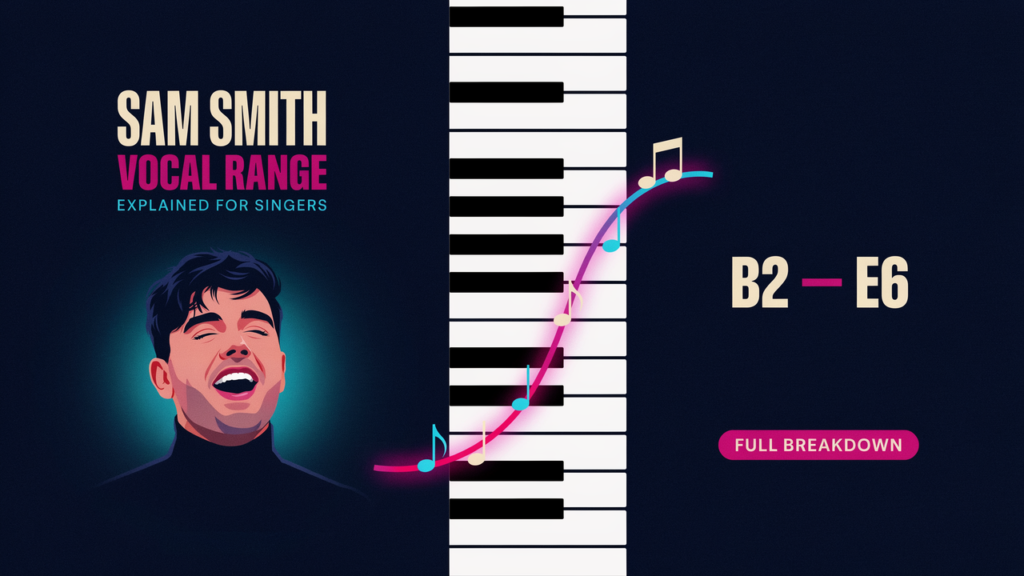
Sam Smith’s vocal range is commonly estimated at approximately A2 to E6, spanning four octaves and seven semitones. However, this broad figure includes rare low notes, upper falsetto, layered studio vocals and isolated extremes. A more conservative range of C3 to D6 better represents clearly identifiable singing across their recorded catalog.
Sam’s voice is best known for its emotional upper register, smooth transitions and light, flexible tone. Although frequently called a countertenor, they can be described more precisely as a high or light tenor with a highly developed falsetto and countertenor-like extension.
What Is Sam Smith’s Vocal Range?
There is no universally accepted range measurement for Sam Smith. Different analyses use different criteria when deciding which notes count.
| Range measurement | Approximate notes | What it represents |
|---|---|---|
| Broad recorded range | A2–E6 | Rare lows, studio layers and upper falsetto |
| Conservative identifiable range | C3–D6 | Clearly attributable lead and supporting vocals |
| Common singing area | Approximately E3–B4 | Frequently used melodic territory |
| Voice type | High or light tenor | Supported by tessitura, tone and register use |
The difference between the broad and conservative figures does not mean one estimate is necessarily wrong. A total recorded range includes every identifiable pitch, while a usable range focuses on notes a singer can perform clearly and repeatedly.
Readers unfamiliar with scientific pitch notation can use this guide to vocal-range notes to understand where A2, middle C and the sixth-octave notes appear on a keyboard.
How Many Octaves Can Sam Smith Sing?
Using A2 as the lowest documented boundary and E6 as the highest, Sam Smith’s range covers four octaves and seven semitones.
The calculation is:
- A2 to A3: one octave
- A3 to A4: two octaves
- A4 to A5: three octaves
- A5 to A6: four octaves
- A6 down to E6: seven semitones below the complete fifth octave
This is often summarized as approximately 4.6 octaves. Using the more conservative C3–D6 estimate produces a range of three octaves and two semitones.
An octave count is useful for comparison, but it does not reveal where the voice sounds strongest. Tessitura, tone, stamina and register coordination are more informative than the distance between two isolated notes.
Sam Smith’s Lowest Notes
Sam’s lower register is less prominent than their middle and upper registers. Most verses do not descend much below C3 or D3, where their tone becomes intimate, warm and speech-like.
“Stay With Me” contains phrases and harmonies around C3, while “Lay Me Down” demonstrates the softer lower-middle qualities of the voice. These notes provide contrast before the melodies rise into the emotional choruses for which Sam is best known.
Some range listings identify A2 as their lowest recorded note. It should be treated as an extreme rather than the bottom of their everyday tessitura. Low notes may also be difficult to verify when a recording contains doubled vocals, background singers or processed harmonies.
The lower extension shows that Sam’s instrument is not limited to high singing. Nevertheless, these rare pitches do not automatically make them a baritone. Voice classification involves more than finding the lowest possible note.
Sam Smith’s Highest Notes
Sam’s highest documented notes are generally produced in head voice or falsetto. Conservative analyses place the upper boundary around C6 or D6, while broader databases report an E6 associated with “Life Support.”
These notes sit far above the range used in most of Sam’s lead melodies. They are better understood as upper extensions than as the center of the voice.
More representative high-note examples include:
- “I’m Not the Only One,” reaching approximately C5
- “Stay With Me,” reaching C5 in upper lines and harmonies
- “Writing’s on the Wall,” reaching approximately D♭5
- “Too Good at Goodbyes,” reaching approximately D5
- “Like I Can,” featuring demanding upper phrases and layered vocals
Some published song ranges count background harmonies rather than the principal melody. For that reason, a highest-note claim should identify whether the pitch comes from the lead vocal, an overdub, a harmony or a live performance.
Singers working toward similar pitches should develop their upper register gradually. This guide to extending the upper vocal range explains why coordination is safer and more productive than forcing volume.
Is Sam Smith a Tenor or Countertenor?
Sam Smith is frequently described as a countertenor because of their light timbre and extensive use of falsetto. In contemporary music, that description communicates how unusually comfortable they sound in the upper register.
A stricter classification would be high or light tenor with a countertenor-like falsetto extension. Much of Sam’s lead singing sits in a range associated with tenors, while the highest notes depend on lighter register coordination.
A countertenor traditionally sings primarily in a developed head or falsetto register, often occupying repertoire comparable to contralto or mezzo-soprano parts. Sam uses those colors, but they also rely extensively on modal voice, mixed coordination and contemporary pop phrasing.
The broader categories covered in types of vocal ranges help explain why a singer’s highest note alone cannot determine their voice type.
Chest Voice, Mix, Head Voice and Falsetto
Sam’s vocal identity comes largely from the contrast between registers.
Their chest-dominant voice appears in lower, conversational phrases. As melodies rise, they reduce vocal weight and move toward a lighter mixed coordination. Head voice and falsetto provide the floating high notes heard in songs such as “Stay With Me” and “Writing’s on the Wall.”
Sam does not always hide the transition between registers. A noticeable flip, breathy onset or momentary vocal break can become part of the emotional delivery. This makes vulnerable lyrics feel immediate rather than technically polished for their own sake.
Their high notes also depend on controlled airflow. Excessive breath pressure would make these transitions unstable, which is why effective breath support for singers matters even when the intended tone sounds soft or airy.
What Makes Sam Smith’s Voice Distinctive?
Sam’s range is only one part of their recognizable sound. Several qualities contribute to their vocal identity:
- A light, flexible upper register
- Clear shifts between fuller and breathier tones
- Controlled vibrato on sustained notes
- Gospel- and soul-influenced phrasing
- Smooth melodic runs
- Precise dynamic changes
- Emotionally exposed delivery
Their recordings often begin with restrained verses and grow toward fuller choruses. This contrast makes the upper notes feel more dramatic without requiring constant belting.
Melismatic runs also play an important role. These passages require each pitch to remain distinct, so developing pitch accuracy is as important as expanding the total range.
Did Sam Smith’s Vocal Surgery Change Their Voice?
Sam Smith underwent vocal-cord surgery in 2015 after experiencing a vocal-cord hemorrhage. They subsequently completed a period of vocal rest and rehabilitation before returning to performance.
It would be inaccurate to claim that surgery permanently increased or reduced their range without clinical evidence. Recordings made at different points in their career can vary because of song choice, production, technique, age and artistic direction.
Later performances may sound fuller or differently balanced, but those changes should not automatically be interpreted as damage. A studio recording and a live performance also place very different demands on the voice.
Frequently Asked Questions
What is Sam Smith’s vocal range?
Their broad recorded range is commonly estimated at A2–E6. A more conservative range of C3–D6 excludes some disputed extremes and uncertain studio layers.
How many octaves can Sam Smith sing?
The broad A2–E6 estimate spans four octaves and seven semitones, or approximately 4.6 octaves.
What is Sam Smith’s highest note?
E6 is among the highest reported notes, although C6–D6 is a more conservative upper boundary for clearly identifiable singing.
What is Sam Smith’s lowest note?
A2 is frequently reported as the lowest extreme. However, C3 is closer to the lower boundary heard regularly in identifiable melodic singing.
Is Sam Smith a countertenor?
Sam has a countertenor-like upper extension and regularly uses falsetto. High or light tenor is a more cautious overall classification when tessitura and modal singing are considered.
Why does Sam Smith sing so high?
They use a coordinated combination of mix, head voice and falsetto rather than carrying a heavy chest voice through the entire upper range.

Harlow is a vocal analysis and singing tools writer at Voice Range Test. She focuses on vocal range testing, voice type analysis, pitch recognition, and singing education tools for singers, musicians, choir performers, and beginners.