
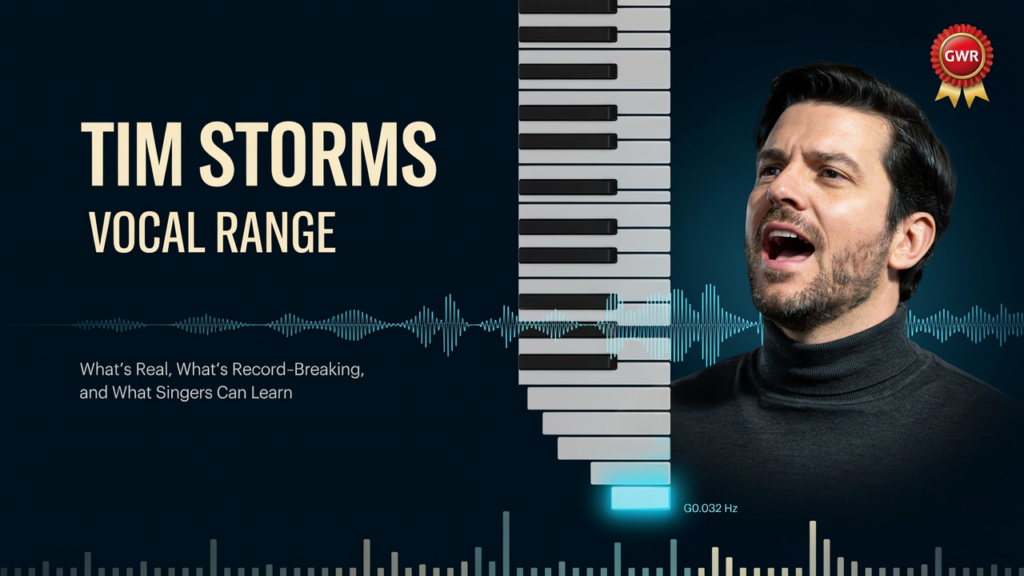
Tim Storms has one of the most extraordinary voices ever measured. He holds Guinness World Records for the greatest vocal range by a male and the lowest vocal note produced by a male.
His widest-range measurement covered approximately ten octaves, from a pitch between G and G♯ in octave −5 to the corresponding area in octave 5. In a separate record attempt, he produced an even lower G−7 at 0.189 Hz.
Those achievements are often combined incorrectly. Tim Storms does not have an officially measured 12-octave range from G−7 to G5. His ten-octave range and G−7 low note come from separate measurements conducted in different years.
What Is Tim Storms’ Vocal Range?
Tim Storms’ Guinness-certified vocal range extends from approximately G/G♯−5 to G/G♯5, measured at 0.7973–807.3 Hz.
This is recognized as a ten-octave range based on its frequency span. Guinness notes that the pitches fall between standard G and G♯ note centers, so the interval expressed through concert-pitch notation is closer to nine octaves and eleven semitones.
| Vocal measurement | Verified result |
|---|---|
| Widest-range record | Approximately G/G♯−5 to G/G♯5 |
| Measured frequencies | 0.7973–807.3 Hz |
| Recognized span | 10 octaves |
| Lowest-note record | G−7 at 0.189 Hz |
| Voice category | Exceptionally low bass |
| Record years | 2008 and 2012 |
According to Guinness World Records, the greatest-range measurement was achieved in 2008. His lower G−7 record followed four years later.
These octave numbers sit far beyond an ordinary piano, so reviewing how vocal range notes are named can make the measurements easier to understand.
Tim Storms’ Two Guinness World Records
Tim Storms holds two related but separate records.
In 2008, his voice was measured across approximately ten octaves, from 0.7973 Hz to 807.3 Hz. This established the record for the greatest vocal range by a male.
In 2012, he produced a G−7 measuring 0.189 Hz, establishing the record for the lowest vocal note by a male. Audiologists and audio engineers used specialized equipment to detect and analyze the extremely slow vocal activity.
The 2012 result does not automatically extend the range measured in 2008. To establish a continuous 12-octave range, the lower and upper endpoints would need to be confirmed together under the appropriate record conditions.
This distinction is essential when comparing him with other singers discussed in our guide to the widest vocal range.
What Is Tim Storms’ Lowest Note?
Tim Storms’ lowest verified note is G−7 at 0.189 Hz.
Hertz measures cycles per second. At 0.189 Hz, one complete cycle takes approximately 5.3 seconds. That is radically different from a conventional sung pitch, in which the vocal folds repeat their vibration many times each second.
For perspective, a standard low piano note still produces vibrations fast enough to be heard as a recognizable pitch. Storms’ G−7 is far below the piano and below the range people normally experience as pitched sound.
His achievement currently represents the most extreme verified example covered by our overview of the lowest vocal range.
Can Humans Hear Tim Storms’ Lowest Note?
Most people cannot hear 0.189 Hz as a normal musical note.
The commonly cited range of human hearing begins around 20 Hz, although actual perception varies with the listener, volume, equipment, and environment. A frequency as low as 0.189 Hz falls deep into the infrasonic region.
Specialized equipment can detect slow vocal-fold activity even when listeners cannot perceive a clear pitch. A person may notice movement, pulses, pressure, vibration, or higher-frequency components produced alongside the fundamental frequency. That is different from hearing the 0.189 Hz fundamental as a clean G.
This is why “lowest vocal frequency” is more precise than imagining a conventionally audible note played several octaves below a piano.
What Is Tim Storms’ Highest Note?
The upper endpoint of Storms’ 2008 range measurement was between G and G♯ in octave 5, at approximately 807.3 Hz.
Some online profiles claim that his range extends to G7. That endpoint is not part of the Guinness range measurement described above. Other sources combine his later G−7 low record with the earlier upper endpoint and describe a 12-octave range, which is also misleading.
His measured upper endpoint is particularly remarkable because Storms is known primarily for his extremely low bass voice. It demonstrates that his record is not based only on descending into vocal fry; it also reflects an unusually broad span of measurable vocal frequencies.
Does Tim Storms Really Have a 12-Octave Range?
Tim Storms does not have an officially confirmed continuous 12-octave range based on the available Guinness measurements.
The 12-octave claim usually comes from this calculation:
- The 2012 lowest-note record: G−7
- The approximate upper endpoint from the 2008 range test: G/G♯5
- The assumed combined range: approximately 12 octaves
The arithmetic may appear logical, but it combines endpoints from two separate record attempts. It does not prove that both notes were produced as part of one continuous range under the same testing conditions.
The accurate description is that Storms has a Guinness-recognized ten-octave vocal range and a separate G−7 lowest-note record.
What Voice Type Is Tim Storms?
Tim Storms is an exceptionally low bass singer. He is also sometimes described as a basso profondo, a term used for particularly deep bass voices.
However, classical voice classification involves more than the lowest possible note. It considers comfortable tessitura, vocal weight, timbre, register transitions, projection, and suitable repertoire. A record-setting frequency does not by itself establish a formal operatic classification.
Storms clearly belongs within the broad bass category, but his extreme frequencies go far beyond the normal range described in our guide to what a bass voice is.
Record Range Versus Musical Singing Range
A record-measured vocal range is not the same as a usable musical range.
Usable range consists of pitches a singer can perform repeatedly with stable intonation, recognizable tone, adequate volume, and control. Extreme frequencies may depend on vocal fry, pulse-like vibration, subharmonic behavior, or other specialized coordination.
Storms does not sing ordinary melodies across ten octaves. Much of his record range falls outside the pitches used in conventional music and, at the lowest end, outside ordinary human hearing.
His musical bass performances therefore occupy a much smaller area than his total measured frequency span. This does not diminish the record. It simply separates an extraordinary physiological capability from practical singing.
The comparison also shows why the typical human vocal range should not be judged against world-record endpoints.
Can You Train Your Voice to Sing That Low?
Training can improve access to your lower register, but anatomy places meaningful limits on how low your voice can go. Vocal-fold size, mass, coordination, and the structure of the vocal tract all affect low-note production.
Safe practice can help you develop:
- A more relaxed lower register
- Better airflow control
- Clearer pitch at the bottom of your range
- Smoother movement into vocal fry
- Greater consistency on existing low notes
Do not force the larynx downward, press the throat, or imitate infrasonic effects with excessive tension. Stop if an exercise causes pain, burning, or persistent hoarseness.
Most singers will never approach Tim Storms’ frequencies—and they do not need to. A clear, repeatable low note is more valuable musically than an unstable extreme.
Frequently Asked Questions
How many octaves can Tim Storms sing?
Tim Storms holds a Guinness record for a vocal range of approximately ten octaves, measured from about 0.7973 Hz to 807.3 Hz.
What is Tim Storms’ lowest note?
His verified lowest note is G−7 at 0.189 Hz, produced during a separate 2012 record attempt.
What is Tim Storms’ highest note?
The upper endpoint of his official 2008 range measurement was between G and G♯ in octave 5, at approximately 807.3 Hz.
Can humans hear Tim Storms’ lowest note?
People generally cannot hear the 0.189 Hz fundamental as a conventional musical pitch. Equipment can detect the vocal activity, while listeners may perceive pulses, vibration, or higher-frequency components.
Does Tim Storms have a 12-octave vocal range?
A continuous 12-octave range has not been established by the cited Guinness measurements. That claim combines his separate G−7 lowest-note record with the upper endpoint from an earlier range test.
What voice type is Tim Storms?
He is an exceptionally low bass singer. He is sometimes described as a basso profondo, although formal voice classification depends on more than extreme notes.
Final Takeaway
Tim Storms’ official achievements are remarkable enough without exaggeration. He has a Guinness-recognized vocal range of approximately ten octaves and separately produced the record-setting G−7 at 0.189 Hz.
His results demonstrate the difference between a measurable vocal frequency and an ordinary musical note. They also show why extreme range, usable singing range, and voice type must be evaluated separately.

Harlow is a vocal analysis and singing tools writer at Voice Range Test. She focuses on vocal range testing, voice type analysis, pitch recognition, and singing education tools for singers, musicians, choir performers, and beginners.