
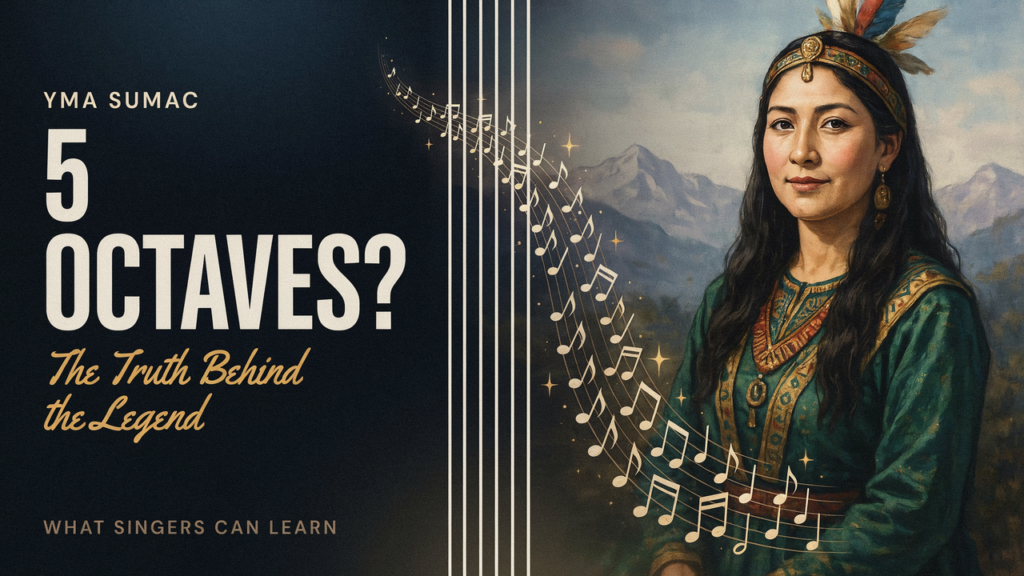
Yma Sumac was celebrated for a voice described as spanning well over four octaves, with five octaves also claimed. The exact lowest and highest notes are not established by the biographical source cited here. Her reputation for an exceptional range is better supported than any single precise endpoint pair.
That leaves two different questions: what historical accounts say about her voice, and what a modern note-by-note analysis can verify. A biography can support the first without supplying the recordings and timestamps needed for the second.
What Does the Documentary Source Say?
The Hollywood Walk of Fame biography identifies Sumac as a Peruvian soprano. It describes her range as exceeding four octaves and notes that five octaves were sometimes claimed at her peak.
This is an attributed description, not a published pitch audit. It does not name a lowest note, highest note, performance date or method for counting vocal effects.
Consequently, this article does not replace the five-octave claim with a supposedly verified four-and-a-half-octave measurement. Both precise totals require a defined evidential basis.
Do the Common Endpoint Claims Equal Five Octaves?
Two note pairs circulated in range discussions illustrate why checking the arithmetic matters:
E2–C♯7: 57 semitones, equal to four octaves and nine semitones.
B2–F♯7: 55 semitones, equal to four octaves and seven semitones.
Five complete octaves require 60 semitones. Neither pair reaches that interval, even though each covers parts of six numbered octave regions.
Scientific pitch notation changes the octave number at C. Counting the octave numbers touched by a range is therefore different from measuring its musical distance. The vocal range notes guide explains the naming system.
These calculations clarify the claims; they do not verify that Sumac sang the endpoints. Nor do they rule out every possible five-octave claim based on other performances.
Why Is It Difficult to Name Her Highest Note?
An upper vocal effect can contain a short pitch, a sliding pitch and strong overtones. Analysts must decide which sound is the fundamental and whether the pitch is sustained enough to count under their chosen rules.
Historical recordings introduce another variable: a transfer played at the wrong speed shifts every pitch. A range analysis should identify the particular release or performance, rather than treating all uploads with the same song title as identical.
Terms such as “whistle-like” describe an audible quality. They do not, by themselves, prove how the vocal folds produced a sound. This article does not assign every extreme note to a physiological register or certify a seventh-octave maximum.
For comparisons with another singer associated with very high sounds, the Minnie Riperton range article also separates biographical octave claims from exact-note evidence.
What About Her Lowest Notes?
The same evidence standard applies at the bottom. A clear melodic note, a growl, a speech-like sound and loosely pitched vocal fry should not be silently treated as equivalent.
E2 is one proposed endpoint, but the source checked here does not establish it. A complete claim should provide an identifiable passage and distinguish the fundamental from background instruments.
Low notes also do not automatically change a singer’s voice type. Sumac’s soprano description can coexist with an unusually broad collection of vocal sounds. The soprano voice guide explains why classification includes more than extremes.
How to Evaluate “Chuncho” Range Demonstrations
“Chuncho (The Forest Creatures)” is frequently discussed as a showcase of Sumac’s range. If you use a performance to assess a claim, record its version and duration first.
Next, isolate the passage being claimed, note its timestamp and compare the pitch with a reference. Check whether a melody, vocal imitation or instrumental sound is being counted. Keep brief effects separate from repeatable sustained singing.
Finally, distinguish a single-performance range from a career compilation. A video combining low and high sounds recorded years apart cannot establish that both appeared in one performance.
These steps make a comparison reproducible. They also reveal why a headline alone cannot determine who possesses the widest vocal range.
Range Is Not the Same as Tessitura
A wide set of endpoints does not mean every intervening note was equally comfortable, loud or repeatable. It also does not tell us where complete phrases sat most naturally.
For your own singing, compare the demands of a specific melody with your repeatable notes. The explanation of what a five-octave range means puts extreme measurements in practical context.
Frequently Asked Questions
Did Yma Sumac have five octaves?
Five octaves were claimed, and the cited biography records that claim. It does not provide the endpoint evidence needed to certify an exact 60-semitone span.
Was she a soprano or contralto?
The Hollywood Walk of Fame identifies her as a soprano. An isolated low note would not establish a separate contralto classification.
What was her exact range?
This article does not certify an exact pair of notes. E2–C♯7 and B2–F♯7 remain claims requiring performance-level documentation.

Harlow is a vocal analysis and singing tools writer at Voice Range Test. She focuses on vocal range testing, voice type analysis, pitch recognition, and singing education tools for singers, musicians, choir performers, and beginners.