
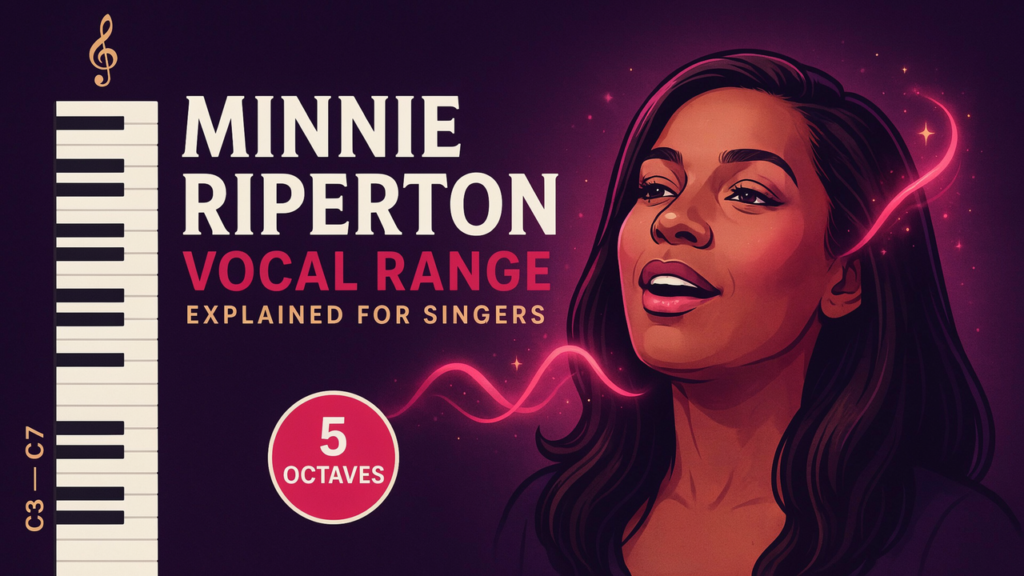
Minnie Riperton is widely described as a singer with a five-octave range, especially because of her whistle-register singing. That is a biographical description rather than a verified pair of career endpoints in this article. The separately circulated D3–F-sharp7 estimate spans four octaves and four semitones, not five complete octaves.
The distinction matters: her reputation for extraordinary high singing is not the same claim as an exact lowest-to-highest measurement. Whichever total a source gives, it should explain which performances and vocal sounds were counted.
Did Minnie Riperton Really Have Five Octaves?
AllMusic’s Minnie Riperton biography describes a five-octave voice. This is useful evidence that the description appears in established music reference writing. The biography does not supply an endpoint-by-endpoint measurement that independently verifies the interval.
D3–F-sharp7 is a different claim. D3 to D7 covers 48 semitones, and D7 to F-sharp7 adds four, giving 52. Five complete octaves would require 60 semitones.
If the lower note were D3, a five-octave upper endpoint would be D8. If the upper endpoint were F-sharp7, the lower endpoint would need to be F-sharp2. These are arithmetic examples, not claims that Riperton sang those particular notes.
There is insufficient evidence here to explain how the five-octave description originated. It would be speculation to say that biographers simply confused five numbered octave regions with five complete intervals.
What Were Her Lowest and Highest Notes?
D3, F7, and F-sharp7 appear in range discussions, but this review does not certify them as absolute limits. Each needs an identifiable recording, timestamp, and explanation of the vocal sound involved.
A brief whistle ornament, sustained vowel, low spoken inflection, and unstable pulse are not equivalent demonstrations. A total that combines them should say so clearly.
Historical live recordings add another difficulty: playback speed and tuning can affect apparent pitch. A clear note in an original-speed source is stronger evidence than an unexplained label on a compilation.
Comparisons with Yma Sumac’s vocal range should apply the same criteria to both singers. Broad biographical descriptions and individually measured notes should remain separate.
The High Notes in “Lovin’ You”
“Lovin’ You” is central to discussions of Riperton’s high singing. However, this article does not assign an exact maximum to its whistle passages without a verified transcription tied to a particular recording.
A published arrangement can represent the main sung melody while handling ornaments differently. Therefore, a relatively narrow sheet-music range does not establish that the recording contains no higher sounds.
When evaluating the famous passage, identify the vocal sound itself rather than accepting the highest frequency visible on a display. Musical sounds can contain harmonics above the fundamental. A high-frequency peak is not automatically the note being sung.
An analysis should also distinguish the original release from live versions and alternate recordings. The title of the song alone is not enough to identify the evidence.
Whistle Register as a Musical Resource
Whistle register describes a very high vocal production that can sound flute-like. An extreme pitch is only one aspect of its musical use. Timing, pitch intention, movement between notes, and connection with the surrounding phrase also matter.
For listening practice, compare a high ornament with the phrase that leads into it. Ask whether it repeats an earlier melodic idea, changes the phrase’s energy, or provides a contrasting color. These observations explain more than a single endpoint number.
The guide to whistle tones separates exploratory practice from forcing an extreme result. A famous performance is not a safe training target for every voice. Stop if attempts produce pain, hoarseness, or loss of ordinary comfortable notes.
Was Minnie Riperton a Coloratura Soprano?
Coloratura refers to agile, ornamental singing and also appears in formal classical voice descriptions. Riperton is often described using the term, but her popular-music work does not by itself establish an operatic Fach.
A high whistle note cannot substitute for an assessment of sustained tessitura, vocal weight, projection, and role suitability. The descriptive value of “coloratura” should not be confused with a formally documented casting classification.
Comparisons with Christina Aguilera can explore different uses of ornamentation. Comparisons with Vitas can raise questions about high-register color. Neither comparison requires declaring one singer better because of a higher alleged maximum.
How to Check an Extreme-Range Claim
Keep the recording title, version, timestamp, proposed note, duration, and uncertainty together. A number without its source cannot be independently checked.
A frequency finder may assist with a stable, clearly isolated sound. It can also follow instruments, harmonics, or background noise. Cross-check unexpected results instead of treating one reading as a record.
Frequently Asked Questions
How many octaves could Minnie Riperton sing?
Five octaves is a widely published biographical description. This article does not certify a complete measured span. The separate D3–F-sharp7 estimate equals four octaves plus four semitones.
Was F-sharp7 her highest note?
It is a reported claim, not an independently verified absolute maximum here. The exact performance and sound need examination.
Does whistle register count toward range?
It can count toward a clearly labelled total demonstrated range. It should not be presented as identical to comfortable lyric singing across the whole span.
Does a narrower song arrangement disprove her high notes?
No. An arrangement documents its own musical content and may not reproduce every ornament in a performance.

Harlow is a vocal analysis and singing tools writer at Voice Range Test. She focuses on vocal range testing, voice type analysis, pitch recognition, and singing education tools for singers, musicians, choir performers, and beginners.