
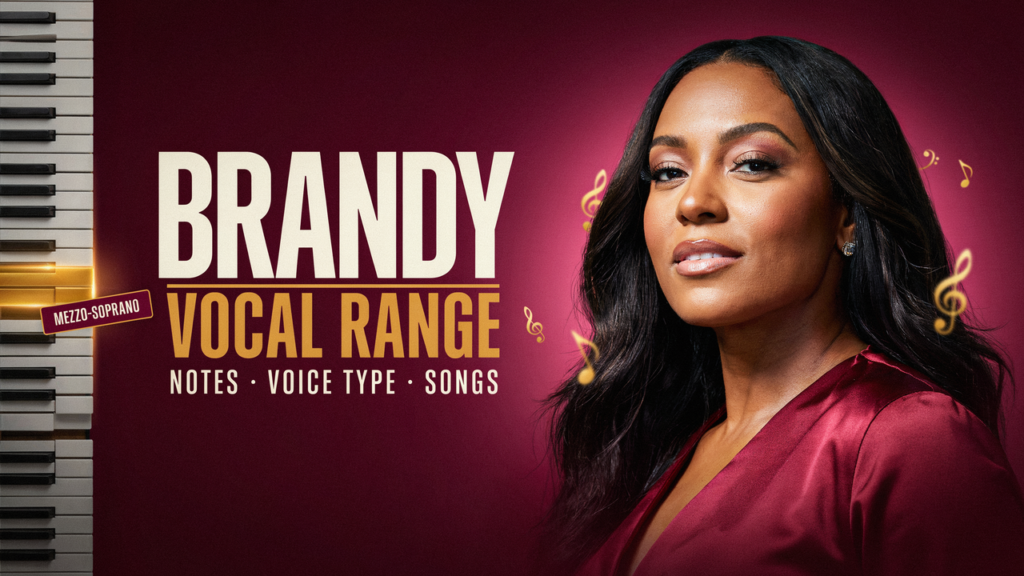
Brandy Norwood’s vocal range is commonly reported as approximately G2 to E6, a span of three octaves and nine semitones. However, those endpoints should be treated as a broad, source-dependent estimate rather than a continuous range she uses regularly. Her clearly recognizable lead vocals are concentrated much closer to the middle, where her smoky tone, rhythmic precision, agile runs, and layered harmonies are most effective.
Brandy is frequently described as a contralto or mezzo-soprano. A practical contemporary description is contralto-leaning mezzo-soprano, although her formal voice type cannot be established from range endpoints alone.
Brandy’s Vocal Range at a Glance
| Vocal characteristic | Approximate description |
|---|---|
| Commonly reported overall range | G2–E6 |
| Calculated span | 3 octaves and 9 semitones |
| Conservative lead-song evidence | Approximately F3–D5 |
| Common voice description | Contralto or low-centered mezzo-soprano |
| Strongest area | Lower-middle and middle register |
| Upper-range approach | Mixed coordination and head voice |
| Signature qualities | Smoky tone, runs, rhythmic phrasing and vocal layering |
The difference between the broad G2–E6 estimate and the more conservative F3–D5 area is important. The first may include background harmonies, brief sounds, unusual registers, and difficult-to-isolate studio layers. The second better represents pitches that can be identified in selected lead melodies.
Readers unfamiliar with scientific pitch notation can use this guide to understand vocal-range notes and octave numbers.
What Are Brandy’s Lowest and Highest Notes?
Brandy’s commonly cited lowest note is G2, while E6 is often presented as her highest. These claims create a reported span of 45 semitones. They should not be interpreted as proof that every note between G2 and E6 is equally strong, comfortable, or regularly available.
Some sources propose different endpoints, including E2 at the bottom and C6 at the top. This inconsistency usually comes from differences in methodology. One analysis may count a background-vocal layer, another may include a short head-voice sound, and another may restrict its measurement to clear lead singing.
Selected song analyses provide more conservative examples:
| Song | Approximate lead-vocal area | What it demonstrates |
|---|---|---|
| “Almost Doesn’t Count” | F3–C5 | Grounded lower-middle singing and controlled upper phrases |
| “Have You Ever” | F♯3–D5 | Dynamic development and sustained emotional phrasing |
| “Talk About Our Love” | G3–D5 | Rhythmic precision and upper-middle flexibility |
| “The Boy Is Mine” | G♯3–F♯4 | Restraint, conversational phrasing and tonal control |
These ranges describe the identifiable lead melody in a song, not Brandy’s complete vocal capacity. Her arrangements frequently contain stacked backing parts, making it difficult to attribute every audible pitch to a single exposed vocal line.
Is Brandy a Contralto or Mezzo-Soprano?
Brandy is often called a contralto because her voice has a dark, husky color and sounds comfortable in the lower-middle register. Other listeners classify her as a mezzo-soprano because of her flexibility and access to higher pitches.
The most responsible answer is that Brandy has a low-centered contemporary voice commonly described as either contralto or mezzo-soprano. “Contralto-leaning mezzo-soprano” communicates her overall sound without pretending that a formal classical classification has been definitively established.
Brandy has also said that she does not consider herself a soprano. That observation supports a lower classification, but a singer’s self-description is not the same as a complete technical assessment.
Voice type depends on more than extreme notes. Tessitura, passaggio, vocal weight, timbre, and the pitches a singer can sustain repeatedly all matter. The guide to what a mezzo-soprano is explains why two singers with similar endpoints may still have very different voices. Brandy’s dark tone may also invite comparison with an alto singing voice, although alto can describe a choral part rather than an individual voice type.
What Makes Brandy’s Voice Distinctive?
Brandy’s reputation is based less on extreme high notes than on what she does inside the song. Her most recognizable strengths include several closely connected skills.
Vocal layering: Brandy builds arrangements from numerous interlocking harmony lines. Rather than simply doubling a melody, she uses contrasting rhythms, tone colors, and chord tones to create depth.
Run construction: Her riffs often sound conversational because the notes are rhythmically organized instead of added as decoration. Even complicated passages usually remain connected to the groove.
Tonal control: She can move between soft, breath-influenced phrases, a smoky lower-middle sound, and firmer upper notes while preserving a recognizable vocal identity.
Rhythmic phrasing: Brandy frequently places words slightly ahead of, behind, or between obvious beats. This gives her singing a relaxed feel even when the underlying arrangement is technically dense.
Restraint: She does not depend on sustained high belts to create intensity. Changes in texture, dynamics, timing, and harmony often carry the emotional progression.
This combination separates Brandy from singers whose styles center on large climactic belts. For example, Jennifer Hudson’s vocal range and style emphasize more overt projection and dramatic power.
Songs That Showcase Brandy’s Voice
“The Boy Is Mine” is a strong example of economical phrasing. Brandy stays within a relatively compact melodic area, allowing tone and rhythmic delivery to define her performance.
“Almost Doesn’t Count” demonstrates the warmth of her lower-middle voice. Its gradual melodic rise also shows how she builds emotional intensity without making range the sole attraction.
“Have You Ever” places greater demands on sustained phrasing and upper-middle control. The song is useful for hearing the difference between Brandy’s regular center and her more demanding upper passages.
“Full Moon” highlights rhythmic precision and layered production. The vocal arrangement works almost like another instrument, with tightly coordinated harmonies surrounding the lead.
“Angel in Disguise” is especially valuable for studying background-vocal architecture. Its layered parts demonstrate why assessing Brandy from one isolated range number misses much of her musicianship.
Listeners interested in similar late-1990s R&B phrasing can compare Brandy with Aaliyah’s vocal range. Aaliyah’s delivery was generally lighter and more minimalist, while Brandy favored denser harmony structures and a fuller lower-middle tone.
Why Is Brandy Called the “Vocal Bible”?
Brandy is called the “Vocal Bible” because singers and producers study her harmonies, runs, vocal textures, and arrangement choices. The nickname does not mean she has the widest range or loudest voice. It refers to the amount of technical and creative information contained in her recordings.
Her influence is particularly noticeable in modern R&B and pop arrangements built from tightly stacked background vocals. Each layer may have its own articulation and dynamic level, yet the complete chord remains balanced.
Brandy’s approach can also be compared with Alicia Keys’ lower-centered vocal style. Both singers can produce warmth and weight in the middle and lower areas, but Brandy’s signature is more closely associated with intricate vocal stacks and fluid runs. Rihanna’s vocal profile offers another useful contrast: Rihanna is recognized strongly through timbre and stylistic character, while Brandy is especially celebrated for harmony construction.
Full Range vs. Usable Range
Brandy’s reported G2–E6 span is interesting, but it does not describe where most of her singing happens. Her usable range consists of the notes she can repeat with clear tone, musical control, and appropriate expression. Her tessitura is narrower still: it is the area where her voice tends to sit comfortably for extended passages.
This distinction explains why Brandy’s artistry cannot be ranked by octave count. A brief E6, a layered background pitch, and a sustained lead-vocal D5 are three different kinds of evidence. The D5 may reveal more about her practical singing ability even though it is not the highest pitch attributed to her.
Frequently Asked Questions
How many octaves can Brandy sing?
Brandy’s commonly reported G2–E6 range spans three octaves and nine semitones. The endpoints remain source-dependent, and her regular lead-vocal range is narrower.
What is Brandy’s lowest note?
G2 is the most widely repeated low-note claim. Some analyses propose E2, but extremely low sounds require careful checking to exclude vocal fry, background layers, or octave-identification errors.
What is Brandy’s highest note?
E6 is commonly cited as Brandy’s highest note. Because her recordings contain dense vocal layering, the register, duration, and context of that extreme should be qualified.
Is Brandy a contralto?
Brandy is frequently described as a contralto because of her dark tone and low-centered sound. Mezzo-soprano or contralto-leaning mezzo-soprano is another common interpretation.
Does Brandy have a larger range than Aaliyah?
Both singers have been assigned broad ranges with uncertain endpoints, so a precise size comparison would be misleading. Their usable ranges, tone, phrasing, and arrangement styles provide more meaningful distinctions.
Why is Brandy considered such an influential vocalist?
Brandy is influential because of her detailed harmony stacks, rhythmic phrasing, vocal runs, tonal control, and ability to make complex arrangements sound cohesive.

Harlow is a vocal analysis and singing tools writer at Voice Range Test. She focuses on vocal range testing, voice type analysis, pitch recognition, and singing education tools for singers, musicians, choir performers, and beginners.