
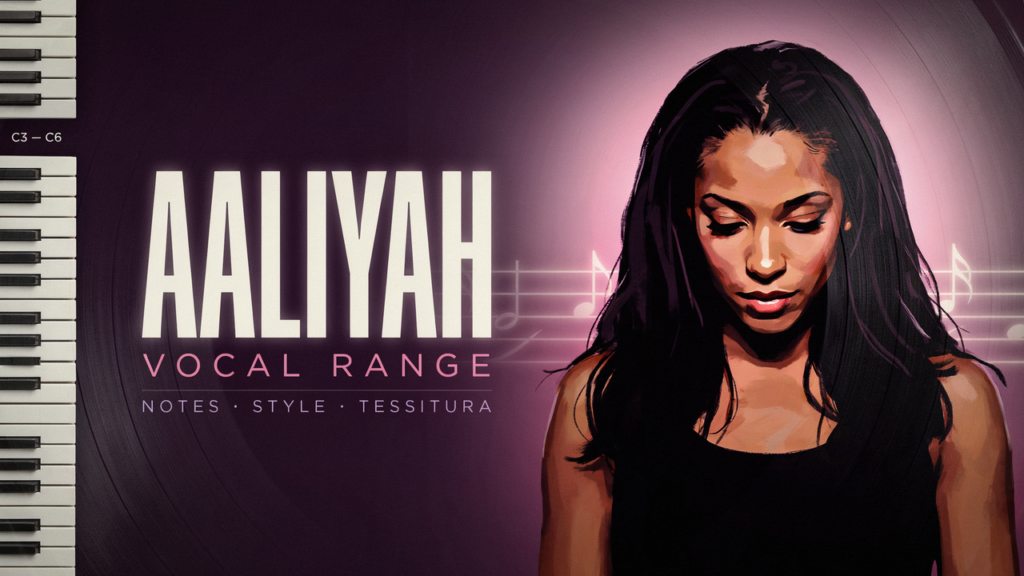
Aaliyah’s vocal range is widely reported as approximately G2 to E6, spanning three octaves and nine semitones. However, this broad estimate includes rare or disputed extremes and should not be mistaken for the part of her voice heard consistently in lead melodies.
A more practical assessment places much of Aaliyah’s comfortable singing between approximately E3 and G5. Her recognizable sound depended less on extreme notes than on her light tone, controlled breathiness, layered harmonies, precise rhythm, and smooth movement between registers.
Aaliyah’s Vocal Range at a Glance
| Vocal characteristic | Approximate description |
|---|---|
| Widely reported full range | G2–E6 |
| Approximate full span | 3 octaves and 9 semitones |
| Practical tessitura | Approximately E3–G5 |
| Conservative lead-melody range | Roughly F3–E♭5 in many cataloged songs |
| Likely voice type | Light lyric soprano or light mezzo-soprano |
| Lower-register quality | Soft, smoky, and intimate |
| Upper-register quality | Light, sweet, and agile |
| Signature strengths | Rhythmic phrasing, harmonies, subtle dynamics, and tonal control |
These ranges are not contradictory when their purposes are understood. G2–E6 represents a possible maximum assembled from different recordings, while her tessitura describes the area where she performed most comfortably and consistently.
Understanding the Reported G2–E6 Range
The G2–E6 estimate appears frequently in online vocal profiles. Mathematically, it covers three complete octaves plus nine additional semitones.
That is an impressive total, but a singer’s maximum range can include several types of vocal production. A low extreme may involve vocal fry or a lightly projected sound, while an upper extreme may come from a harmony, ad-lib, studio layer, or very light head voice.
Aaliyah’s recordings contain detailed background arrangements, stacked harmonies, and softly mixed vocal layers. These production choices make it difficult to attribute every audible pitch to the main lead vocal with absolute certainty.
For that reason, G2–E6 is best described as her widely reported maximum range, not an undisputed continuous range that she used equally at every pitch. Her practical singing range was narrower and more relevant to understanding how her voice functioned.
What Was Aaliyah’s Lowest Note?
G2 is commonly listed as Aaliyah’s lowest note, but it is also one of the least representative parts of her voice. Notes this low would sit far beneath the tessitura heard in most of her well-known lead performances.
Her musically useful low register was more evident around E3, F3, and the surrounding pitches. “Miss You,” for example, is often cataloged with a lead melody beginning around F3. These notes reveal her lower color without relying on a disputed extreme.
Aaliyah approached low notes gently. She rarely tried to make them sound unusually heavy or dramatic. Instead, she used close microphone placement, smooth airflow, and restrained dynamics to create an intimate tone.
This approach differs from singers who rely on a darker and more chest-dominant lower register. A comparison with Rihanna’s vocal range shows how two R&B/pop singers can share some pitches while using different vocal weight and tonal textures.
What Was Aaliyah’s Highest Note?
E6 is widely identified as the upper end of Aaliyah’s reported range. As with G2, this pitch should be understood as an extension rather than the center of her singing voice.
Some fan-made compilations claim even higher notes, occasionally reaching into the seventh octave. Such claims may include background layers, unusual sound effects, harmonics, or pitches that cannot be verified confidently as a controlled solo vocal. They should not be used as the primary basis for evaluating her range.
Aaliyah’s more dependable upper singing appeared throughout the fifth octave. In this area, she could produce light head-voice phrases, agile embellishments, and carefully shaped ad-libs without abandoning her understated style.
“Journey to the Past” is particularly useful because it required a more open and traditionally projected vocal approach than many of her R&B recordings. It demonstrates that the softness associated with Aaliyah was an artistic choice rather than proof that she lacked upper-register ability.
Listeners interested in another singer known for a light, intimate presentation can compare her approach with Selena Gomez’s vocal range.
Was Aaliyah a Soprano or Mezzo-Soprano?
Aaliyah is frequently classified as a light lyric soprano, although some modern vocal analyses describe her as a light mezzo-soprano. Light lyric soprano is a reasonable description of her youthful tone, upper-register ease, flexibility, and relatively low vocal weight.
The mezzo-soprano interpretation comes from her frequent use of a comfortable middle register and her preference for soft, grounded R&B melodies. However, repertoire choices alone do not establish voice type.
Voice classification also depends on tessitura, timbre, passaggio, register balance, and the pitches a singer can sustain naturally. A maximum range such as G2–E6 overlaps several categories and cannot settle the question by itself.
Calling Aaliyah a light soprano is therefore useful, but it should not be treated as a definitive classical fach. She was a contemporary R&B singer whose microphone technique and studio arrangements allowed her to use her instrument differently from an unamplified classical vocalist.
The guide to what a soprano is explains why high notes alone do not automatically determine this classification.
How Aaliyah Used Her Vocal Registers
Aaliyah’s lower register was delicate rather than heavy. She maintained a soft attack and avoided forcing additional weight into pitches that were naturally quieter.
Her middle register formed the center of her musical identity. It sounded smooth, conversational, and relaxed, allowing her to fit closely around complex drum patterns. Even when the production was rhythmically busy, her vocal delivery remained calm.
Her upper-middle register preserved that lightness. Instead of turning every rising phrase into a large belt, she often reduced vocal weight and allowed the sound to move toward a head-dominant coordination.
Her head voice was sweet and fluid. She used it for harmonies, ad-libs, and moments of contrast rather than treating every high note as a vocal climax.
Aaliyah also possessed enough agility for quick runs and ornamental phrases. Her technique made those details sound natural and unhurried. A modern comparison can be heard in SZA’s vocal range, where breath-led textures and unusual phrasing also play important expressive roles.
Vocal Highlights in Famous Aaliyah Songs
“Are You That Somebody?” is an excellent demonstration of rhythmic control. The vocal line interacts with Timbaland’s unpredictable percussion while Aaliyah maintains a calm, precise delivery. Its difficulty lies in timing, articulation, and tonal consistency more than extreme height.
“One in a Million” highlights her ability to float above a dense electronic arrangement. She uses restrained dynamics and carefully placed accents, allowing the vocal to remain present without competing with the beat through volume.
“Try Again” shows how comfortably she could combine repetition, rhythmic phrasing, and subtle tonal changes. The melody may sound effortless, but reproducing its exact pocket requires strong musical timing.
“More Than a Woman” contains layered harmonies and smooth register coordination. Its polished studio sound demonstrates how effectively Aaliyah could use multiple vocal textures without making the arrangement feel crowded.
“Journey to the Past” reveals a broader, more projected side of her voice. It is valuable evidence against the idea that she could sing only in a whispery R&B style.
Aaliyah’s controlled softness can also be compared with the intimate approach found within Sabrina Carpenter’s vocal range, although their phrasing and production belong to different pop eras.
Why Aaliyah’s Soft Singing Was Effective
Breathiness is sometimes mistaken for an absence of technique. In Aaliyah’s case, the airy quality was usually part of a coordinated aesthetic built around close microphones, layered vocals, and detailed production.
She controlled how much vocal weight entered a phrase. Her sound could remain light without losing pitch focus, rhythmic clarity, or emotional intention. This balance helped her vocals sit inside a track instead of dominating it.
Her restraint also made dynamic changes more effective. Because she did not sing at maximum intensity throughout a song, a slightly stronger phrase could create a noticeable emotional lift.
This quality influenced later R&B and pop singers who use intimacy as a source of intensity. Tate McRae’s vocal range offers another example of how breath-led tone can become a recognizable stylistic feature.
Is Aaliyah Difficult to Sing?
Aaliyah’s songs can be deceptively difficult. The melodies may not require constant belting, but they demand accurate pitch, disciplined breath control, smooth register transitions, and precise rhythmic placement.
A common mistake is to imitate her breathiness by releasing too much air. That can weaken pitch stability and create unnecessary dryness or fatigue. A safer approach is to begin with a clear, comfortable tone and add only a small amount of air as a stylistic color.
Singers must also resist the urge to overperform. Aaliyah’s delivery depended on subtle accents, small dynamic changes, and rhythmic confidence. Adding excessive volume or ornamentation can remove the understated character that makes the songs distinctive.
Frequently Asked Questions
What was Aaliyah’s vocal range?
Her widely reported maximum range is approximately G2–E6. Her practical tessitura was narrower, with much of her comfortable singing occurring around E3–G5.
How many octaves could Aaliyah sing?
The reported G2–E6 range spans three octaves and nine semitones, or about 3.75 octaves.
Was Aaliyah a soprano?
She is commonly described as a light lyric soprano because of her light vocal weight, flexibility, and upper-register quality. Some sources classify her as a light mezzo-soprano, so the label remains interpretive.
What was Aaliyah’s highest note?
E6 is the most commonly reported upper extreme. Claims extending into the seventh octave are difficult to verify and may involve background vocals, harmonics, or other layered sounds.
Did Aaliyah use whistle register?
There is not enough dependable evidence to describe whistle register as an established part of her technique. Her highest credible notes are more reasonably associated with a light head-voice coordination.
Why did Aaliyah sing so softly?
Her restrained delivery was an artistic and production choice. It complemented close-mic recording, layered harmonies, and rhythmically complex instrumentals while giving her music an intimate quality.

Harlow is a vocal analysis and singing tools writer at Voice Range Test. She focuses on vocal range testing, voice type analysis, pitch recognition, and singing education tools for singers, musicians, choir performers, and beginners.