
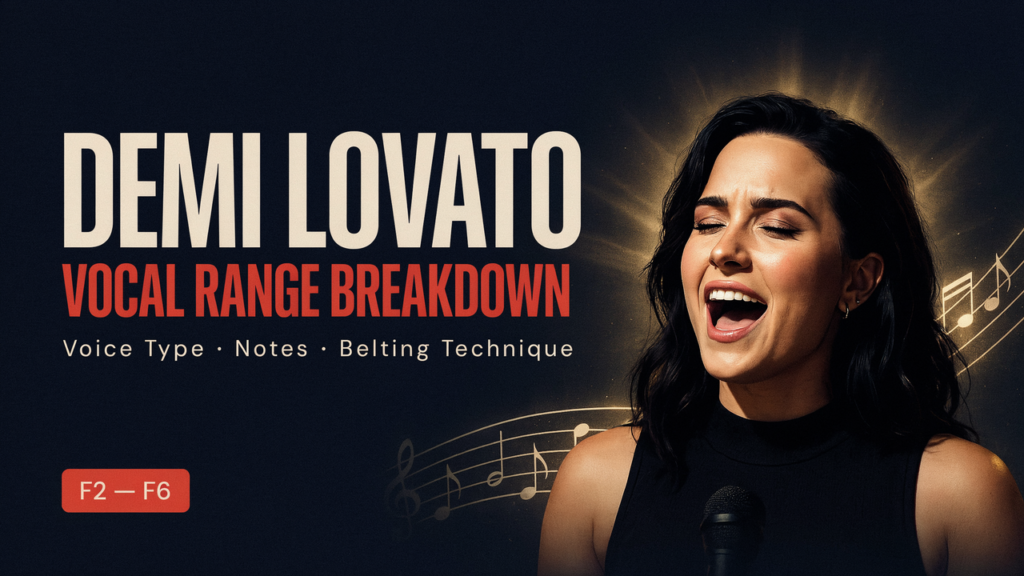
Demi Lovato’s strongly supported vocal range extends approximately from C3 to C♯6, covering three octaves and one semitone. This includes a low C3 associated with “Neon Lights” and an upper C♯6 demonstrated in live performance. Broader online profiles sometimes extend Lovato’s range into the sixth or seventh octave by counting rare whistle-like sounds, but those claims require more qualification.
Lovato’s practical singing range is narrower than the broadest reported total. The most consistently demonstrated strengths are a solid lower-middle register, powerful mixed belts through the fifth octave, and a bright head voice. These abilities are more representative of Lovato’s singing than a momentary extreme note.
What Is Demi Lovato’s Vocal Range?
A reasonable evidence-based estimate of Demi Lovato’s demonstrated range is C3–C♯6. The distance between those notes is 37 semitones, equal to three octaves and one semitone.
However, this should not be mistaken for a completely comfortable range. Published song notation and recognizable performances place much of Lovato’s regularly used material between approximately E3 and G5. The voice can move outside that area, but the notes within it appear more frequently in complete musical phrases.
Lovato’s range can therefore be understood in three layers:
- Practical song range: Approximately E3–G5
- Broader demonstrated range: Approximately C3–C♯6
- Reported extreme range: Sometimes extended as high as E♭7 when disputed whistle-register sounds are included
This separation prevents an isolated high sound from being treated as though it carries the same musical value as the sustained belts in “Stone Cold” or “Heart Attack.”
Lowest and Highest Supported Notes
Lovato’s exact extremes vary by source because analysts do not always apply the same standards. Some count only clear studio singing, while others include live improvisations, warm-ups, vocal effects, and whistle-register sounds.
| Note or Range | Song or Performance | Vocal Context | Evidence Status |
|---|---|---|---|
| C3 | “Neon Lights” | Lower-register studio note | Supported by published song notation |
| E3–E5 | “Give Your Heart a Break” | Full written song range | Supported by published song notation |
| F3–G5 | “Heart Attack” | Low phrases through upper belts | Supported by published song notation |
| F3–G♯5 | “Stone Cold” | Soft low singing and intense upper belts | Supported by published song notation |
| A3–G5 | “Tell Me You Love Me” | Midrange phrasing and upper extension | Supported by published song notation |
| C♯6 | Live vocal variation | High mixed or belt-dominant production | Strongly reported from direct performance evidence |
| E♭7 and nearby claims | Vocal showcase compilations | Whistle-like or extreme upper sound | Source-dependent and not independently settled |
The table also reveals why “Stone Cold” is a better example of Lovato’s functional ability than an isolated whistle note. Its F3–G♯5 span covers more than two octaves within one demanding song and requires quick changes in volume, intensity, registration, and emotional color.
How Many Octaves Can Demi Lovato Sing?
Using C3 as the lowest supported studio note and C♯6 as the upper demonstrated extension, Demi Lovato’s range covers three octaves and one semitone.
If only commonly repeated song notes are counted, the practical range is closer to two octaves and several additional notes. If rare whistle-register claims are accepted, the total becomes much wider—but that figure does not describe the range Lovato regularly uses in performances.
This is an important distinction. A full vocal range includes every credible note a singer can produce, while a usable range consists of notes that can be controlled, repeated, and incorporated into musical phrases. Tessitura is narrower still: it describes the area where the voice spends most of its time comfortably.
A singer can therefore possess a three-octave demonstrated range without singing across all three octaves in every song.
Is Demi Lovato a Soprano or Mezzo-Soprano?
Demi Lovato is most commonly described as a mezzo-soprano in popular-music discussions, particularly because of the voice’s weight, strong middle register, darker lower colors, and chest-dominant mixed belts. Some analysts instead classify Lovato as a soprano, pointing to the relatively high tessitura and ability to sustain demanding fifth-octave melodies.
The most responsible description is a mezzo-soprano-like contemporary voice with a substantial soprano extension. This wording acknowledges the voice’s tonal weight without pretending that a classical Fach has been formally established.
Range alone cannot resolve the disagreement. Voice type also depends on tessitura, timbre, passaggio, register balance, vocal weight, and the area where singing feels most sustainable. The difference between these classifications becomes clearer when comparing soprano and mezzo-soprano characteristics rather than looking only at the highest note.
Lovato’s strong upper belts can make the voice sound soprano-like, but powerful fifth-octave singing does not automatically prove a soprano classification. Similarly, a low C3 does not automatically make the singer a contralto.
Chest Voice, Mixed Belts, Head Voice, and Whistle Notes
The strongest part of Lovato’s instrument is the belt-dominant upper-middle range. Instead of carrying pure chest voice indefinitely, Lovato uses varying chest and head resonance to maintain intensity as pitches rise. The result is commonly described as a mixed belt.
This coordination is central to songs such as “Heart Attack,” “Sorry Not Sorry,” “Skyscraper,” and “Stone Cold.” The notes sound large because of their focused resonance, firm vocal-fold closure, bright vowels, and emotional delivery—not simply because they are high.
Lovato also uses a lighter head voice and falsetto-like colors when the music calls for vulnerability. These registers should not be confused with the stronger mixed production heard in climactic choruses.
Whistle-register claims need the most caution. Very high squeals, slides, and brief exclamations may contain a measurable pitch, but they do not always provide enough evidence to establish a controlled whistle register. Lovato has produced extremely high sounds, yet the frequently repeated E♭7 claim remains more source-dependent than the well-documented fifth-octave belts.
For comparison, Christina Aguilera’s range also includes powerful belts, rasp, head voice, and extreme vocal effects that must be classified separately.
Songs That Demonstrate Demi Lovato’s Range
“Stone Cold” is one of Lovato’s strongest overall vocal showcases. It moves from restrained F3 phrases to a G♯5 climax, demanding both dynamic control and upper-register power. The challenge comes not only from the highest pitch but also from repeatedly moving between soft and forceful production.
“Heart Attack” covers approximately F3–G5. Its upper phrases require focused mixed coordination, stamina, and accurate vowel shaping. Trying to reproduce the volume by pushing heavier chest voice upward can make the song unnecessarily difficult.
“Give Your Heart a Break” spans approximately E3–E5. Although its highest written note is lower, the song tests consistency, rhythmic precision, breath management, and repeated upper-middle singing.
“Tell Me You Love Me” reaches approximately G5 and highlights Lovato’s soulful phrasing, vocal weight, and ability to build intensity across a sustained arrangement.
Lovato’s version of “Let It Go” spans approximately G3–E5. Comparing it with Idina Menzel’s vocal range demonstrates how two powerful singers can approach related material with different keys, tonal colors, and stylistic priorities.
Listeners interested in similar contemporary belting can also compare Lovato with Kelly Clarkson and Jennifer Hudson. Each singer combines range with a different balance of vocal weight, resonance, agility, and phrasing.
What Makes Demi Lovato’s Voice Powerful?
Lovato’s vocal impact comes from more than range. The recognizable sound combines a weighty middle register, bright upper resonance, firm attacks, controlled distortion, strong vibrato, and dramatic dynamic changes.
Several qualities stand out:
- Chest-dominant mixed belts that retain substantial tonal weight
- Clear shifts between soft intimacy and high-intensity singing
- Strong sustained notes in the upper fourth and fifth octaves
- Rock-influenced rasp and vocal distortion
- Soul-inspired runs, bends, and dynamic phrasing
- The ability to maintain emotional clarity during technically demanding passages
This versatility allows Lovato to move between pop, rock, soul, and ballad material. The rock-oriented weight in later performances also creates a useful comparison with Miley Cyrus’s vocal range, although their tone production and tessitura are distinct.
Demonstrated Range Versus Comfortable Tessitura
Lovato’s C3–C♯6 demonstrated span describes the outer boundaries of credible performances, not the range every singer should attempt when covering Lovato’s songs.
Much of Lovato’s characteristic singing sits in the middle and upper-middle voice, where repeated belts create more difficulty than the written span alone suggests. A song containing only two octaves can still be exceptionally demanding if it stays near the singer’s upper transition area for long periods.
Anyone comparing their voice with Lovato’s should focus on repeatable notes rather than isolated extremes. The site’s voice type test can provide an initial estimate, but tessitura, register comfort, and tone remain essential. Stop if high-note practice causes pain, burning, persistent tightness, or a loss of normally easy notes.
Frequently Asked Questions
What is Demi Lovato’s highest note?
A C♯6 is a strongly reported upper mixed or belt-dominant note from live performance. Higher whistle-like notes, sometimes reported around E♭7, are less consistently documented and should be treated as source-dependent extremes.
What is Demi Lovato’s lowest note?
C3 is a supported lower note associated with “Neon Lights.” Some live compilations identify nearby C♯3 notes, but the exact lowest note depends on whether brief, quiet, or performance-specific sounds are counted.
Can Demi Lovato sing whistle notes?
Lovato has produced very high whistle-like sounds, but the control and exact pitches of the broadest claims are disputed. These sounds should be listed separately from head voice and mixed belts.
What is the vocal range of “Stone Cold”?
The written range of “Stone Cold” is approximately F3–G♯5. Its difficulty also comes from dynamic contrasts, sustained upper singing, and emotionally intense mixed belts.
Is Demi Lovato a mezzo-soprano?
Mezzo-soprano is the most common popular classification, although some analysts interpret Lovato as a soprano. “Mezzo-soprano-like voice with soprano extension” is a suitably cautious description.
Why are Demi Lovato’s songs difficult to sing?
Many of the songs require repeated fifth-octave belts, quick dynamic changes, strong breath management, and consistent mixed-voice coordination. Their difficulty cannot be judged from octave span alone.

Harlow is a vocal analysis and singing tools writer at Voice Range Test. She focuses on vocal range testing, voice type analysis, pitch recognition, and singing education tools for singers, musicians, choir performers, and beginners.