
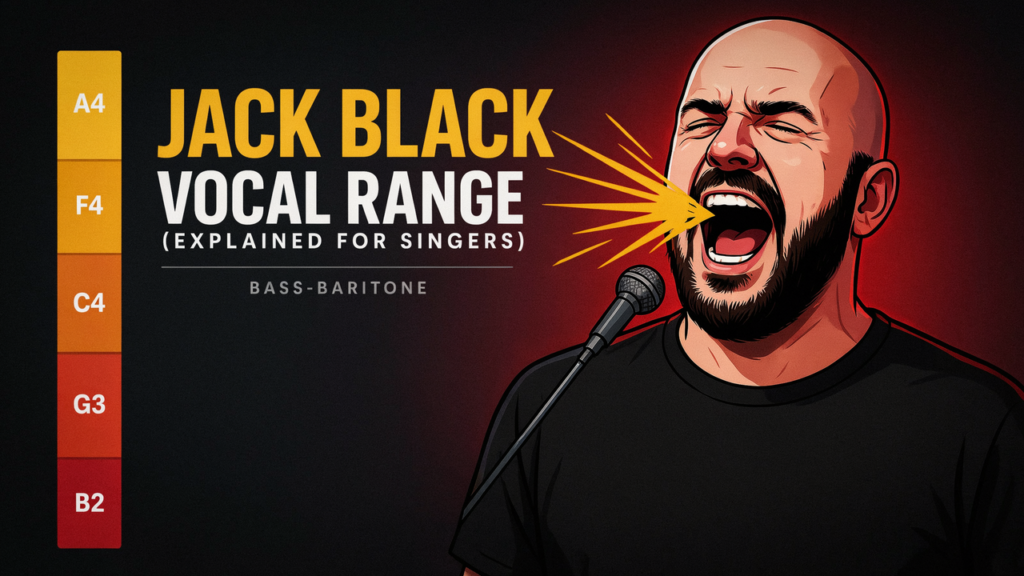
Jack Black’s commonly reported practical vocal range is approximately E2 to C5, with occasional falsetto and distorted extensions reaching around E5. The E2–C5 span covers two octaves and eight semitones, while including the E5 extension produces a full three-octave range.
Those figures require some qualification. C5 represents a more useful upper boundary for his recognizable melodic singing, whereas notes approaching E5 usually involve falsetto, distortion, a brief scream, or studio layering. Jack Black is best described as a baritone-leaning rock singer with a strong tenor extension, sometimes informally called a baritenor.
What Is Jack Black’s Vocal Range?
Jack Black’s vocal performances can be divided into three useful areas:
| Range area | Approximate notes | Typical use |
|---|---|---|
| Lower register | E2–G2 | Darker phrases and character-based delivery |
| Primary singing range | A2–B4 | Clean rock singing, theatrical phrasing and powerful choruses |
| Upper melodic range | B♭4–C5 | Mixed or head-dominant high notes |
| Extended effects | D5–E5 | Falsetto, distorted screams and momentary effects |
The commonly reported E2–C5 range equals 32 semitones, or two octaves and eight semitones. If E5 is accepted as an effects-inclusive upper boundary, the total becomes exactly three octaves.
That does not mean every note from E2 through E5 carries equal strength. His most consistent vocal work happens in the middle and upper-middle portions of the range, where he combines a resonant chest voice with a bright, theatrical rock sound.
This separation between full range and usable range is important when reading any singer profile. The site’s guide to understanding vocal-range notes explains why one isolated extreme should not automatically define a singer’s everyday capabilities.
Jack Black’s Lowest and Highest Notes
No official range measurement has been published by Jack Black or Tenacious D. Available figures are estimates derived from recordings and live performances, so individual transcriptions may disagree by a semitone or classify the same sound differently.
| Note or area | Song or context | Vocal production | Evidence status |
|---|---|---|---|
| E2–F2 | Reported lower-register performances | Low chest-dominant singing | Commonly reported, but the exact lowest example is source-dependent |
| B♭4–C5 | “Wonderboy” | Clean or lightly driven upper mix | Strongly supported upper melodic area |
| Around C5 | “Tribute” and “Kickapoo” | Bright theatrical rock mix | Commonly identified and repeatable in performance |
| D5 or higher | “Beelzeboss” | Metal-style scream or distorted effect | Effects-inclusive rather than ordinary clean singing |
| Up to E5 | “Master Exploder” | Falsetto-based or distorted high production | Commonly reported, but brief and production-dependent |
The most responsible summary is therefore that C5 is a reasonable upper limit for Black’s conventional melodic range, while E5 represents his broader collection of high vocal effects.
Similarly, E2 may be retained as a commonly reported low boundary, but it should not be presented as a repeatedly documented tessitura note. His voice is not defined primarily by unusually low singing; its most distinctive qualities appear higher in the range.
Is Jack Black a Baritone or Tenor?
Jack Black sounds like a baritone-based contemporary singer with considerable upper extension. “Baritenor” can be a useful informal description, but it is not a precise classical Fach assignment.
His voice has several baritone-like qualities:
- Substantial weight in the lower-middle register
- A warm and sometimes dark chest-voice color
- Strong projection through midrange rock phrases
- More vocal mass than a typical light tenor
However, Black can also sing convincingly around G4–C5, using a bright mixture of chest and head resonance. That upper flexibility gives his voice a tenor-like reach without proving that he is a classical tenor.
A singer’s voice type depends on more than the lowest and highest available notes. Tessitura, timbre, vocal weight, passaggio and sustained comfort all matter. Readers can explore how these factors interact with the site’s voice type test, although an online result should still be treated as an estimate.
Black’s combination of theatrical power and upper-register flexibility creates a useful comparison with Adam Lambert’s vocal range. Lambert generally demonstrates greater refinement and extension, while Black favors a heavier, deliberately exaggerated rock character.
How Jack Black Produces His High Notes
Jack Black’s highest sounds are not all produced in the same register. That is one reason descriptions of his range vary.
His upper melodic notes often use a bright rock mix. Instead of carrying the full weight of his lower chest voice upward, the sound becomes narrower and more head-influenced. Strong vowel shaping and focused resonance help the note remain audible over guitars without requiring the same vocal mass used lower in the range.
Falsetto provides another color. Black can switch into a lighter upper register for humor, contrast or an intentionally dramatic rock effect. In some performances, he adds distortion to this lighter coordination, creating a sound that appears heavier than an undistorted falsetto.
His approach shares some theatrical energy with Brendon Urie’s singing, though their timbres and register balances differ. Black’s metal-influenced high sounds can also be compared with Rob Halford’s upper register, but Halford’s sustained high-register technique and repertoire occupy a more specialized area.
Distortion should not be confused with pitch. A high scream may contain a recognizable fundamental note, additional overtones and noise at the same time. Only the stable underlying pitch belongs in a conventional note-based range measurement.
Best Songs for Hearing Jack Black’s Voice
“Master Exploder” is the obvious showcase for Black’s upper extension. It combines forceful midrange singing, sudden register changes, falsetto-based sounds and metal distortion. The recording may enhance the scale of the performance through normal studio production, but the central vocal skills are also apparent in live performances.
“Tribute” offers a clearer picture of his practical rock voice. Its phrases demonstrate rhythmic accuracy, tonal character and the ability to move from conversational delivery into projected upper notes.
“Kickapoo” emphasizes Black’s theatrical side. He changes character, intensity and tonal color while navigating a demanding rock arrangement. The song is valuable because it shows that his exaggerated delivery remains musically organized.
“Wonderboy” reveals more of his clean melodic control. It provides a better basis for evaluating sustained pitch than a collection of isolated screams.
“Peaches” is less demanding in total range, but it demonstrates phrasing and character control. A narrow song does not measure an artist’s complete range; it shows only the notes required by that recording.
For another example of a singer whose dramatic presentation can distract listeners from genuine technique, compare Black with Axl Rose’s vocal range.
Is Jack Black Actually a Good Singer?
Yes. Jack Black is a capable rock and theatrical singer whose comedic presentation sometimes hides the quality of his musicianship.
Range is only one part of that ability. His strengths also include rhythmic precision, clear articulation, dynamic contrast, register switching and the confidence to maintain musical character during highly energetic performances.
He does not always aim for a smooth or traditionally beautiful tone. Many Tenacious D songs deliberately use exaggerated vowels, mock-operatic phrasing and oversized metal screams. Those artistic choices should not be mistaken for an inability to sing cleanly.
The strongest evidence of his skill is not a disputed E5. It is his ability to deliver recognizable pitch, power, timing and character across acoustic comedy rock, heavy arrangements, film songs and live performances.
Frequently Asked Questions
What is Jack Black’s highest note?
E5 is sometimes reported as his highest extension, particularly in effects-heavy performances such as “Master Exploder.” C5 is a more defensible upper boundary for his conventional melodic singing.
What is Jack Black’s lowest note?
E2 is commonly listed as his lower limit, although the specific recording used to establish that boundary varies between range analyses.
How many octaves can Jack Black sing?
His commonly reported E2–C5 singing range covers two octaves and eight semitones. Including the possible E5 extension gives him an effects-inclusive range of three octaves.
Is Jack Black a tenor?
He is better described as a baritone-leaning rock singer with a strong tenor extension. “Baritenor” is useful as an informal description, but it is not a confirmed classical classification.
Does Jack Black use falsetto?
Yes. Falsetto is one of several upper-register colors he uses, alongside mixed singing, distortion and brief metal-style screams.
Is the singing in “Master Exploder” real?
The recording uses studio production, but Jack Black can reproduce the essential style and many of its demanding vocal effects live. Production enhancement does not mean the underlying performance is artificial.

Harlow is a vocal analysis and singing tools writer at Voice Range Test. She focuses on vocal range testing, voice type analysis, pitch recognition, and singing education tools for singers, musicians, choir performers, and beginners.