
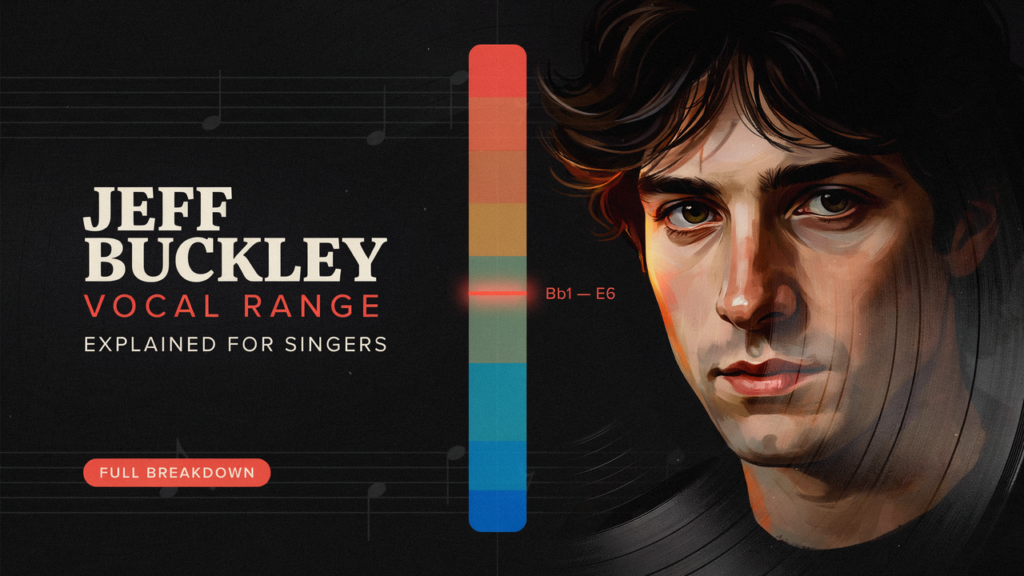
Jeff Buckley’s commonly supported vocal range extends from approximately E2 to G5, covering three octaves and a minor third. Broader estimates reach into the sixth octave, but these frequently depend on brief falsetto vocalizations, live improvisations, layered recordings, or questionable automated pitch detection.
Buckley was a tenor with exceptional upper-register flexibility. His distinction was not simply reaching high notes; it was moving among chest voice, mixed coordination, head voice, and falsetto while preserving pitch, dynamics, and emotional continuity.
Jeff Buckley’s vocal range E2–G5
82.4–784 Hz · 3 octaves and 3 semitones · Tenor, often described as light lyric
Documented range You
Don’t know your range? Take the voice range test.
Jeff Buckley’s Vocal Range at a Glance
| Vocal characteristic | Evidence-based description |
|---|---|
| Commonly supported range | Approximately E2–G5 |
| Total span | 39 semitones |
| Octave span | 3 octaves and a minor third |
| Broader reported extremes | Up to D6–G6, but disputed |
| Voice type | Tenor, often described as light lyric |
| Strongest area | Middle and upper-middle registers |
| Upper-register production | Mix, head voice and falsetto |
| Signature qualities | Dynamic control, register flexibility, vibrato and melisma |
The E2–G5 estimate combines pitches from different songs and performances. It should not be interpreted as Buckley’s comfortable range on every phrase. His functional tessitura was narrower, while his total recorded range included contrasting registers and occasional extremes.
Jeff Buckley’s Lowest and Highest Notes
The E2 often attributed to Buckley is associated with “Forget Her.” It reveals that his voice could descend well below the area normally highlighted in his music. However, isolated access to E2 does not make him a baritone or bass. His sustained repertoire, register balance, and upper comfort remain strongly tenor-oriented.
The climactic G5 in “Grace” is more representative of his celebrated upper extension. The pitch appears at an intense emotional and musical peak, where tone, distortion, and register balance interact. It should not be described as an ordinary chest note.
| Pitch or range area | Recording or context | Interpretation |
|---|---|---|
| Around E2 | “Forget Her” | Commonly reported low sung extreme |
| C3–E4 | Lower and central melodic phrases | Regular connected singing |
| F4–A4 | Upper-middle phrases | Tenor chest and mixed coordination |
| B4–G5 | Climaxes, head voice and falsetto | Strongly represented but register-dependent |
| D6–G6 claims | Selected databases and detected peaks | Disputed or potentially misidentified |
This distinction prevents a falsetto peak from being compared directly with a full-voice note. Both may belong to the singer’s demonstrated range, but they do not indicate the same vocal function.
Did Jeff Buckley Sing Above G5?
Some sources report sixth-octave pitches from Buckley, including D6, E♭6, F♯6, or G6. These claims require caution.
A detected high frequency may come from:
- A brief falsetto vocalization
- A harmonic rather than the fundamental pitch
- Layered backing vocals
- An instrument within the mix
- An octave-labeling error
- A live improvisation with unclear audio
- A momentary squeal or non-melodic sound
For example, song databases sometimes list “Last Goodbye” as reaching G6. That figure is difficult to reconcile with the clearly audible lead melody and may reflect an automated detection or attribution problem.
Similarly, unusually high figures attached to “Lover, You Should’ve Come Over” should be separated from its central melodic line. Buckley uses upper-register ornamentation and expressive vocalizations, but not every detected peak represents a sustained lead-vocal note.
G5 therefore remains a more responsible upper boundary for his clearly recognizable musical range. Higher pitches can be acknowledged as reported extremes without presenting them as settled evidence.
Was Jeff Buckley a Tenor?
Jeff Buckley was a tenor, commonly described as a light lyric tenor in popular vocal analysis. The label fits his relatively light vocal weight, upper-middle comfort, flexible head voice, and ability to sustain expressive singing above the area where many baritones become heavy or strained.
Voice type is not determined by range endpoints alone. Buckley’s E2 does not make him a bass, just as one high falsetto note would not establish his tessitura. Classification also considers:
- Where the voice sounds most comfortable
- Vocal weight and timbre
- Register transitions
- Repeatable full-voice notes
- The pitch area used throughout complete songs
- How easily the voice changes coordination
Buckley’s higher tessitura and light register transitions contrast with the darker, heavier center found in many rock baritones. The vocal range chart can show where his pitches overlap several voice categories, but overlap alone does not change his tenor identity.
Range Versus Tessitura
Buckley’s total range extended beyond three octaves, but his tessitura was the smaller area where he could sing repeatedly with control. Much of his repertoire moves through the third and fourth octaves before expanding into head voice or falsetto for emotional peaks.
This is why his songs can feel high even when their melodies do not constantly contain extreme notes. Buckley often kept the voice light and connected in the upper-middle register instead of retreating to a lower key or forcing a heavy chest setup upward.
A singer may be able to touch Buckley’s G5 in falsetto but still struggle with the sustained phrasing leading to it. Conversely, someone may possess strong fourth-octave notes yet lack the quiet head-voice control required by his softer material.
How Buckley Moved Between Vocal Registers
Buckley’s register transitions were central to his style. He could begin a phrase with a speech-like chest tone, reduce vocal weight as the melody rose, move into a head-dominant sound, and finish in falsetto without making the changes feel disconnected.
“Corpus Christi Carol” demonstrates his ability to sustain a high, light production for much of a performance. The sound is very different from the more forceful climax of “Grace,” yet both belong to the same vocal identity.
His upper-register delicacy has parallels with Thom Yorke’s vocal range, while the dramatic falsetto contrasts heard in Matt Bellamy’s vocal range offer another useful comparison.
Buckley could also produce a more forceful rock sound. However, his approach differed from the heavier intensity associated with Chris Cornell’s vocal range. Buckley frequently prioritized tonal transparency and dynamic vulnerability rather than maintaining maximum vocal weight.
Songs That Best Demonstrate His Voice
“Grace” provides the clearest overview of Buckley’s dramatic range. It moves from controlled central phrases toward intense high-register peaks, including the commonly cited G5.
“Forget Her” demonstrates a lower side of his voice and helps establish the reported E2 boundary.
“Corpus Christi Carol” displays sustained falsetto and careful breath control. Its light production should not be confused with belting merely because the pitches are high.
“Mojo Pin” shows how Buckley built from intimate singing into more powerful upper phrases. The challenge lies in managing the gradual increase in intensity without losing freedom.
“Hallelujah” is less about extreme range than breath, straight-tone control, phrasing, and delicate upper vocalizations. Its apparent simplicity exposes pitch instability and unnecessary tension.
The higher contemporary tenor territory in Kellin Quinn’s vocal range provides another comparison, although Quinn’s stylistic placement and vocal intensity differ significantly from Buckley’s.
Why Jeff Buckley’s Songs Are Difficult
Buckley’s songs are challenging because they require control at both quiet and loud dynamics. A singer cannot rely on volume to stabilize every upper note.
Common difficulties include:
- Sustaining soft high notes without becoming breathy
- Moving between registers without a sudden break
- Preserving pitch during emotional phrasing
- Managing long phrases
- Controlling vibrato and straight tone
- Adding intensity without pressing the throat
- Reproducing improvisations consistently
A note identifier can help singers verify pitches, but matching Buckley’s notes does not reproduce his coordination. His upper range should first be practiced lightly and in a suitable key. Pain, burning, persistent hoarseness, or loss of normally easy notes are reasons to stop.
Frequently Asked Questions
What was Jeff Buckley’s vocal range?
Jeff Buckley’s commonly supported range was approximately E2–G5, spanning three octaves and a minor third. Wider claims exist but often depend on disputed sixth-octave detections.
What was Jeff Buckley’s highest note?
G5 is a defensible upper note from his recognizable musical singing, particularly in “Grace.” Higher sixth-octave pitches are reported but require stronger recording-level verification.
What was Jeff Buckley’s lowest note?
E2 is commonly identified as Buckley’s lowest sung note and is associated with “Forget Her.” It was an extreme rather than the center of his tenor tessitura.
Did Jeff Buckley sing in falsetto?
Yes. Falsetto was an important expressive register in Buckley’s music. “Corpus Christi Carol” is a particularly clear example of his sustained light upper production.
Was Jeff Buckley a tenor or baritone?
Jeff Buckley was a tenor. His low extension overlapped baritone territory, but his vocal weight, tessitura, and upper-register freedom support a tenor classification.
How many octaves could Jeff Buckley sing?
The supported E2–G5 estimate covers three octaves and a minor third. Claims approaching four or more octaves depend on whether disputed sixth-octave sounds are included.

Harlow is a vocal analysis and singing tools writer at Voice Range Test. She focuses on vocal range testing, voice type analysis, pitch recognition, and singing education tools for singers, musicians, choir performers, and beginners.