
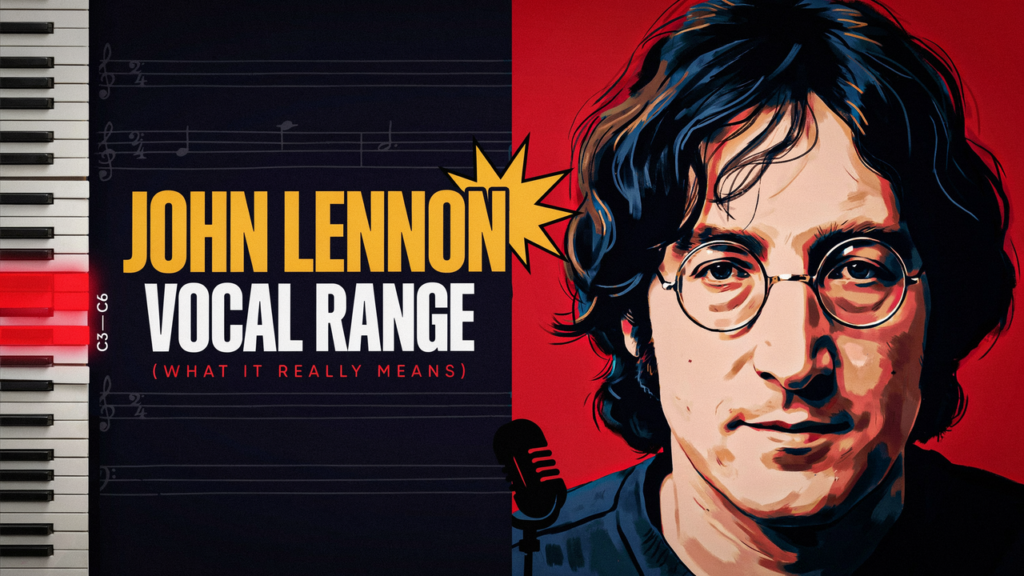
John Lennon’s commonly reported vocal range is approximately G2 to D5, a span of 31 semitones, or two octaves and seven semitones. However, those endpoints should be treated as a recording-based estimate rather than an absolute measurement. Lennon’s Beatles and solo recordings contain double tracking, harmony vocals, shouting, falsetto, and studio effects that make some extreme notes difficult to attribute and classify.
His most dependable singing was concentrated in a narrower middle range. Lennon’s vocal identity came less from extreme notes and more from his penetrating tone, expressive phrasing, rhythmic urgency, and ability to move from intimate singing to an abrasive rock sound.
What Was John Lennon’s Vocal Range?
A practical summary of John Lennon’s recorded vocal range is:
| Category | Approximate Notes | Interpretation |
|---|---|---|
| Commonly reported recorded range | G2–D5 | Includes the widest frequently catalogued song-based endpoints |
| More representative working area | Roughly B2–A4 | The region containing much of his recognizable lead singing |
| Lower register | G2–C3 | Darker notes found in restrained solo material |
| Upper full-voice area | G4–B4 | Bright, urgent notes frequently delivered with considerable intensity |
| Extreme upper notes | C5–D5 | Often brief, forceful, falsetto-based, or difficult to separate from surrounding vocals |
The wider G2–D5 estimate should not be confused with Lennon’s tessitura. Vocal range covers the distance between the lowest and highest identifiable pitches, while tessitura describes the region in which a singer repeatedly performs with the greatest comfort and consistency.
Lennon did not spend entire songs at either endpoint. Much of his singing occupied the middle and upper-middle part of his voice, where his words remained clear and his tone could cut through guitars, drums, and layered harmonies.
John Lennon’s Lowest and Highest Notes
“Working Class Hero” is frequently associated with Lennon’s lower recorded singing, with some song databases placing its bottom pitch around G2. The sparse arrangement makes his low placement easier to hear than it would be in a dense Beatles mix. Even so, a quiet low pitch, vocal fry, and fully sustained sung note should not automatically be treated as equivalent evidence.
The D5 often reported as Lennon’s highest note is connected with “Happy Xmas (War Is Over).” That claim requires more caution because the recording contains multiple singers and layered vocal parts. Depending on how the arrangement is analyzed, the highest audible pitch may not represent a sustained solo full-voice note from Lennon.
His upper singing is more clearly represented by the forceful phrases and exclamations heard across songs such as “Twist and Shout,” “Help!,” “Revolution,” and “Mother.” Some of these sounds approach or enter the fifth octave, but they vary in production: one may be a pitched shout, another a strained full-voice sound, and another a lighter coordination.
This evidence explains why published Lennon ranges vary so widely. A cautious profile should report the broad estimate while clearly labeling uncertain extremes.
Was John Lennon a Tenor or a Baritone?
John Lennon is most reasonably described as a tenor-leaning rock singer or high baritone with access to tenor territory. “Baritenor” can be useful as an informal description, but it is not a precise classical classification.
Several characteristics make his voice sound tenor-like:
- Bright, forward resonance
- Strong projection through the upper-middle range
- Frequent singing around G4, A4, and above
- A relatively lean tone in many early Beatles recordings
- The ability to add urgency without making every high phrase sound heavy
At the same time, Lennon possessed more low-mid weight and darkness than many light tenors. His lower solo material could sound grounded and speech-like, which is why some listeners hear him as a high baritone.
Extreme notes alone cannot settle the classification. Voice type also depends on tessitura, timbre, vocal weight, register transitions, and where the singer performs most comfortably. Readers can explore these distinctions with the site’s voice type test, although an automated result should still be treated as an estimate.
Demonstrated Range vs. Comfortable Range
A singer can produce a note once without being able to use it reliably throughout a song. Lennon’s broad recorded span includes occasional extremes, but his musically important range was narrower.
His most recognizable singing generally sits between the low third octave and upper fourth octave. Within that area, he could change color dramatically: restrained and conversational in “Julia,” distant and dreamlike in “Strawberry Fields Forever,” exposed in “Jealous Guy,” or forceful in “Come Together.”
This distinction is important when comparing Lennon with Paul McCartney’s vocal range. McCartney regularly displayed greater upper-range flexibility and moved between contrasting vocal colors with unusual ease. Lennon’s strength was different: he could make a relatively compact melodic phrase sound immediate, vulnerable, sarcastic, or confrontational.
Anyone comparing a personal result with Lennon’s endpoints should first understand how vocal-range notes are interpreted. Matching G2 and D5 does not mean two singers share the same tessitura, tone, stamina, or voice type.
How Lennon Used Full Voice, Falsetto, and Rock Shouts
Lennon’s upper range was not produced with one consistent register. His recordings contain firm modal singing, lighter upper notes, falsetto, cries, and aggressive rock shouts.
Falsetto was usually a color rather than the foundation of his singing. His more characteristic high sound came from a bright, speech-connected coordination with pronounced edge. That approach made the voice seem larger and higher, even when the melody itself was not exceptionally wide.
His roughness should not be mistaken for uncontrolled volume. Studio production also shaped the result through double tracking, compression, saturation, echo, and other effects. Attempting to recreate that sound by squeezing the throat is neither an accurate reproduction nor a safe shortcut.
Lennon’s use of vocal edge can be compared with the darker authority associated with Jim Morrison’s vocal range or the changing vocal personalities heard across David Bowie’s singing range. Each singer used tone and phrasing to create an identity that cannot be explained by endpoints alone.
What Made John Lennon’s Voice Distinctive?
Lennon’s voice combined brightness with a slightly rough, vulnerable quality. His consonants were often rhythmically decisive, while his vowels could become nasal, narrow, or deliberately raw. These choices helped the vocal remain intelligible inside busy arrangements.
He was also effective at changing emotional distance. A close, almost private delivery could suddenly become a shout without losing the identity of the phrase. That contrast is central to performances such as “A Day in the Life,” “Don’t Let Me Down,” and “Mother.”
His conversational phrasing shares some expressive priorities with Bob Dylan’s vocal approach, although Lennon generally used a stronger melodic center and a more penetrating rock tone. His early influences also included singers such as Roy Orbison, whose sustained phrasing and upper-register control represented a very different way of creating intensity.
Why John Lennon Vocal-Range Estimates Differ
John Lennon range claims differ because analysts do not always count the same sounds. A compilation may include:
- Spoken or semi-spoken pitches
- Brief vocal fry
- Falsetto
- Screams and pitched shouts
- Background harmonies
- Notes sung by another performer
- Studio-altered or layered vocals
- Unreleased material and informal recordings
A credible estimate should identify the recording, confirm that Lennon is the singer, and explain the vocal context. Without those details, an enormous range figure may say more about the compiler’s counting rules than Lennon’s usable singing voice.
Frequently Asked Questions
How many octaves could John Lennon sing?
The commonly reported G2–D5 range spans 31 semitones, equal to two octaves and seven semitones. His regularly used and sustainable range was probably narrower.
What was John Lennon’s highest note?
D5 is frequently reported as his upper endpoint, but its attribution and vocal context are not completely secure. Lennon’s more clearly recognizable high singing generally appears in the upper fourth octave and around C5 in forceful or brief passages.
What was John Lennon’s lowest note?
G2 is commonly listed as his lowest recorded pitch and is associated with “Working Class Hero.” It should be described as a song-based estimate rather than a formally measured physiological limit.
Did John Lennon sing in falsetto?
Yes. Lennon used falsetto occasionally for contrast and color, although his signature sound relied more heavily on bright full voice, vocal edge, and intense rock phrasing.
Who had the wider vocal range, John Lennon or Paul McCartney?
Paul McCartney is generally credited with the wider and more flexible recorded range. Lennon’s distinction was his instantly identifiable tone and emotionally direct delivery rather than exceptional range width.

Harlow is a vocal analysis and singing tools writer at Voice Range Test. She focuses on vocal range testing, voice type analysis, pitch recognition, and singing education tools for singers, musicians, choir performers, and beginners.