
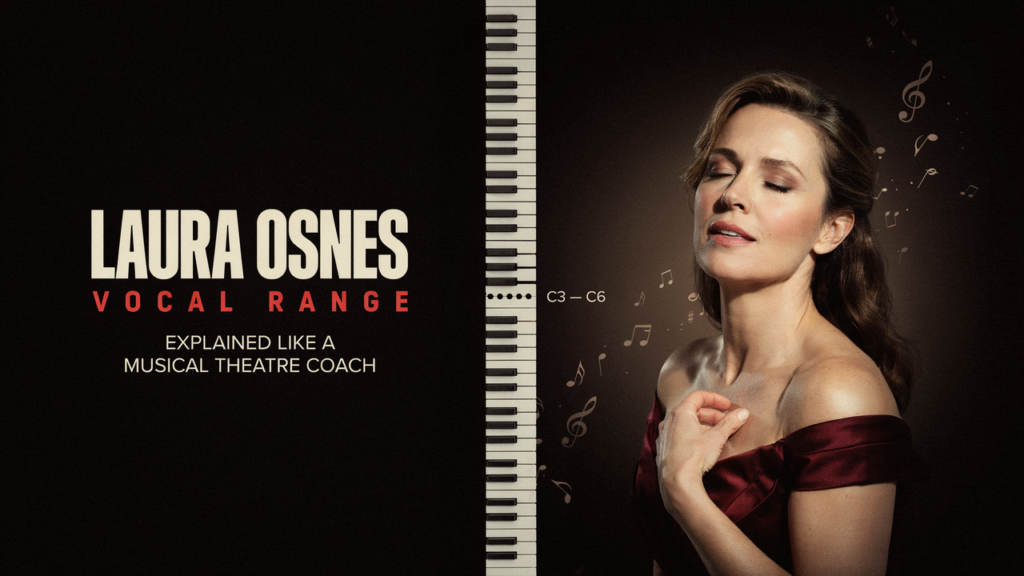
Laura Osnes’ complete vocal range is not verified by the sources reviewed here. A directly identifiable published example is “When I See You Again,” whose cited arrangement lists G-flat3–E-flat5. That is a song-level reference, not a confirmed career boundary.
Claims such as F-sharp3–F-sharp5, an extension to G5, or a C6 maximum need evidence from particular performances. Written role requirements do not automatically prove which notes an individual performer sang.
“When I See You Again”: What Is Documented?
The Musicnotes arrangement of “When I See You Again”, product MN0221225, lists G-flat3–E-flat5 in G-flat major. The scoring is Piano/Vocal/Chords.
That span contains 21 semitones: one octave plus a major sixth. G-flat3 is enharmonically equivalent to F-sharp3 on an equal-tempered keyboard, and E-flat5 to D-sharp5. Different note spelling does not necessarily mean a different pitch.
This entry establishes what the publisher lists for the edition. It cannot establish Osnes’ highest possible note, comfortable tessitura, or the full extent of her theatre work.
Why Role Ranges Are Not Personal Measurements
A casting breakdown describes what a production seeks. A score describes written music. A performance documents what a particular singer actually did in a particular version. These sources can support one another, but they are not interchangeable.
Roles may have optional notes, alternate keys, revised passages, or cuts. An actor’s association with a role is therefore not enough to certify every printed endpoint as part of that performer’s demonstrated range.
For a comparison with Idina Menzel, check both the edition and the performance before combining score ranges into a career total.
Is Laura Osnes a Soprano?
Soprano is a familiar musical-theatre description associated with her work, but this review does not establish a formal operatic Fach. Musical-theatre descriptions can encompass several styles within the same role.
The guide to soprano voices explains why range alone is insufficient. Tessitura, sustained tone, transitions, and repertoire matter alongside the ability to reach one note.
Likewise, a performer who uses belt does not automatically become a mezzo-soprano. A stylistic technique and a voice classification answer different questions.
Legit Singing, Mix, and Belt
In theatre, “legit” commonly refers to a classical-influenced sound, while belt and mix describe approaches associated with other dramatic and musical demands. Teachers do not always use these words identically.
Do not infer a precise muscular mechanism from the sound of a recording. Instead, listen for the musical result: clear words, connected phrases, dynamic contrast, and whether the chosen tone serves the scene.
Comparisons with Kristin Chenoweth can be useful when examining repertoire and style. They do not establish identical upper limits or interchangeable casting suitability.
Choosing an Audition Cut
Read the audition requirements first: duration, style, accompaniment, and whether transposition is allowed. Then select the version and mark the vocal line rather than counting notes in the piano part.
Test the opening, the longest sustained passage, and the ending. A cut should work as a complete musical statement. Reaching its highest note once is not enough if earlier phrases make the final section unreliable.
For the cited G-flat3–E-flat5 span, raising the melody by one semitone gives G3–E5. Lowering it by one gives F3–D5. Both preserve the 21-semitone width while changing where it sits in your voice.
Use a song key finder as an aid, then confirm the result with the score and accompanist. Clearly mark any agreed key change.
Practice the Character’s Words as Well as the Notes
Speak a short passage naturally, then in the written rhythm. Sing the melody on an easy vowel before restoring the consonants. If a specific word disrupts the phrase, isolate that word with the surrounding notes.
Record at a comfortable intensity. Listen for whether the text remains understandable and whether the phrase has a clear destination. Increased volume is not the only way to communicate a dramatic change.
A comparison with Rachel Zegler is most informative when it considers a particular song or role. Matching another performer’s tone is less useful than finding a version you can sing consistently.
Frequently Asked Questions
Is F-sharp3–F-sharp5 her confirmed range?
This review does not certify that as a career total. The cited song edition lists G-flat3–E-flat5, which is a different and narrower claim.
Can Laura Osnes sing C6?
A verified C6 performance is not established here. It should not be listed as a confirmed maximum without direct evidence.
Does originating a role prove its entire written range?
No. Confirm the edition, optional notes, and the actual performance rather than assuming every requirement was demonstrated unchanged.
Does a smaller score range mean easier music?
No. Phrase length, diction, dynamics, and repeated tessitura can make a modest span demanding.

Harlow is a vocal analysis and singing tools writer at Voice Range Test. She focuses on vocal range testing, voice type analysis, pitch recognition, and singing education tools for singers, musicians, choir performers, and beginners.