
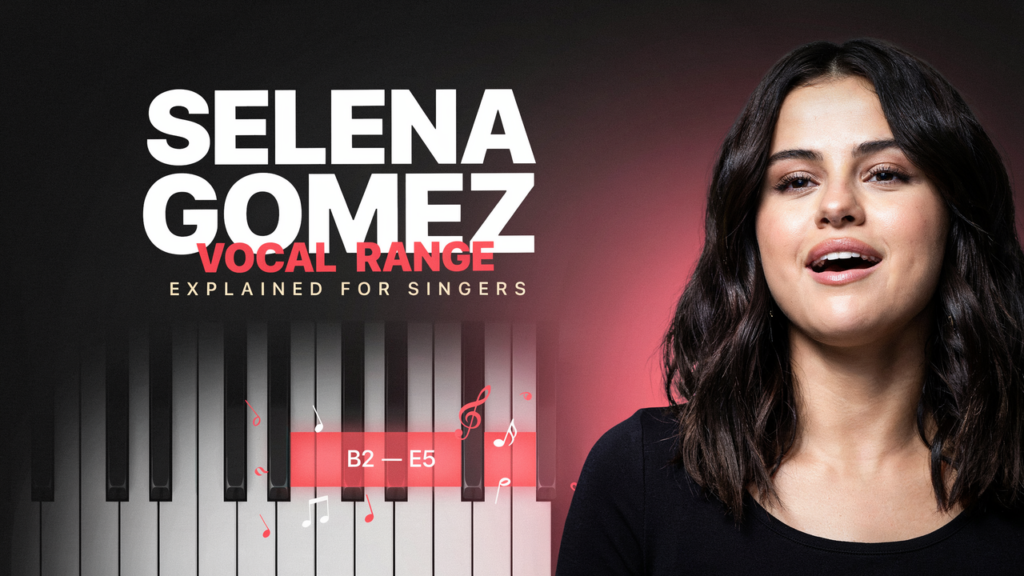
Selena Gomez’s full career vocal range is not established by the sources reviewed here. D3–D6 and the narrower D3–E5 are reported estimates, not verified boundaries. One identifiable published example is “Lose You to Love Me,” whose cited arrangement lists B3–A4.
That song-level span is useful for choosing a cover. It is not evidence that Gomez has only those notes, nor does it establish a three-octave total or a particular classical voice type.
“Lose You to Love Me”: A Specific Reference
The Musicnotes piano/vocal/guitar edition, product MN0202705, lists B3–A4 in E major. The listed vocal interval is ten semitones, a minor seventh.
An arrangement documents its own musical requirements. Different keys, cuts, and versions may produce different listings, so retain the product and key when comparing sources.
The relatively small interval does not measure the singer’s total capability. It also does not make the performance automatically easy: exposed pitch, sustained words, and deliberate phrase endings still require control.
Does D3–D6 Prove Three Octaves?
D3–D6 is exactly three octaves, or 36 semitones. To establish that as a recorded range, both notes must be identified in specific performances and clearly attributed to Gomez.
The alternative D3–E5 spans 26 semitones: two octaves plus a major second. It needs the same evidence. Choosing a smaller figure is not enough to justify calling it a confirmed practical range.
A very high database entry may reflect arrangement metadata, a harmony, or another vocal part. Those are possibilities to investigate, not explanations to assert without checking the source.
Is Selena Gomez an Alto or Mezzo-Soprano?
These terms are used differently. Alto commonly names a choral part, while mezzo-soprano is a solo classical category. This review does not certify a formal classification for Gomez.
The comparison of alto and mezzo-soprano explains why the labels are not interchangeable. A low-sounding phrase or breathy color does not establish the singer’s full tessitura.
Likewise, the operatic Fach system considers repertoire and sustained vocal function. It should not be assigned to a pop singer solely from the highest and lowest notes listed online.
Why an Understated Vocal Can Be Challenging
A restrained performance leaves room for listeners to hear small changes in tuning, consonants, and timing. Avoid equating a narrow melody with an absence of musical skill.
When practicing, listen to the ends of phrases. Does the final word remain clear? Does the pitch drift as the volume falls? Is the next entrance deliberate? These questions produce more useful feedback than asking whether your voice sounds exactly like the recording.
Breathiness is an audible quality, not a diagnosis or a full description of vocal-fold behavior. Do not create it by leaking as much air as possible or sacrificing clarity.
Choosing a Comfortable Key
Using the cited B3–A4 arrangement, lowering the melody by two semitones gives A3–G4. Raising it two semitones gives C-sharp4–B4. In both cases, the ten-semitone width remains unchanged.
Test the complete phrases in the proposed key. Moving down may ease one note while making lower words unclear. Moving up may improve low-note audibility but change how the upper phrase feels.
Confirm that your accompaniment uses the same transposition. A tutorial or karaoke version may use a different key from the original published edition.
A Short Practice Sequence
Begin with an easy warm-up in a comfortable part of your voice. The vocal warm-up generator can offer preparation ideas, but shorten or stop them if your voice feels uncomfortable.
Choose one phrase. Speak the words naturally, then in rhythm. Sing the melody on an easy vowel before restoring the words at a comfortable intensity.
Record two or three attempts with quiet pauses. Use the pitch accuracy test for an additional reference, while keeping the backing track out of the microphone where possible.
Once the phrase is dependable, connect it to the preceding line. The transition often reveals a timing or breath-planning task that an isolated note test misses.
What a Range Test Cannot Tell You
A detector does not assess expression, tone preference, vocal health, or the suitability of an entire song. It may also follow accompaniment or display unstable readings during noisy sounds.
Keep repeatable pitches separate from momentary attempts. Note the date, key, and conditions so future comparisons are meaningful.
For a broader plan, the guide to improving singing helps separate pitch, rhythm, diction, and phrasing goals. A new extreme note is not the only sign of progress.
Frequently Asked Questions
Does Selena Gomez have three octaves?
D3–D6 is a three-octave claim, but the complete span is not independently established here.
Is D6 a verified usable note?
This article does not certify it. A specific performance and vocal attribution are needed, along with evidence of repeatability for a usable-range claim.
What is the range of “Lose You to Love Me”?
The cited Musicnotes edition lists B3–A4 in E major. Other editions or transpositions may differ.
Can a song with a small range still be difficult?
Yes. Phrase length, exposed intonation, dynamics, and clear words can create substantial demands without extreme notes.

Harlow is a vocal analysis and singing tools writer at Voice Range Test. She focuses on vocal range testing, voice type analysis, pitch recognition, and singing education tools for singers, musicians, choir performers, and beginners.