
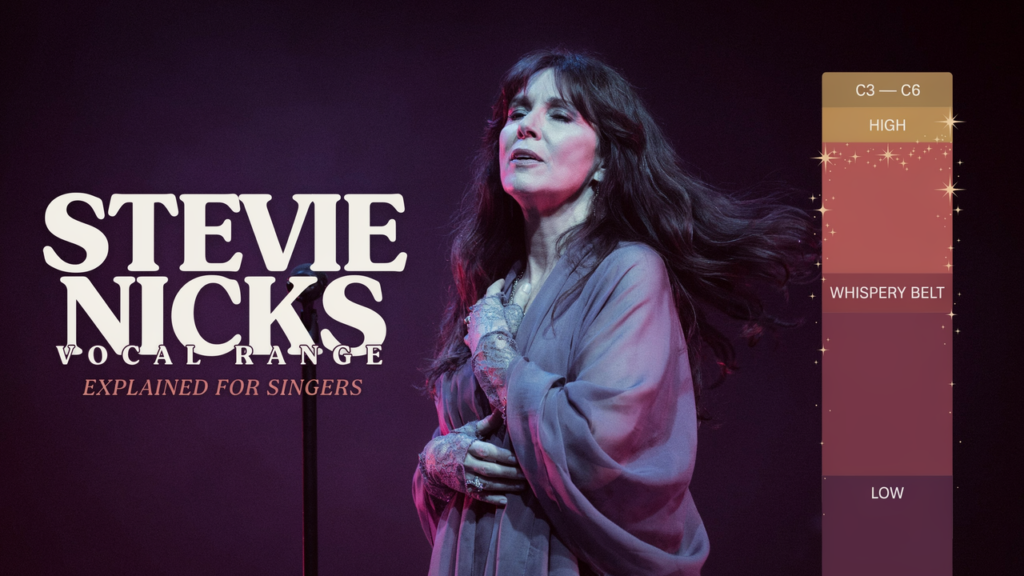
Stevie Nicks’ most defensible recorded vocal range is approximately D3 to E5, spanning two octaves and two semitones. Some analyses extend her lower limit to C3, while song databases report a much wider D♯3–C6 span. Those broader estimates require caution because harmonies, backing singers, studio layering, and different vocal registers can complicate note attribution.
Nicks is commonly classified as a contralto or low mezzo-soprano. Her importance as a singer, however, comes less from extreme notes than from her dark timbre, distinctive rasp, conversational phrasing, controlled vibrato, and ability to give simple melodies a recognizable emotional identity.
What Is Stevie Nicks’ Vocal Range?
A practical working estimate for Stevie Nicks’ range is D3–E5. This includes a strong lower register, a substantial middle range, and fifth-octave notes produced through both full voice and a lighter upper coordination.
| Vocal-range detail | Approximate result |
|---|---|
| Conservative recorded range | D3–E5 |
| Total span | Two octaves and two semitones |
| Source-dependent lower claim | C3 |
| Broader database estimate | D♯3–C6 |
| Common voice-type description | Contralto or low mezzo-soprano |
| Most characteristic area | Lower-middle and middle female range |
The wider D♯3–C6 estimate should not automatically be treated as her usable solo range. The proposed C6 appears in a recording with multiple vocal layers, making it important to confirm whether the pitch belongs to Nicks, another singer, or a background part.
Her lead-vocal range and broader recorded range are therefore not necessarily identical. The guide to different types of vocal ranges explains why an isolated extreme note should not be confused with a singer’s comfortable or repeatable range.
Evidence for Her Lowest and Highest Notes
Nicks has demonstrated low-third-octave pitches across different stages of her career. D3 is a reasonable conservative lower endpoint, while C3 appears in some broader analyses of live and studio material.
Her upper range is similarly dependent on context. “Sisters of the Moon” is frequently associated with an E5 in a lighter falsetto-like production. Live performances from the Mirage era have also been credited with strong D5 notes.
| Note or area | Song or context | Vocal context | Evidence status |
|---|---|---|---|
| C3 | Selected recordings and performances | Low lead-vocal claim | Source-dependent |
| D3 | Multiple lower-register performances | Sung lead vocal | Reasonably supported |
| B4 | Common upper note across her repertoire | Full or mixed production | Frequently demonstrated |
| D5 | Live “Sisters of the Moon” performances | Stronger full-voice production | Commonly reported |
| E5 | Studio “Sisters of the Moon” | Lighter upper register | Commonly reported |
| C6 | “Talk to Me” database attribution | Layered studio context | Attribution uncertain |
This evidence shows why a vocal range needs more than two note names. The register, recording, vocal layer, and repeatability of each note all affect what the range means.
Why Published Range Estimates Disagree
Stevie Nicks has recorded lead vocals, harmonies, overdubs, demos, and live improvisations across several decades. Analysts do not always apply the same rules to this material.
A wider estimate may include:
- Background harmonies
- Brief upper-register notes
- Falsetto or light head voice
- Live improvisations
- Unreleased demos
- Layered studio vocals
- Notes touched momentarily
- Pitches whose singer is difficult to identify
A conservative estimate usually counts clear lead-vocal notes that can be attributed to Nicks with reasonable confidence. Neither method is automatically wrong, but the result must be labelled correctly.
Her range has also changed in practical use over time. Earlier performances generally feature more frequent upper-register singing, while later arrangements often emphasize her lower and middle voice. This does not mean every earlier high note disappeared; it means her repertoire and repeatable performance range evolved.
Is Stevie Nicks a Contralto or Mezzo-Soprano?
Stevie Nicks is widely described as a contralto, particularly because of her dark timbre, low vocal placement, and strength in the lower-middle register. A low mezzo-soprano description may fit some of her earlier recordings more accurately.
Contralto and mezzo-soprano ranges overlap. The distinction cannot be decided by finding one low note or one high note. Voice classification also considers tessitura, vocal weight, resonance, register transitions, and where the singer can perform repeatedly.
Nicks’ voice has several qualities commonly associated with lower female voices:
- A warm, dark tonal color
- Strong chest-dominant middle notes
- Comfortable conversational phrasing
- Substantial presence in the third octave
- Less dependence on consistently high soprano placement
The term “alto” may also be used informally, but alto is commonly a choir part rather than a precise solo voice type. The alto versus contralto comparison explains this difference.
Her early work can also display qualities associated with a mezzo-soprano voice, including a strong middle range and access to expressive upper notes.
How Stevie Nicks’ Voice Changed Across Her Career
Nicks’ voice did not remain acoustically identical across decades. Her tone, register balance, comfortable placement, and approach to live arrangements changed gradually.
In her earlier Fleetwood Mac period, her voice often sounded lighter and more flexible. Performances of “Rhiannon,” “Gold Dust Woman,” and “Dreams” include greater use of airy upper colors, clearer head-dominant sounds, and dynamic changes between softness and intensity.
During her solo breakthrough, her vocal sound became heavier and more visibly centered on the chest and middle registers. Songs such as “Edge of Seventeen” and “Stand Back” depend on rhythmic drive, tonal character, and repeated middle-range singing more than extreme high notes.
In later performances, Nicks generally uses a lower placement and adjusts some material to suit her current voice. Key changes, altered melodies, backing vocals, and different register choices are normal strategies for maintaining a long performance career.
These changes should not be reduced to a single unsupported cause. Age, touring demands, repertoire, stylistic preference, and vocal adaptation can all influence how a singer uses the voice over time.
What Creates Stevie Nicks’ Distinctive Vocal Sound?
Nicks’ recognizable sound is a combination of timbre, phrasing, resonance, and texture.
Dark, smoky timbre
Her tone contains strong lower-middle color and comparatively little of the bright, bell-like quality associated with some sopranos. This tonal darkness can make a note sound lower than its measured pitch.
Rasp and vocal texture
Rasp is part of her familiar sound, but singers should not attempt to reproduce it by squeezing the throat or scraping the vocal folds. Forced roughness can cause discomfort and does not recreate the resonance or phrasing behind her tone.
If an attempted imitation produces burning, pain, persistent hoarseness, or a loss of normally easy notes, stop. Work on clear phonation first and use vocal tension release rather than forcing distortion.
Conversational phrasing
Nicks often shapes melodies as though she is telling a story. She may lean behind the beat, emphasize unusual consonants, stretch selected vowels, or allow one note to carry the emotional weight of an entire phrase.
Controlled vibrato
Her vibrato is often narrow, slow, or selectively introduced rather than applied identically to every sustained note. This makes the voice sound personal instead of mechanically polished.
These choices demonstrate why vocal control involves more than singing accurately. Dynamics, timing, register choice, and tone all affect the result.
Songs That Demonstrate Different Parts of Her Voice
Several Fleetwood Mac and solo songs reveal different aspects of Nicks’ singing:
- “Dreams” demonstrates relaxed phrasing, middle-range control, and a restrained delivery.
- “Rhiannon” shows the contrast between intimate verses and more intense live upper phrases.
- “Gold Dust Woman” highlights darker tone, texture, and dramatic vocal escalation.
- “Landslide” relies on storytelling, pitch stability, and control at relatively modest volume.
- “Edge of Seventeen” requires rhythmic stamina and repeated upper-middle singing.
- “Stand Back” demonstrates direct rock delivery within a compact range.
- “Sisters of the Moon” contains some of the upper notes most frequently discussed in analyses of her voice.
Many of these songs have moderate individual ranges. Their difficulty lies in maintaining character, timing, and intensity rather than merely reaching the endpoints.
Why Her Songs Are Harder to Sing Than They Sound
Nicks’ melodies can appear simple when written as notes, but her vocal identity is difficult to reproduce convincingly.
A singer may reach every pitch in “Dreams” yet lose its relaxed rhythmic feel. “Landslide” exposes weak breath control and unstable soft singing. “Edge of Seventeen” requires repeated phrases to remain focused without becoming shouted.
Her performances also demonstrate the difference between singing a melody and commanding attention. Strong stage presence for singers can grow from phrasing, focus, and emotional commitment rather than constant high notes or loudness.
The safest approach is to sing the notes in your own healthy tone, preserve the phrasing that serves the song, and transpose when the original key does not fit your repeatable range.
Frequently Asked Questions
How many octaves can Stevie Nicks sing?
Her conservative D3–E5 recorded range spans two octaves and two semitones. Wider estimates exist, but their extreme notes are more dependent on source and vocal attribution.
What is Stevie Nicks’ highest supported note?
E5 is a commonly reported upper note, associated with a lighter upper-register moment in “Sisters of the Moon.” Strong D5 notes have also been attributed to live performances.
What is Stevie Nicks’ lowest note?
D3 is a defensible conservative endpoint. Some analyses credit her with C3, particularly when including a wider selection of live and later-career recordings.
Is Stevie Nicks a true contralto?
Contralto is a reasonable description of her lower placement and dark vocal character, especially in later years. Some of her earlier work may function more like a low mezzo-soprano.
Why does Stevie Nicks’ voice sound raspy?
Her sound combines natural timbre, textured phonation, chest-dominant resonance, and stylistic phrasing. The effect should not be copied by deliberately squeezing or irritating the throat.
Did Stevie Nicks’ vocal range become lower with age?
Her later performances generally use a lower tessitura and fewer sustained upper notes. This reflects a change in how she uses her voice, although it does not define every note she remains capable of producing.

Harlow is a vocal analysis and singing tools writer at Voice Range Test. She focuses on vocal range testing, voice type analysis, pitch recognition, and singing education tools for singers, musicians, choir performers, and beginners.