
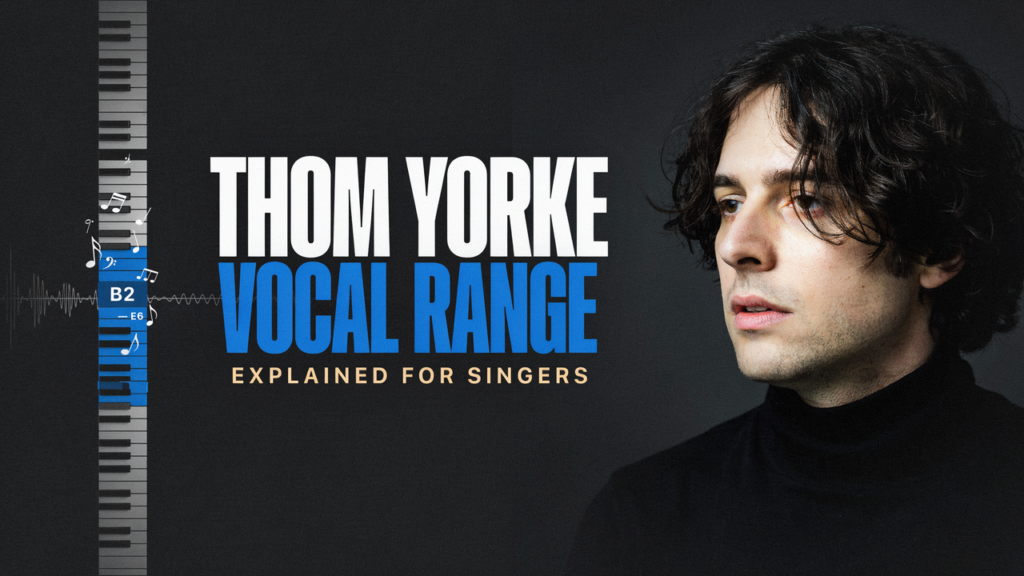
Thom Yorke’s documented vocal range is approximately B2 to A5, spanning two octaves and ten semitones. Broader online compilations sometimes credit him with notes from around E2 to E6 or beyond, but those estimates often include processed vocals, background layers, spoken sounds, or brief falsetto extremes that are difficult to verify consistently.
The most accurate conclusion is that Yorke has demonstrated nearly three octaves across identifiable recordings, with possible extensions outside that span. More important than the size of his range is how effectively he moves between a grounded lower register, an intense modal voice, and his signature falsetto.
Thom Yorke’s vocal range B2–A5
123–880 Hz · 2 octaves and 10 semitones · Tenor
Documented range Wider reported range (E2–E6) You
Don’t know your range? Take the voice range test.
What Is Thom Yorke’s Vocal Range?
A defensible recorded estimate for Thom Yorke is B2–A5. This equals 34 semitones, or two octaves and ten semitones.
This range should not be interpreted as his fixed physical limit. It represents notes identified in a selection of released performances. A singer may be capable of pitches that never appear in a commercially released song, while studio production can make other apparent extremes difficult to attribute confidently.
| Range category | Approximate notes | Interpretation |
|---|---|---|
| Documented song-based range | B2–A5 | Notes identified across available recordings |
| Common broader claim | Around E2–E6 | Source-dependent and not consistently verified |
| Most characteristic area | Middle and upper male range | Where much of Yorke’s recognizable singing occurs |
| Primary upper-register sound | Falsetto or light head-dominant production | Central to his vocal identity |
Readers unfamiliar with pitch names can review how vocal range notes and octave numbers work before comparing these estimates.
Thom Yorke’s Lowest Note
Yorke’s lowest clearly catalogued pitches reach approximately B2, with “Cymbal Rush” commonly identified as an example of his lower recorded singing.
Some range compilations place his bottom note closer to E2. These lower claims require caution because a pitch can come from spoken delivery, vocal fry, a quiet backing layer, or a processed recording rather than a clearly sustained sung note.
A lowest note also says little about where a singer sounds most comfortable. Yorke can darken his tone and descend below his customary melodic placement, but that does not automatically make the lower second octave his normal tessitura.
Thom Yorke’s Highest Note
Song-based databases place Yorke’s documented upper limit at approximately A5, with “5.17” frequently associated with that pitch. Wider fan-compiled analyses have proposed notes in the sixth octave, including E6 and G♯6, but the context of these sounds is not always consistently documented.
Yorke usually reaches his highest pitches through a light falsetto or head-dominant coordination. These notes should therefore be separated from his highest strong modal or chest-dominant notes.
This distinction matters because a singer’s highest audible pitch, highest falsetto note, and highest repeatable full-voice note may be three different measurements. All can belong to the singer’s overall range, but they do not represent the same vocal demand.
Why Thom Yorke’s Reported Range Varies
Different sources give different answers because they may use different standards for what counts as a vocal note.
One analysis might include every recognizable pitch, while another counts only clear lead vocals. Reported endpoints can change depending on whether the analyst includes:
- Studio and live performances
- Falsetto and head voice
- Vocal fry or spoken pitches
- Screams and momentary sounds
- Background vocal layers
- Effects, pitch shifting, or heavy processing
- Unreleased demos and alternate versions
- Notes that are touched briefly rather than sustained
This is why Yorke’s range may be described as nearly three octaves in one place and four octaves or more elsewhere. The smaller figure can be better supported without proving that the larger figure is impossible.
A claimed range should always be judged by the evidence behind its endpoints, not merely by its octave total. The site’s guide to the human vocal range provides more context for interpreting large range claims.
Is Thom Yorke a Tenor?
Thom Yorke is generally described as a tenor, although applying classical voice categories to an alternative-rock singer has limitations.
His tenor classification is supported more by his recurring upper-register placement, relatively light vocal color, and facility above the staff than by his extreme notes alone. His lower notes do not automatically make him a baritone, just as an A5 falsetto does not determine his voice type.
Voice type depends on several connected qualities:
- Comfortable tessitura
- Vocal weight and timbre
- Register transitions
- Sustainable modal range
- Where the voice projects most naturally
The difference between total range and comfortable placement is explained further in the guide to tessitura. For the basic classification itself, see what a tenor is.
How Thom Yorke Uses Falsetto
Falsetto is not merely an occasional effect in Yorke’s singing. It is one of the main expressive colors of his voice.
Songs such as “Reckoner,” “Nude,” “Lotus Flower,” and “How to Disappear Completely” demonstrate different uses of a lighter upper register. He may allow the tone to sound breathy and exposed, keep it narrow and focused, or layer it into the surrounding arrangement.
His upper register is effective because it serves the song rather than functioning only as a display of high notes. Yorke combines it with unusual phrasing, controlled dynamics, slides, sustained vowels, and deliberate changes in vocal intensity.
Falsetto notes count toward a singer’s total demonstrated range when they are clearly pitched. However, they should be labelled separately when comparing voices because falsetto does not have the same weight, tone, or coordination as chest-dominant singing.
Songs That Show Different Parts of His Voice
Several Radiohead and solo recordings illustrate Yorke’s range more clearly than a single octave number can.
- “Cymbal Rush” demonstrates his lower recorded area and subdued delivery.
- “Creep” moves from restrained verses into forceful upper phrases, making the register and dynamic contrast difficult to reproduce.
- “How to Disappear Completely” shows sustained, floating upper singing rather than aggressive belting.
- “Nude” demonstrates controlled falsetto, smooth register movement, and precise soft singing.
- “Reckoner” keeps a light upper-register coordination at the center of the performance.
- “Lotus Flower” combines falsetto with rhythmic phrasing and repeated melodic control.
- “5.17” is commonly catalogued as containing one of his highest identifiable pitches.
These songs also show why comfortable range matters more than one extreme note. A singer may touch the endpoints but still struggle with the repeated upper phrases, breath management, dynamics, or tonal control between them.
What Singers Can Learn From Yorke’s Range
Yorke’s singing demonstrates that vocal impact does not depend on making every high note loud. He frequently reduces vocal weight as he ascends and uses a lighter register as an intentional sound.
Singers attempting Radiohead material should identify the register used in each phrase instead of trying to carry chest voice upward indefinitely. If a melody sits too high, transposing the song is safer and more musical than forcing the original key.
It is also useful to compare songs against your repeatable range rather than your most extreme pitches. A range approaching three octaves is substantial, but the ability to control the notes inside it matters more than the number itself. The guide to whether a three-octave vocal range is good explains this distinction in practical terms.
Frequently Asked Questions
How many octaves can Thom Yorke sing?
A documented B2–A5 span equals two octaves and ten semitones, which is just under three octaves. Wider four-octave claims exist but depend on which recordings and vocal sounds are counted.
What is Thom Yorke’s highest note?
Approximately A5 is a reasonably documented song-based upper endpoint. Higher sixth-octave notes have been reported, but their recording context and classification are less consistent.
What is Thom Yorke’s lowest note?
B2 is a defensible documented estimate. Claims extending toward E2 may include less clearly established vocal material.
Does Thom Yorke sing in falsetto?
Yes. Falsetto or a light head-dominant coordination is a defining part of Yorke’s sound, especially in songs such as “Reckoner,” “Nude,” and “Lotus Flower.”
Is Thom Yorke a tenor or baritone?
He is most commonly classified as a tenor. His occasional low notes do not outweigh his lighter vocal quality and frequent upper-range placement.
Can falsetto be included in a vocal range?
Yes. A clearly pitched falsetto note can count toward total range, but it should be distinguished from modal, mixed, or chest-dominant singing.

Harlow is a vocal analysis and singing tools writer at Voice Range Test. She focuses on vocal range testing, voice type analysis, pitch recognition, and singing education tools for singers, musicians, choir performers, and beginners.