
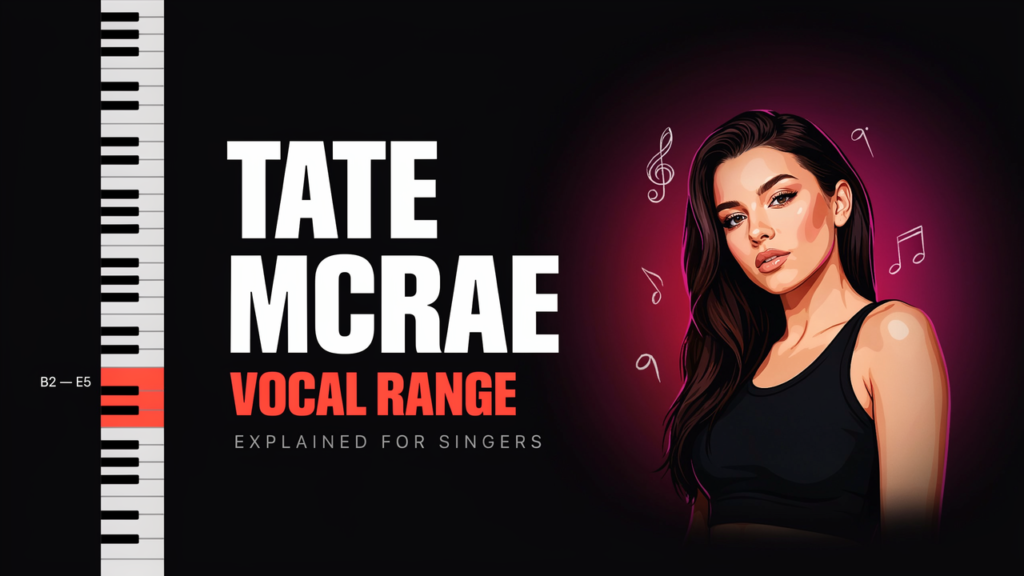
Tate McRae’s documented vocal range is approximately E3 to E5, spanning exactly two octaves. This estimate is based on identifiable pitches in her released songs, with E3 appearing in “what would you do?” and E5 appearing in songs such as “Darkest Hour.”
Her complete physical range may extend beyond these notes. However, E3–E5 is a more defensible recorded estimate than a wider range based on isolated live moments or unidentified vocal sounds. McRae is commonly described as a mezzo-soprano, known for a breathy tone, speech-like phrasing, controlled lower-middle notes, and a connected upper register.
What Is Tate McRae’s Vocal Range?
Tate McRae’s catalogued range of E3–E5 contains 24 semitones, equivalent to exactly two octaves.
| Vocal-range detail | Approximate result |
|---|---|
| Lowest documented note | E3 |
| Highest documented note | E5 |
| Total documented span | Two octaves |
| Common voice-type description | Mezzo-soprano |
| Characteristic vocal area | Lower-middle to upper-middle female range |
| Common vocal qualities | Breathy, intimate, slightly raspy and speech-like |
This measurement should not be interpreted as the full limit of McRae’s voice. A recorded range contains notes that appear in available songs, while a singer’s total capability may include pitches that have never been released or independently catalogued.
The broader guide to female vocal ranges explains how these notes compare with common female voice categories.
Tate McRae’s Lowest and Highest Notes
McRae’s lowest catalogued pitch is approximately E3, associated with “what would you do?” E3 sits below middle C and gives her enough lower extension for conversational verses and darker pop melodies.
Her highest catalogued note is approximately E5. “Darkest Hour” is one recording associated with this upper endpoint. E5 is not exceptionally high for every female singer, but reaching it cleanly within a song requires suitable registration, accurate pitch, and control over vocal weight.
| Song | Approximate song range | What it demonstrates |
|---|---|---|
| “what would you do?” | E3–E5 | Broad recorded span and lower extension |
| “Darkest Hour” | A3–E5 | Upper-middle range and high endpoint |
| “she’s all i wanna be” | F3–C5 | Connected pop range and rhythmic delivery |
| “you broke me first” | A3–B♭4 | Soft dynamics, phrasing and breath control |
| “One Day” | B3–C5 | Sustained middle-range singing |
The exact endpoints of a recording can vary slightly between analyses because background vocals, harmonies, effects, and brief melodic ornaments are not always counted in the same way. The E3–E5 estimate should therefore be treated as a documented working range rather than an absolute biological limit.
Is Tate McRae a Mezzo-Soprano?
Tate McRae is reasonably described as a mezzo-soprano in contemporary-pop terms, but this is not the same as receiving a formal classical voice classification.
Her recorded range overlaps both mezzo-soprano and soprano territory. The stronger reasons for the mezzo-soprano description are her comfortable lower-middle placement, comparatively dark vocal color, and frequent use of melodies around the middle of the female range.
Voice type cannot be determined from the lowest and highest notes alone. It also depends on:
- The area where the singer can perform comfortably
- Vocal weight and natural timbre
- Register-transition points
- Where the voice projects most easily
- The notes that can be repeated without strain
- The style and training background of the singer
McRae’s E5 does not automatically make her a soprano, just as her E3 does not make her a contralto. A singer’s comfortable tessitura is usually more informative than two extreme notes.
Readers comparing their voices with hers can also review how to find a voice type without relying only on range endpoints.
What Makes Tate McRae’s Voice Distinctive?
McRae’s recognizable sound comes from how she shapes the notes inside her range rather than from extreme high-note displays.
Breathy vocal color
She frequently uses a controlled amount of air in her tone, particularly in intimate verses. This can make the performance sound vulnerable and close to spoken communication.
Breathiness is a stylistic choice, but it still requires control. Releasing too much air can make phrases unstable, shorten breath capacity, and weaken pitch definition. Effective breathy singing retains enough vocal-fold connection for the melody to remain clear.
Speech-like phrasing
McRae often approaches lyrics with natural consonants, slides, and conversational rhythms. Instead of sustaining every vowel like a traditional ballad singer, she may shorten or bend notes to fit the emotional and rhythmic shape of a phrase.
This style can sound effortless while requiring precise timing. A singer covering her music must reproduce the rhythm and pitch simultaneously rather than concentrating only on the highest note.
Vocal fry and textured onsets
Some phrases begin with a creaky or lightly textured sound commonly identified as vocal fry. McRae uses this color selectively to add attitude or intimacy.
Not every raspy sound in her singing is vocal fry. Texture may also come from quiet production, close microphone placement, consonant emphasis, or intentional changes in vocal-fold closure.
Connected upper-middle register
McRae generally avoids making every upper note sound like a heavy belt. Her higher phrases often use a lighter, mixed coordination that allows the voice to remain flexible.
This balance is important in dance-pop material, where a singer may need to maintain pitch and phrasing while moving. Developing reliable vocal control techniques is therefore more useful than simply trying to sing louder.
Why Tate McRae’s Songs Can Be Difficult to Sing
Many of McRae’s songs do not appear unusually wide on paper. Their difficulty comes from coordination rather than range alone.
“You Broke Me First,” for example, covers a relatively moderate pitch span. Its challenge is maintaining an intimate tone without losing breath stability or allowing the pitch to become vague.
“She’s All I Wanna Be” adds faster rhythmic phrasing and repeated register movement. “Darkest Hour” extends higher, while tracks such as “Greedy” depend heavily on precise timing, tonal attitude, and consistency.
Common challenges include:
- Keeping soft phrases in tune
- Maintaining clarity with a breathy tone
- Moving between speech-like and sustained singing
- Repeating upper-middle notes without pushing
- Preserving diction during fast rhythms
- Controlling airflow while dancing or moving
- Matching studio-style phrasing without copying vocal strain
Singers who become flat during quiet phrases may benefit from working specifically on pitch accuracy.
What Singers Can Learn From Her Technique
The most useful lesson from McRae’s singing is that vocal identity can come from phrasing, tone, and dynamic choices rather than an unusually large range.
When practicing one of her songs, begin with a clear, balanced tone. Add breathiness only after the melody is stable. This prevents stylistic effects from hiding problems with pitch or airflow.
Mark where the melody moves above your comfortable speaking area. Instead of carrying a heavy chest-dominant sound upward, reduce the weight gradually and allow a more balanced coordination. If the entire chorus feels high, transpose the song rather than forcing the original key.
Breath management is especially important when combining singing with movement. A singer needs controlled airflow, not the largest possible inhalation. The guide to breath support for singers explains how to keep pressure and airflow manageable.
Frequently Asked Questions
How many octaves can Tate McRae sing?
Her documented E3–E5 range covers exactly two octaves. Her complete physical range may be wider than the notes currently catalogued from released songs.
What is Tate McRae’s highest documented note?
Her highest commonly catalogued note is approximately E5. “Darkest Hour” is one song associated with this upper endpoint.
What is Tate McRae’s lowest documented note?
Her lowest catalogued note is approximately E3, associated with “what would you do?”
Is Tate McRae a mezzo-soprano or soprano?
She is commonly described as a contemporary mezzo-soprano because of her lower-middle placement and vocal color. Her range overlaps soprano territory, so the label should not be based on endpoints alone.
Why does Tate McRae’s voice sound raspy?
Her sound combines breathy production, speech-like phrasing, textured onsets, and occasional vocal fry. Studio production and close microphone placement can also emphasize these qualities.
Is “Greedy” difficult to sing?
“Greedy” is challenging because of its rhythmic precision, phrasing, tonal control, and repeated delivery rather than an exceptionally wide range.

Harlow is a vocal analysis and singing tools writer at Voice Range Test. She focuses on vocal range testing, voice type analysis, pitch recognition, and singing education tools for singers, musicians, choir performers, and beginners.