
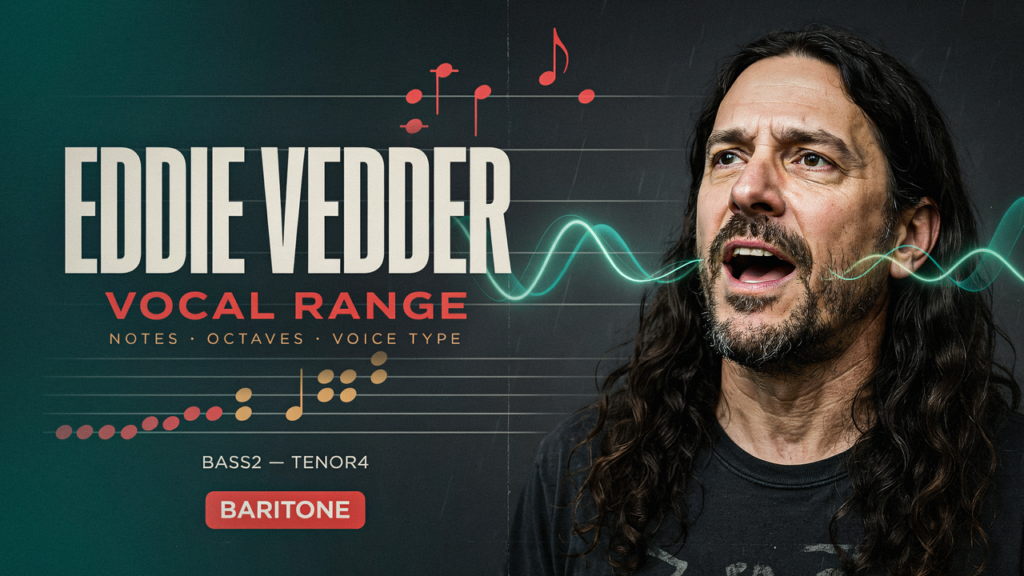
Eddie Vedder’s practical singing range is approximately E2 to F5, spanning three octaves and one semitone. Wider compilations credit him with sounds from G1 to A6, but those extremes include vocal fry, growls, screams, and possible overtones rather than consistently sustained melodic notes.
Vedder is best described as a baritone with a strong upper extension. His vocal identity comes from more than low notes: chest resonance, unusual vowel shaping, controlled rasp, wide vibrato, dynamic contrast, and powerful high mixed singing all contribute to the distinctive Pearl Jam sound.
What Is Eddie Vedder’s Vocal Range?
Vedder’s range changes depending on which sounds an analysis accepts:
| Range category | Approximate notes | Interpretation |
|---|---|---|
| Practical melodic range | E2–F5 | Clearer, musically usable singing |
| Widest reported range | G1–A6 | Includes fry, growls, screams, or overtones |
| Strong lower range | E2–B2 | Chest-dominant baritone notes |
| Upper power range | Fourth octave into F5 | Mixed voice, belts, and rock cries |
| Likely voice type | Baritone | Strong low center with tenor extension |
E2–F5 covers 37 semitones, equal to three octaves and one semitone. The claimed G1–A6 span covers more than five octaves, but presenting that figure without explaining the vocal registers would be misleading.
Vedder’s comfortable tessitura is much narrower than his full collection of sounds. Much of his recognizable singing sits between the second and fourth octaves, with fifth-octave notes reserved for climactic moments.
What Is Eddie Vedder’s Lowest Note?
A G1 in “Breakerfall” is frequently presented as Vedder’s lowest note. However, the sound is better treated as an extreme low effect because it uses a growling or fry-like coordination rather than an ordinary sung tone.
Vedder’s more useful lower boundary is around E2. Notes in this area retain clearer pitch, stronger resonance, and more connection to his melodic voice. They also align with the low center heard throughout Pearl Jam’s catalog.
His depth does not come from pitch alone. Vedder often darkens vowels, lowers the laryngeal impression, emphasizes chest resonance, and shapes consonants heavily. These choices make his voice sound larger and deeper than its written notes might suggest.
The difference between baritone depth and extremely low bass singing becomes clearer in a baritone vs bass comparison. Vedder can reach low notes, but his weight and tessitura do not make him a true bass.
His low resonance may remind listeners of Johnny Cash’s vocal range, although Vedder uses more distortion, wider dynamic changes, and a stronger upper extension.
What Is Eddie Vedder’s Highest Note?
Vedder’s highest strong melodic singing reaches approximately E5 or F5. Pearl Jam’s rendition of “Love, Reign o’er Me” is one of the most important demonstrations of this upper power.
The song requires repeated high singing rather than one isolated peak. Vedder approaches its climax with an intense mixed coordination that combines pitch, rasp, and a cry-like quality. The sound is heavier and more connected than a light falsetto, though it is not identical to carrying unchanged chest voice upward.
Some range compilations credit Vedder with an A6. That sound should not be treated as a normal sung note without qualification. An extreme scream can generate a perceived pitch or strong overtone far above the singer’s repeatable melodic range.
For this reason, F5 is a more informative upper limit for his practical singing. A6 may belong in a list of extended vocal effects, but it does not describe where Vedder normally performs melodies.
His ability to combine a dark lower voice with soaring highs differs from the smoother extension heard across Roy Orbison’s vocal range. Orbison generally used cleaner resonance, while Vedder often integrates grit and emotional pressure into the sound.
Is Eddie Vedder a Baritone or Tenor?
Eddie Vedder is most reasonably classified as a baritone with tenor extension.
His speaking voice, lower-register resonance, vocal weight, and comfortable melodic center support the baritone label. However, he can sing well above the expected upper boundary of a basic baritone range, especially during climactic rock passages.
Calling Vedder a tenor based only on E5 or F5 ignores where most of his voice sits. A singer’s highest note does not determine voice type. Tessitura, timbre, vocal weight, passaggio, and the amount of effort required in different registers are more meaningful.
His profile falls within the broad variation found among male vocal ranges. Contemporary rock singers frequently cross traditional category boundaries by using mix, falsetto, distortion, and microphone amplification.
How Eddie Vedder Creates His Signature Sound
Vedder’s recognizable tone is built around chest resonance and deliberate modification of words. He often rounds or darkens vowels, changes diphthongs, and places consonants in unexpected rhythmic positions.
This approach is sometimes imitated as “yarling,” but reducing his technique to one exaggerated pronunciation misses its purpose. Vowel modification can help a singer maintain resonance, shape emotion, and navigate difficult pitches. Vedder’s choices also make his voice immediately identifiable.
His singing commonly uses:
- Strong chest-register resonance
- Wide and sometimes delayed vibrato
- Darkened or rounded vowels
- Controlled rasp and growls
- Cry-like upper attacks
- Slides between pitches
- Sudden changes in volume
- Speech-like rhythmic phrasing
Vedder’s low, dramatic delivery shares certain qualities with Jim Morrison’s vocal range. Both singers used baritone weight and theatrical phrasing, but Vedder generally demonstrates a broader upper extension and more athletic live intensity.
Rasp, Growls and Vocal Distortion
Not every rough sound in Vedder’s singing is produced in the same way. Some passages use mild rasp layered over a clear pitch, while others approach shouts, growls, or scream-like effects.
“Even Flow” demonstrates how he alternates between stable melodic singing and textured attacks. Isolated vocals reveal greater pitch detail and vibrato than the full rock mix may initially suggest.
“Jeremy” and “Alive” also show his ability to increase intensity without completely abandoning pitch. The roughness adds urgency, but the melodic center remains audible.
Distortion complicates range measurement. Software may identify an overtone instead of the fundamental pitch, while listeners may interpret a growl as an unusually low note. Credible analysis must determine the underlying note before adding it to a singer’s range.
Vedder’s use of rough texture can be compared with Kurt Cobain’s vocal range. Cobain often allowed distortion to dominate the sound, whereas Vedder more frequently maintained a rounded pitch beneath the grit.
Vedder’s Clean and Softer Singing
Vedder’s reputation for dark growls can overshadow his quieter singing. “Just Breathe,” “Guaranteed,” “Society,” and other acoustic performances reveal a gentler vocal approach with less distortion and clearer phrasing.
In these songs, he reduces vocal weight without losing the earthy center of his tone. His delivery becomes more conversational, and vibrato is used selectively rather than continuously.
“Black” is another important example of dynamic control. The early phrases remain restrained, allowing the voice to grow gradually toward the emotional climax. This arc makes the final intensity more effective than beginning the song at maximum volume.
These performances show that his voice is not dependent on rasp. Distortion is one expressive option within a broader technique.
How Eddie Vedder’s Voice Changed
Vedder’s early Pearl Jam voice had enormous physical intensity. On Ten, he used heavy chest resonance, pronounced vibrato, forceful attacks, and explosive upper phrases.
As he matured, his tone became rougher and less uniformly powerful at the top. Years of touring demanding material likely contributed, alongside normal aging. However, he also developed greater restraint and stylistic variety.
Later performances often use altered melodies, lighter attacks, and more selective high notes. His solo work particularly emphasizes storytelling, acoustic phrasing, and lower-volume singing.
A narrower or less predictable upper range does not erase his earlier ability. It means his current practical range should be distinguished from the lifetime collection of notes and effects documented across several decades.
Frequently Asked Questions
How many octaves can Eddie Vedder sing?
His practical E2–F5 range spans three octaves and one semitone. The reported G1–A6 span exceeds five octaves but includes fry, growls, screams, and possible overtones.
What is Eddie Vedder’s voice type?
He is best described as a baritone with a strong upper extension. His lower resonance and tessitura support the baritone classification despite his powerful fifth-octave notes.
What is Eddie Vedder’s lowest note?
G1 is widely claimed from “Breakerfall,” but it appears to be a growl or fry-based effect. E2 is a more representative lower boundary for his melodic voice.
What is Eddie Vedder’s highest note?
His strongest practical highs reach approximately E5 or F5. “Love, Reign o’er Me” is an important example of his upper mixed singing.
Does Eddie Vedder sing with vocal fry?
Yes. He uses fry-like and growling sounds for texture, particularly at the bottom of his extended range. Those effects should be separated from his supported chest voice.
Why does Eddie Vedder pronounce words differently?
His vowel modifications help create resonance, navigate pitches, shape emotion, and establish his recognizable style. The pronunciation is partly functional and partly artistic.

Harlow is a vocal analysis and singing tools writer at Voice Range Test. She focuses on vocal range testing, voice type analysis, pitch recognition, and singing education tools for singers, musicians, choir performers, and beginners.