
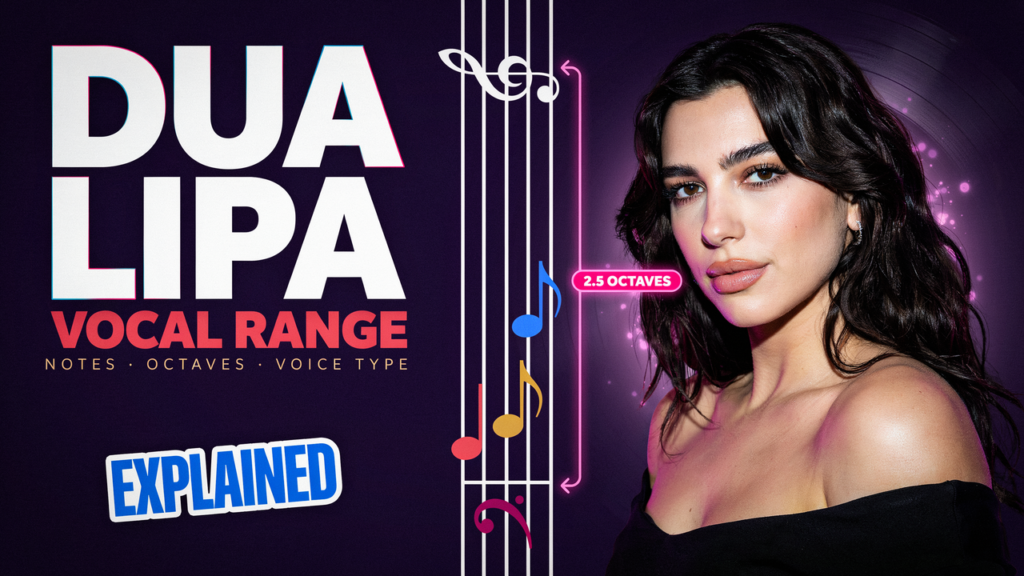
Dua Lipa’s vocal range is commonly estimated at a little over two octaves, with many range discussions placing her around the lower third octave up to the mid or upper fifth octave. Exact note claims vary by source, so the safest way to understand her voice is through her practical singing range, tessitura, and tone.
Her signature sound is not built around whistle notes or huge high belts. Dua Lipa stands out because of her low-set, smoky tone, strong rhythmic delivery, and confident chest-dominant pop style. She often sings in a range that feels lower than many modern female pop singers, which is why listeners often describe her voice as alto-like.
Dua Lipa’s vocal range D3–G5
147–784 Hz · 2 octaves and 5 semitones · Mezzo-soprano with alto-like color
Documented range You
Don’t know your range? Take the voice range test.
Dua Lipa’s Vocal Range at a Glance
Dua Lipa’s range is usually discussed as a low female pop voice with enough upper extension for dance-pop choruses. Some sources estimate her full range around D3 to G5, while others use narrower practical ranges such as C3 to B4. These numbers should be treated as estimates, not permanent or official limits.
| Range Area | Common Estimate | What It Shows |
|---|---|---|
| Lower range | Around C3/D3 to E3 | Dark, husky, alto-like color |
| Middle range | Around F3 to B4 | Her strongest and most recognizable area |
| Upper range | Around C5 to G5 in some songs | Pop peaks, mix, and lighter upper notes |
| Practical tessitura | Lower-to-middle female range | Comfortable dance-pop phrasing |
The important point is that Dua Lipa’s best notes sit lower than the typical bright soprano pop sound. If you are comparing her to general female vocal ranges, she is a strong example of a modern singer whose tone and tessitura matter more than extreme range size.
Is Dua Lipa an Alto or Mezzo-Soprano?
Dua Lipa is most accurately described as a mezzo-soprano with alto-like color. In pop discussions, people often call her an alto because her voice sounds low, smoky, and grounded. Technically, though, “alto” is often used casually outside classical and choral settings.
A true voice type depends on tessitura, vocal weight, passaggio, tone color, and where the voice feels most natural. Dua’s comfortable singing area sits low for a pop female voice, but that does not automatically make her a true contralto.
A better description is low mezzo-soprano. She has a dark lower register, a strong middle voice, and enough upper range for modern pop choruses. For singers learning the difference, this guide on what a mezzo-soprano is explains why many female pop voices live between soprano brightness and alto depth.
If you are unsure about the label, the alto vs mezzo-soprano comparison is useful. Dua Lipa sits close to that boundary in sound, even if mezzo-soprano is the safer technical category.
Lowest and Highest Notes: What the Evidence Shows
Dua Lipa’s lowest notes are usually the most distinctive part of her voice. She often sings verses with a relaxed, low placement that gives her music a cool, controlled, slightly husky character.
Her higher notes are present, but they are usually used as pop peaks rather than long, dramatic displays. In other words, she can move upward when the song needs it, but her vocal brand is not based on constantly singing high.
| Song | Vocal Range Feature | What It Shows |
|---|---|---|
| “IDGAF” | Low, direct delivery | Her lower register and speech-like tone |
| “Don’t Start Now” | Higher dance-pop chorus | Controlled upper pop energy |
| “Levitating” | Moderate range with rhythmic phrasing | Groove, timing, and chest-dominant tone |
| “Physical” | Strong mid-range drive | Power without excessive belting |
| “Break My Heart” | Brighter upper movement | Her pop mix and chorus lift |
| “New Rules” | Repetitive hook phrasing | Tone consistency and rhythmic control |
This is why a single “highest note” does not explain Dua Lipa’s voice very well. Her strongest singing is not about reaching the most extreme pitch. It is about keeping her tone stable while delivering sleek, rhythmic pop melodies.
Chest Voice, Mix and Upper Range
Dua Lipa relies heavily on a chest-dominant sound. Her voice often feels grounded, direct, and close to speech. This gives her songs a strong identity, especially in verses and hooks.
Her mix helps her move into higher chorus notes without losing the darker color of her voice. She does not usually flip into a very airy or delicate upper sound. Instead, she keeps the tone firm and stylish, which fits dance-pop production well.
This is different from singers who build their style around high belts or dramatic vocal runs. Dua’s technique is more about consistency, rhythm, and tone placement. She can sing higher than some listeners expect, but she usually chooses a controlled, lower-centered sound because it matches her musical identity.
For comparison, Rihanna’s vocal range also shows how a distinctive tone can matter as much as raw range. Both singers have recognizable voices because of color, phrasing, and attitude, not just octave count.
Songs That Show Dua Lipa’s Range
“Don’t Start Now” is one of the best examples of Dua Lipa’s dance-pop range. The verses stay controlled and rhythmic, while the chorus lifts higher without turning into a heavy belt.
“Levitating” shows her ability to sit in a groove. The song is not vocally extreme, but it requires steady timing, clear articulation, and relaxed confidence.
“Physical” brings more intensity. It shows how Dua can use her middle voice with drive while keeping the sound clean and modern.
“IDGAF” highlights the lower side of her voice. The delivery is direct, low, and almost conversational, which is one reason the song feels so controlled.
“Break My Heart” gives a brighter picture of her upper pop range. It is useful for hearing how her voice lifts in a chorus while still keeping her signature tone.
“Houdini” continues that sleek, rhythmic style. The vocal sits inside the beat rather than floating above it, which is a major part of her sound.
Why Dua Lipa’s Voice Stands Out
Dua Lipa’s voice stands out because it is instantly recognizable. She does not sound like a generic high pop soprano. Her lower placement, husky tone, and clean rhythmic phrasing make her voice feel modern and confident.
Compared with Lana Del Rey, Dua’s voice is more dance-pop focused and rhythmically firm. Lana leans into softness, mood, and cinematic phrasing, while Dua uses a more direct, polished, beat-driven delivery.
Dua Lipa’s vocal range may not be the widest among major pop singers, but that is not a weakness. Her songs are built around the part of her voice that sounds best: low, stylish, controlled, and memorable.
If you want to test whether Dua Lipa songs fit your own voice, use a vocal range calculator and compare your comfortable notes with the actual range of songs like “Levitating,” “Physical,” and “Don’t Start Now.”
Frequently Asked Questions
What is Dua Lipa’s vocal range?
Dua Lipa’s vocal range is commonly estimated at a little over two octaves. Some sources place her around D3 to G5, while others use narrower practical estimates. The exact range depends on the song, performance, and whether upper mixed notes are included.
Is Dua Lipa an alto?
In pop language, Dua Lipa is often called an alto because her voice sounds low and smoky. Technically, she is better described as a low mezzo-soprano with alto-like color.
Is Dua Lipa a mezzo-soprano?
Yes, mezzo-soprano is the safest technical label for Dua Lipa. Her voice sits lower than many female pop singers, but she still has enough upper extension for pop choruses.
What is Dua Lipa’s lowest note?
Her lowest commonly discussed notes sit around the lower third octave. These low notes are part of her signature sound, especially in songs with relaxed, speech-like verses.
What is Dua Lipa’s highest note?
Her highest reported notes vary by source, with some estimates reaching into the fifth octave. Her upper range is usually used for pop chorus lift rather than dramatic high-note display.
Why does Dua Lipa’s voice sound so low?
Her voice sounds low because she often sings with a chest-dominant, dark-toned placement. Her tessitura sits lower than many bright pop voices, giving her music a smoky and grounded quality.

Harlow is a vocal analysis and singing tools writer at Voice Range Test. She focuses on vocal range testing, voice type analysis, pitch recognition, and singing education tools for singers, musicians, choir performers, and beginners.