
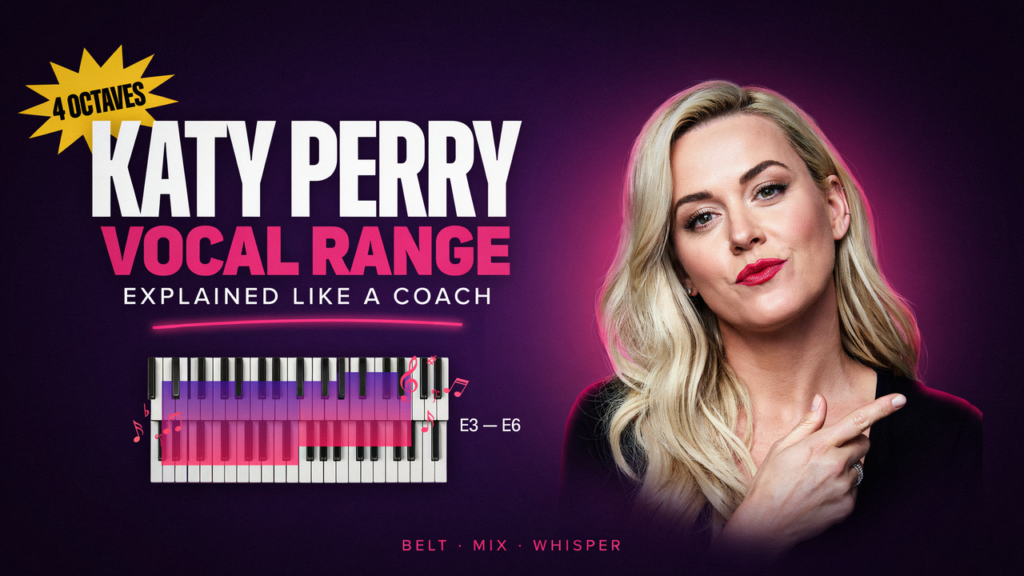
Katy Perry’s vocal range is commonly documented from approximately E3 to C♯6, giving her a total span of 2 octaves and 10 semitones. Some unofficial vocal profiles credit her with notes below E3 or above C♯6, but those broader claims may include studio layering, backing vocals, brief exclamations, or sounds that are difficult to classify.
Her total range is impressive, but it does not fully explain why her songs are challenging. Perry’s music frequently requires sustained upper-middle notes, forceful belts, repeated choruses, and enough stamina to preserve vocal clarity throughout a performance.
Katy Perry’s vocal range E3–C♯6
165–1,109 Hz · 2 octaves and 9 semitones · Soprano-leaning contemporary pop voice
Documented range You
Don’t know your range? Take the voice range test.
Katy Perry Vocal Range at a Glance
| Vocal characteristic | Approximate assessment |
|---|---|
| Documented vocal range | E3–C♯6 |
| Total span | 2 octaves and 10 semitones |
| Common working range | Approximately A3–E5 |
| Likely voice category | Soprano-leaning contemporary pop voice |
| Recognizable strengths | Strong middle register, bright belts, vocal projection |
| Notable challenges | Sustained high passages, repeated belts, breath management |
The E3–C♯6 estimate represents notes identified across Perry’s recorded catalog. It should not be interpreted as the range she uses comfortably and consistently in every performance.
What Is Katy Perry’s Lowest Note?
Katy Perry’s lowest reliably documented area is around E3, heard in the lower portions of songs such as “Walking on Air” and “Witness.” Some fan-created range profiles place her lowest note at D3, while more extreme estimates reach even lower.
These lower claims require caution. A note buried in a harmony, processed studio layer, or quiet vocal effect does not necessarily represent a singer’s functional lower register. E3 is therefore a more defensible endpoint for describing Perry’s clearly documented catalog range.
Her lower notes have a warm, speech-like quality. They contribute to the weight of her middle register, which is one reason listeners sometimes assume she is a mezzo-soprano.
For comparison, Dua Lipa’s vocal range is also associated with a darker pop timbre and a prominent lower-middle register.
What Is Katy Perry’s Highest Note?
The upper endpoint commonly assigned to Katy Perry is C♯6, associated with a high vocal moment in “Hey Hey Hey.” Other profiles credit her with notes between F6 and G♯6, but many of these claims are difficult to verify as clear, sustained lead-vocal pitches.
A singer may produce an extremely high sound through head voice, falsetto, a squeal-like coordination, or studio-enhanced layering. That does not mean the note belongs to the same functional register used for melodic singing.
Perry’s C♯6 is part of her documented range, but her artistic identity is not built around sixth-octave singing. Her more important high notes are the powerful fourth- and fifth-octave phrases she must repeat throughout her pop choruses.
Readers interested in another singer known for forceful upper-register singing can compare her approach with Miley Cyrus’s vocal range.
How Many Octaves Can Katy Perry Sing?
From E3 to C♯6, Katy Perry covers 34 semitones, equal to 2 octaves and 10 semitones. It is reasonable to describe this as nearly three octaves, but calling it a full three-octave range would be inaccurate.
Range totals can also be misleading. A singer may touch notes across almost three octaves while using a much smaller portion for most melodies. Perry’s practical pop range appears to center roughly around A3 to E5, although individual songs may move outside that area.
This working range includes much of her conversational lower register, full middle voice, and recognizable upper belts.
Is Katy Perry a Soprano or Mezzo-Soprano?
Katy Perry is frequently described as either a lyric soprano or a mezzo-soprano. Neither label should be treated as indisputable because classical voice classifications consider more than the highest and lowest notes.
Voice type also depends on tessitura, register transitions, vocal weight, resonance, and where the voice functions most comfortably. Pop production can further obscure these qualities by changing keys, layering vocals, and using amplification.
Perry is best described cautiously as a soprano-leaning contemporary pop singer with a warm and relatively weighty middle register. Her darker tone does not automatically make her a mezzo-soprano, just as her C♯6 does not automatically prove a classical soprano classification.
The difference between range and tonal character also appears when comparing Perry with Rihanna’s vocal range, whose distinctive timbre cannot be explained by voice type alone.
Katy Perry’s Practical Range and Tessitura
Vocal range includes every identifiable note, while tessitura describes the area where a singer spends much of a song. Perry’s tessitura is more useful than her extreme endpoints when evaluating her music.
Many of her melodies sit in the middle and upper-middle parts of the voice before rising into sustained choruses. This creates a cumulative challenge. A single E5 may be manageable, but singing several forceful high phrases with consistent pitch and tone is much more demanding.
Her sound commonly combines:
- A speech-influenced lower and middle register
- A bright, forward pop belt
- Chest-dominant mixed coordination in strong choruses
- Lighter head-voice colors for higher or softer passages
- Deliberate vocal breaks, growls, and textured effects
Perry’s belting should not be described as pure chest voice at every pitch. Higher belts normally require changing resonance and reducing vocal weight to remain sustainable.
Vocal Ranges of Popular Katy Perry Songs
Song ranges vary by transcription, arrangement, live key, and whether ad-libs are counted. The following estimates should therefore be treated as practical guides rather than absolute measurements.
| Song | Approximate melodic range | Main vocal challenge |
|---|---|---|
| “Firework” | A3–E5 | Repeated high belts and breath control |
| “Roar” | B3–E5 | Bright projection and sustained choruses |
| “Teenage Dream” | B♭3–F5 | High tessitura and upper ad-libs |
| “Dark Horse” | B3–D5 | Rhythmic precision and tonal consistency |
| “California Gurls” | C4–D5 | Sustained pop placement and phrasing |
| “Thinking of You” | G♯3–C5 | Dynamic control and emotional phrasing |
| “Unconditionally” | Approximately B3–F5 | Wide phrases, intensity, and stamina |
| “The One That Got Away” | B3–E5 | Register balance and controlled choruses |
“Firework” is especially difficult because its challenge comes from repetition. The singer must keep returning to the upper-middle register without pushing, shouting, or losing pitch accuracy.
You can use the Song Key Finder to identify a song’s key before transposing it into a more comfortable range.
Why Are Katy Perry’s Songs Hard to Sing?
Katy Perry’s songs often sound straightforward because they use memorable melodies and direct lyrics. Their technical difficulty becomes apparent when someone attempts to sing the complete arrangement.
The main challenges include sustained vowels, high chorus placement, abrupt changes in intensity, and limited recovery time between demanding phrases. Songs such as “Firework” also encourage inexperienced singers to increase volume instead of improving resonance.
To sing these songs more safely:
- Lower the key if the chorus consistently feels strained.
- Avoid carrying heavy chest voice upward.
- Practice the melody softly before adding performance intensity.
- Plan breaths before long phrases.
- Keep the jaw and tongue released during sustained vowels.
- Stop if the voice becomes painful or remains hoarse.
A Pitch Accuracy Test can help reveal whether missed high notes are caused by range limitations or difficulty matching the target pitch.
Has Katy Perry’s Voice Changed?
Perry’s vocal delivery has varied across different albums and performance periods. Earlier recordings often emphasize a brighter, more speech-driven pop-rock sound, while later material sometimes uses smoother phrasing, softer dynamics, and more restrained production.
Live performances can also change because of touring schedules, health, age, arrangement choices, and artistic preference. A lowered key does not automatically indicate vocal decline. Artists frequently adjust songs so they can perform demanding sets consistently.
Like Selena Gomez, Perry demonstrates how vocal identity can depend more on phrasing, tone, and recognizable delivery than on extreme notes alone.
Can You Sing Katy Perry’s Songs?
Singers comfortable between approximately A3 and E5 may be able to perform many Katy Perry songs in their original keys. However, comfort matters more than merely reaching each note once.
“Dark Horse” and “Thinking of You” may be more approachable starting points. “Firework,” “Teenage Dream,” and “Unconditionally” require greater upper-register control and stamina.
Transposing a song is a normal musical decision. Matching Perry’s key is unnecessary if it causes neck tension, shouting, breathiness, or lingering vocal fatigue.
Frequently Asked Questions
What is Katy Perry’s vocal range?
Her best-supported documented range is approximately E3 to C♯6.
How many octaves does Katy Perry have?
E3–C♯6 spans 2 octaves and 10 semitones, which is slightly less than three octaves.
What is Katy Perry’s highest note?
C♯6 is a commonly documented upper endpoint. Higher notes have been reported, but their status as clear lead-vocal pitches is uncertain.
What is Katy Perry’s lowest note?
E3 is a reliable lower endpoint, although some unofficial profiles report D3 or lower.
Is Katy Perry a soprano?
She can reasonably be described as soprano-leaning, but her exact voice type remains debated because contemporary pop voices do not always fit classical categories neatly.
What is Katy Perry’s hardest song to sing?
“Firework” is one of her most demanding hits because it combines repeated upper-middle belts, long phrases, high intensity, and limited recovery time.
Final Assessment
Katy Perry’s documented vocal range is approximately E3–C♯6, covering 2 octaves and 10 semitones. Her functional strength lies less in extreme sixth-octave notes and more in her substantial middle voice, bright upper belts, recognizable tone, and ability to deliver demanding pop choruses.
Her songs demonstrate why vocal range should never be evaluated by endpoints alone. Tessitura, repetition, phrasing, breath control, and vocal stamina are often the factors that make her music genuinely difficult to perform.

Harlow is a vocal analysis and singing tools writer at Voice Range Test. She focuses on vocal range testing, voice type analysis, pitch recognition, and singing education tools for singers, musicians, choir performers, and beginners.