
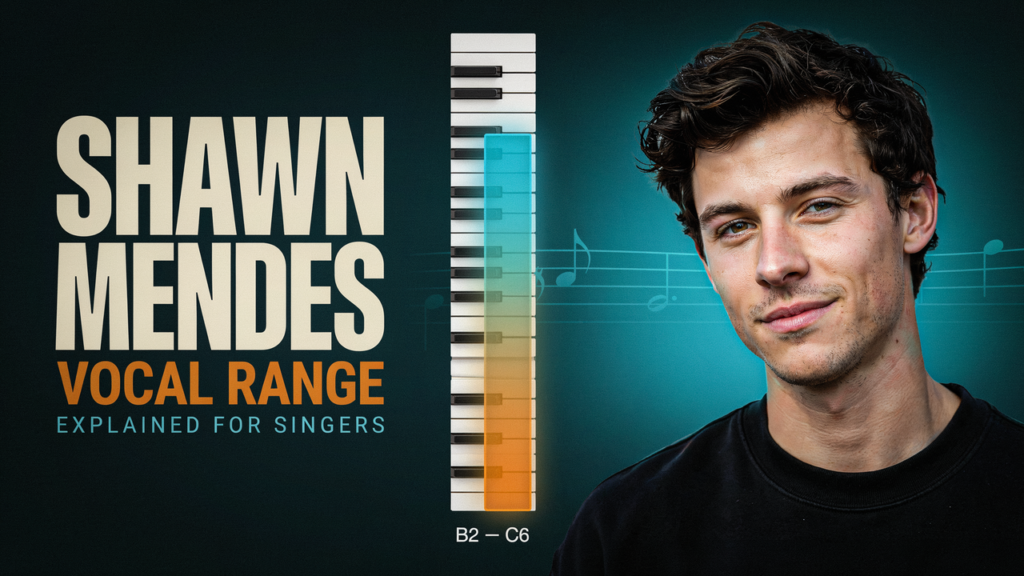
Shawn Mendes’ inclusive recorded vocal range is reported as approximately F2 to C6, spanning three octaves and seven semitones. However, this broad measurement includes low extremes, falsetto, ad-libs, and potentially layered studio vocals. His more consistently demonstrated connected range is closer to G2 through B4 or C♯5.
Mendes is best described as a contemporary tenor. His signature sound comes from a warm lower register, chest-dominant verses, strong mixed choruses, controlled falsetto, and dynamic transitions from soft singing to an intense upper register.
What Is Shawn Mendes’ Vocal Range?
The widest current song-database estimate for Shawn Mendes is F2–C6. The F2 lower endpoint is associated with “The Weight,” while “Heartbeat” is listed as reaching C6.
That does not mean Mendes sings every note between F2 and C6 with the same register, volume, or reliability. His range is better understood through three separate measurements.
| Range category | Approximate notes | What it represents |
|---|---|---|
| Inclusive recorded range | F2–C6 | All attributable extremes, including light upper sounds |
| Connected modal/mixed range | About G2–B4/C♯5 | Stronger lead-vocal singing |
| Common song tessitura | B2–A4 | Where many verses and choruses are concentrated |
| Common voice type | Tenor | Based on repertoire placement and register behavior |
F2–C6 contains 43 semitones, equal to three octaves and seven semitones. This is an impressive recorded span, but it should not be described as nearly four octaves of full voice.
Readers can compare these notes with typical male vocal ranges to understand how far Mendes extends beyond a standard tenor framework.
Evidence for His Lowest and Highest Notes
Mendes’ reported F2 appears in “The Weight.” This is notably lower than the range used throughout most of his popular singles. Other songs provide clearer examples of his repeatable lower singing, including B2 in “Mercy” and “Wonder.”
The C6 attributed to “Heartbeat” represents the opposite extreme. It sits well above his normal chorus range and should be classified as a light upper-register note or studio extreme unless the exact vocal layer demonstrates otherwise.
| Note or area | Song | Vocal context | Interpretation |
|---|---|---|---|
| F2 | “The Weight” | Low recorded endpoint | Inclusive range |
| B2 | “Mercy” | Clear lower melodic note | Repeatable song range |
| B2 | “Wonder” | Lower verse area | Clear lead vocal |
| A4 | “Mercy” and “Wonder” | Upper chorus range | Strong connected singing |
| B♭4 | “Stitches” | Belted or mixed chorus note | Strong upper note |
| Up to C♯5 | “Treat You Better” ad-libs | Mixed upper phrase | Source- and version-dependent |
| C6 | “Heartbeat” | Extreme upper-register attribution | Requires register context |
This distinction prevents one brief C6 from being mistaken for Mendes’ normal tessitura. A singer’s highest audible note, highest falsetto note, and highest repeatable mixed note are different measurements.
Is C6 Part of His Usable Range?
C6 can count as part of Mendes’ overall recorded range if it is clearly pitched and attributable to him. It should not automatically be treated as part of his comfortable or repeatable singing range.
A usable note should generally be:
- Clearly pitched
- Intentionally sung
- Repeatable under similar conditions
- Produced without obvious instability
- Suitable for a musical phrase
- Available without harming nearby notes
Mendes’ recognizable upper singing usually occurs much lower, especially around G4–B4. Occasional C5 or C♯5 phrases demonstrate additional mixed or head-dominant extension, while higher notes are more likely to use falsetto.
The difference between an isolated extreme and a dependable high note is important when working to extend the upper vocal range.
Is Shawn Mendes a Tenor or Baritone?
Shawn Mendes is most reasonably classified as a tenor, although “baritenor” is sometimes used informally to describe his warm lower color.
His second-octave notes and relatively full lower-middle register can create a baritone-like impression. Voice type, however, is not determined by the lowest note alone.
Evidence supporting a tenor classification includes:
- Frequent choruses around G4–A4
- Repeated access to B♭4 and B4
- Connected notes around C5
- A bright upper resonance
- Regular use of high pop keys
- Comfortable transitions into falsetto
A baritone may be able to sing many Mendes songs after transposition, but the original keys often require extended singing near the top of a typical baritone’s comfortable range.
Mendes’ overall range overlaps several male categories. That overlap does not change the high, tenor-oriented placement of much of his repertoire.
How Shawn Mendes Uses Chest Voice, Mix and Falsetto
Mendes changes vocal coordination according to the emotional and dynamic needs of a song.
Chest-dominant lower singing
Songs such as “Mercy” begin with a relatively warm, direct sound. The lower phrases retain speech-like weight and help create contrast with the chorus.
Mixed upper choruses
As he approaches A4 and B4, Mendes generally reduces some chest weight while keeping the tone connected. This mixed coordination allows the chorus to sound powerful without becoming a completely separate falsetto.
The sound may still appear chest-dominant because of its brightness and intensity. That does not mean the lower register has been carried upward without adjustment.
Falsetto for contrast
Mendes uses falsetto for softer upper phrases, emotional breaks, ad-libs, and tonal contrast. Falsetto can add height and vulnerability without requiring the density of a mixed note.
His falsetto counts toward his overall range, but it should be identified separately when evaluating how difficult a song is to perform.
Controlled rasp
A slightly raspy edge appears in some of his intense choruses. Singers should not create this effect by squeezing the throat. The melody should first be secure in a clean, comfortable tone.
Learning how to sound better when singing is more useful than trying to reproduce another singer’s texture exactly.
Songs That Demonstrate His Vocal Range
Mendes’ best-known songs reveal different parts of his range and technique.
- “Mercy” spans approximately B2–A4 and shows the transition from a restrained verse to an intense chorus.
- “Wonder” also covers approximately B2–A4, with repeated upper phrases and strong dynamic development.
- “Stitches” demonstrates a high pop chorus, with a prominent upper note around B♭4.
- “Treat You Better” covers roughly D3–A4 in its main melody, with some analyses placing later ad-libs higher.
- “In My Blood” uses dynamic contrast, a rising emotional build, and demanding upper-register singing.
- “Lost in Japan” combines lighter phrasing, falsetto color, and R&B-influenced upper vocals.
- “Heartbeat” is associated with the C6 endpoint in broad database measurements.
These songs show that Mendes’ difficulty comes primarily from high tessitura, repeated choruses, register transitions, and vocal intensity—not from the single highest note.
Why Shawn Mendes’ Songs Can Be Difficult to Sing
Many Mendes songs begin in an accessible lower or middle area before rising into repeated A4 and B4 phrases. A singer may feel comfortable during the verse and become fatigued halfway through the chorus.
Common problems include:
- Carrying too much chest weight upward
- Increasing breath pressure as the pitch rises
- Spreading vowels on high notes
- Switching abruptly into a weak falsetto
- Losing pitch during soft phrases
- Adding rasp before the clean note is stable
- Practicing repeatedly without adequate recovery
Use a lower key if the chorus requires pushing. Transposition preserves the melody while allowing the singer to develop coordination gradually.
Because his quieter phrases can expose unstable intonation, singers should also work on singing on key before concentrating on vocal texture.
What Singers Can Learn From His Technique
Mendes’ performances demonstrate the value of dynamic contrast. His choruses sound large partly because the preceding verses are often restrained.
When practicing one of his songs:
- Learn the melody in a comfortable key and clear tone.
- Mark the highest repeated note, not only the highest ad-lib.
- Keep the verse relaxed without making it excessively breathy.
- Reduce vocal weight gradually as the melody ascends.
- Practice the chorus in short sections before singing the full song.
- Add stylistic rasp only with appropriate training.
- Retest the song after rest to confirm that the notes are genuinely repeatable.
A structured approach to practicing singing effectively will produce more reliable progress than repeatedly forcing the original recording.
Stop if high-note practice causes pain, burning, a rougher speaking voice, or loss of normally easy pitches. Those are signs to rest and reassess rather than continue pushing.
Frequently Asked Questions
How many octaves can Shawn Mendes sing?
The inclusive F2–C6 estimate spans three octaves and seven semitones. His connected modal and mixed range is narrower, with falsetto contributing to the highest pitches.
What is Shawn Mendes’ highest documented note?
C6 is the highest current database attribution, associated with “Heartbeat.” It should be treated as an extreme upper-register note rather than his normal chorus range.
What is his lowest documented note?
F2 is the lowest reported endpoint, associated with “The Weight.” B2 is a clearer recurring lower note in songs such as “Mercy” and “Wonder.”
Is Shawn Mendes a tenor or baritone?
He is best described as a tenor. His warm lower register creates some baritone color, but his repertoire and recurring upper placement are tenor-oriented.
Does Shawn Mendes sing in falsetto?
Yes. He uses falsetto for softness, contrast, upper extensions, and ad-libs, while many of his stronger chorus notes use mixed coordination.
What is Shawn Mendes’ highest mixed or belted note?
B4 is a more consistently demonstrated connected upper note, with some performances or ad-libs reaching approximately C5 or C♯5.

Harlow is a vocal analysis and singing tools writer at Voice Range Test. She focuses on vocal range testing, voice type analysis, pitch recognition, and singing education tools for singers, musicians, choir performers, and beginners.