
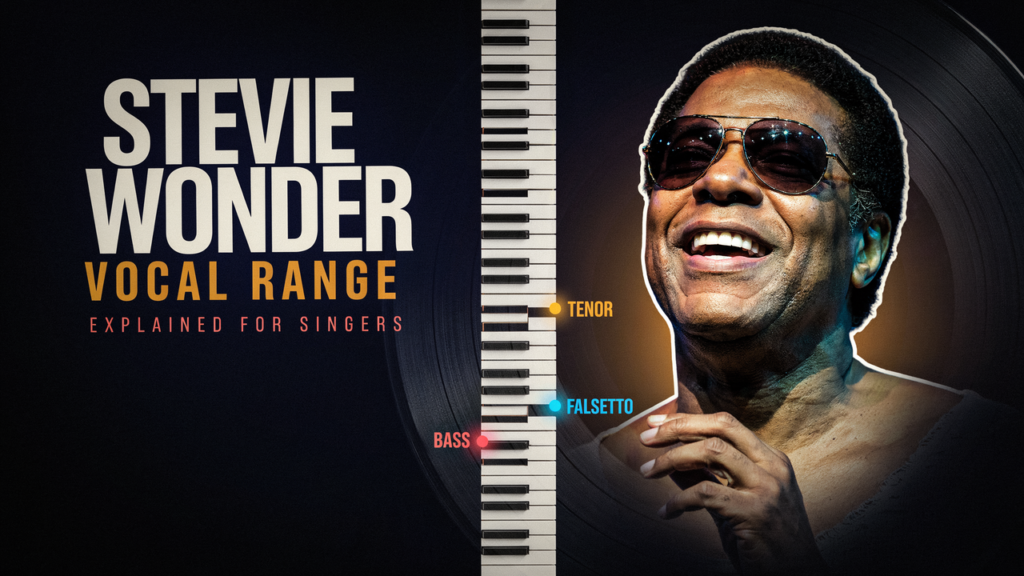
Stevie Wonder’s commonly reported vocal range is approximately D♯2 to D6, spanning three octaves and eleven semitones—one semitone short of four complete octaves. However, these career-spanning endpoints are source-dependent and include different registers, brief notes, and recordings from different periods.
His familiar working voice is narrower and centered much higher. Stevie Wonder is generally described as a lyric tenor, recognized for his bright tone, agile upper register, expressive mixed voice, and controlled falsetto.
What Is Stevie Wonder’s Vocal Range?
A frequently indexed estimate places Stevie Wonder’s complete recorded range at D♯2–D6. Alternative profiles report ranges such as F2–E♭6 and C2–B5, showing that there is no universally accepted pair of endpoints.
These disagreements occur because analysts may count:
- Brief notes and sustained notes differently
- Studio and live performances
- Lead vocals and background layers
- Modal voice, falsetto, and head-dominant sounds
- Vocal fry or speech-like pitches
- Recordings from different stages of his career
The following evidence provides a more useful picture than one range figure alone:
| Note or range | Song or context | Vocal context | Evidence status |
|---|---|---|---|
| Approximately D♯2 | “I Wish” | Reported low career extreme | Source-dependent |
| D♯3–A♯4 | “Superstition” | Main studio melody | Strongly supported song range |
| D♯3–G♯4 | “As” | Main studio melody | Strongly supported song range |
| Approximately B3–E5 | “Isn’t She Lovely” | Published lead-melody range | Reasonably supported |
| Up to approximately D6 | “For Your Love” | Light upper-register singing | Commonly reported |
The notes use scientific pitch notation, where middle C is C4. The human vocal range guide provides wider context for interpreting these pitches.
What Is Stevie Wonder’s Lowest Note?
D♯2 is commonly reported as Stevie Wonder’s lowest recorded note, often associated with “I Wish.” However, the exact octave and vocal context should be treated cautiously.
That low endpoint sits far beneath his normal tenor tessitura. It may represent a brief low production rather than a note he could sustain repeatedly with the same resonance and projection found in his middle register.
Other profiles place his lowest note closer to F2. The difference does not change his basic voice type: occasional second-octave notes do not make him a bass or baritone. Voice classification depends more heavily on the region where the voice functions consistently.
What Is Stevie Wonder’s Highest Note?
D6 is frequently identified as Stevie Wonder’s highest recorded pitch, with “For Your Love” commonly connected to that upper extreme. Some profiles instead place the top around B5 or E♭6.
These sixth-octave notes do not represent a chest-dominant tenor belt. They belong to a lighter upper production, such as falsetto or a head-dominant sound. Register is essential when interpreting the difficulty and significance of an extreme pitch.
Stevie Wonder’s more representative upper singing lies in the fourth and fifth octaves. Songs such as “Isn’t She Lovely” demonstrate his ability to maintain brightness, rhythmic accuracy, and expressive phrasing around E5 without relying only on isolated extreme notes.
How Many Octaves Can Stevie Wonder Sing?
The reported D♯2–D6 range covers 47 semitones, equal to three octaves and eleven semitones.
The calculation is:
- D♯2 to D♯3: one octave
- D♯3 to D♯4: a second octave
- D♯4 to D♯5: a third octave
- D♯5 to D6: eleven additional semitones
This is one semitone short of four full octaves, so it should not be rounded upward. The site’s guide to whether a four-octave vocal range is good explains why usable notes matter more than a rounded total.
The full span also combines different registers and career periods. It does not mean Wonder used every note between D♯2 and D6 with equal comfort, power, or frequency.
What Voice Type Is Stevie Wonder?
Stevie Wonder is generally classified as a tenor, often described more specifically as a lyric tenor in contemporary vocal discussions.
A lyric tenor typically has a bright, flexible quality and relative ease in higher melodic writing. Wonder’s singing displays those characteristics through his clear upper-middle register, expressive high notes, agility, and lighter vocal weight.
He is not a countertenor simply because he can sing in falsetto or reach the sixth octave. Countertenor is a specialized classification and performance tradition, while falsetto is an upper-register coordination available to many male singers.
The tenor voice guide explains the category in more detail. Wonder’s low extreme overlaps baritone and bass pitches, but his working register and tonal behavior remain tenor-like. The distinction becomes clearer when comparing tenor and baritone voices.
Modal Voice, Mixed Voice, and Falsetto
Stevie Wonder does not produce every note in the same way. His broad range depends on coordinated transitions among several vocal registers and tonal settings.
His modal voice carries the main substance of songs such as “Superstition” and “As.” It has a bright, focused quality that remains rhythmically precise even when the melody becomes intense.
In higher passages, he can reduce vocal weight and use a mixed or head-dominant coordination. This allows the pitch to rise without forcing the full weight of his lower voice upward.
Falsetto adds another color. Wonder uses it musically for softness, contrast, and emotional emphasis rather than merely to display a high note. His ability to shift registers smoothly is one reason many performances sound spontaneous even when the vocal decisions are highly controlled.
Range Versus Working Tessitura
Stevie Wonder’s total recorded range describes his outermost reported notes. His working tessitura is the smaller area where much of his music repeatedly sits.
Songs such as “Superstition” and “As” remain largely within the third and fourth octaves. “Isn’t She Lovely” rises higher, but even that song does not require the complete D♯2–D6 span.
This distinction matters for singers. “Superstition” may appear moderate on a range chart, yet its repeated upper phrases, syncopation, vowel shapes, rhythmic attack, and sustained energy make it demanding. A narrow song can be more difficult than a wider song if its tessitura remains high or its phrasing allows little recovery.
Songs That Showcase Stevie Wonder’s Voice
“Superstition” demonstrates his bright modal voice, precise rhythmic delivery, vocal attack, and ability to maintain intensity across repeated phrases.
“As” showcases a warmer, more lyrical side of his voice. Its range is not exceptionally wide, but the performance depends on control, phrasing, emotional progression, and endurance.
“Isn’t She Lovely” highlights his upper tenor register and melodic flexibility. The repeated high phrases require ease and consistency rather than a single dramatic peak.
“My Cherie Amour” uses a comparatively compact melodic range, allowing his tone, diction, and phrasing to carry the performance.
“For Your Love” is important to discussions of his upper extension because it is frequently linked to his highest reported notes.
“I Wish” is associated with his lower extreme, though its alleged D♯2 should be separated from the higher area where most of the lead melody functions.
How Stevie Wonder’s Voice Changed Over Time
Stevie Wonder’s recorded career covers several decades, so one range measurement cannot describe every period equally.
Younger singers often have easier access to certain high notes, while mature voices may develop greater tonal weight or modify repertoire and keys. Touring demands, health, musical choices, and natural aging can all influence how a singer approaches a song.
Later performances should therefore be evaluated on their own terms rather than compared note-for-note with studio recordings made decades earlier. A changed arrangement or lowered key does not erase the range demonstrated earlier in a career.
What Makes Stevie Wonder’s Singing Distinctive?
Stevie Wonder’s importance as a vocalist comes from far more than his highest and lowest pitches. His defining abilities include:
- Bright and instantly recognizable tenor timbre
- Highly developed rhythmic phrasing
- Smooth register transitions
- Expressive melisma and improvised runs
- Controlled vibrato
- Flexible dynamics
- Clear emotional communication
- Strong pitch control across complex melodies
His vocal control is particularly evident in how he varies the timing, intensity, and shape of repeated phrases. Two lines containing the same notes may sound completely different because of his rhythmic placement and tonal choices.
Frequently Asked Questions
What is Stevie Wonder’s vocal range?
Stevie Wonder’s commonly reported career-spanning range is approximately D♯2–D6. The exact endpoints remain source-dependent because different analyses count registers and brief sounds differently.
What is Stevie Wonder’s lowest note?
D♯2 is frequently cited as his lowest recorded note and is often associated with “I Wish.” It should be treated as a reported extreme rather than his normal lower singing boundary.
What is Stevie Wonder’s highest note?
D6 is commonly reported as his highest pitch, often linked to “For Your Love.” The note belongs to a light upper-register production rather than a sustained chest-voice belt.
Does Stevie Wonder have a four-octave range?
His reported D♯2–D6 range spans three octaves and eleven semitones. It is one semitone short of four complete octaves.
Is Stevie Wonder a tenor?
Yes. Stevie Wonder is generally classified as a contemporary lyric tenor because of his bright timbre, upper-register facility, vocal weight, and working tessitura.
Does Stevie Wonder use falsetto?
Yes. Wonder uses falsetto alongside modal, mixed, and head-dominant singing. His upper register provides expressive contrast and extends beyond his normal working range.

Harlow is a vocal analysis and singing tools writer at Voice Range Test. She focuses on vocal range testing, voice type analysis, pitch recognition, and singing education tools for singers, musicians, choir performers, and beginners.